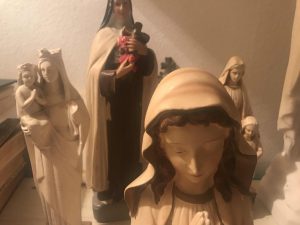
My Auntie Mae survived 100 years and four months. She was an institution, holding one corner of a huge family together. And she was kind, good-humored, and deeply committed to her Catholic faith. Because of this strong faith, the family held a traditional funeral despite the ongoing pandemic. I traveled to join them in Northern Connecticut while maintaining social distance.
When everyone was inside the church, I sat on the steps outside and meditated. I was supported by the step behind my lower back and my ankles were folded in front of me. I rocked slightly from side to side, enraptured by the racing clouds, and feeling the chilly wind on my arms.
After many extremely busy days when I could barely take in this loss, a range of emotions tore through me: grief, for the loss of my aunt, for all she takes with her, and for the painful fact that everything dissolves and changes, even my own precious life and the lives of those I love. At moments I lowed with sadness, then settled back into calm rocking. I also felt fear, as COVID cases rise in Brooklyn–where I live along with my ten-year-old son, Simon–anxiety, intense job stress, joy, nostalgia, and tenderness.
I felt very close to my aunt in these moments, even though I wasn’t inside the church observing the Catholic rituals.
When the rest of the family went to a banquet hall, I made a cup of tea in the attached apartment at my parents’ house, and carried it next door with me to sit on my Aunt Mae’s steps. I watched the ghosts in the windows and yard, seeing a movie of my own parents’ wedding in the driveway on my father’s 21st birthday, imagining the tobacco and vegetable fields that the family once owned, remembering picnics long in the past, thinking of the Christmas Eve parties that I have attended every year of my life in the house, and of the antique wooden toys in a chest in the living room that my mother, now 69, played with as a toddler, that I played with, and that Simon also played with.
I sat there patiently for some time.
Then I went to a place my grandfather loved, in the woods by the Scantic River. I drew a big circle in the soft dirt and danced inside it. I spent ages in Flowing, and wondered if I would ever move into the rhythm of Staccato. When Staccato did finally present, it was gentle, muted. Chaos was the same, releasing me in tiny increments. Lyrical shifted me quickly into Stillness, and I gazed up at the sunlight breaking through the leaves far above, and felt the currents of the river pulling resolutely along.
A few days later, I attended Henya Emmer’s weekend class in Battery Park, led on this occasion by Ray Diaz.
That morning I had done a remote yoga class with my cherished teacher Maria Cutrona. At the end, I stayed on the floor rather than rising to join the circle. I had the curious sense that I was spinning down through deep space; and remembered that as a teen I would feel the same sensation after a long run, while laying on the roof of my parents’ house in the sun with my eyes closed, some kind of unknowable source briefly opening its portal.
Ray greeted me with an extended elbow as I entered the tree-lined enclosed circular area near once-immigration-center Castle Clinton and Pier A, a dock for large tourist boats.
I checked in, then stepped onto the dance floor. Trees curved above, lawns stretched behind, and boats glided by on the Hudson River–close to its transition to the Atlantic Ocean. The pavement in this area was set in rolling circles, perhaps once home to a fountain, next to the famous Castle Clinton national monument.
Ray started us with an invitation to shake and I dove right in. This is a silent-disco-style event; and I held onto my headphones to avoid accidentally flinging them off. Soon holding the headphones became part of my dance, and I experimented with tipping myself and balancing the headphones on one side of my head. At times, I held the headphones in my hand and danced without music, especially when I was swept away.
I took my shoes off in Flowing and moved off to the side, where instead of pavement there was soft gravel. The sensation was too much, almost tickling. It forced me to slow down, but I before long I put my shoes back on.
I thought of my teacher Maria Cutrona’s words from the same morning, “The world needs you to believe that you can be a healer.”
“It’s time to wake up,” Ray said firmly into the mic as we shifted into the rhythm of Staccato. I ranged around the circular dance floor, then moved again to the soft gravel at the side closest to the river. I danced with my own shadow, rocking my hips with big, powerful arms. “Use your knees to power it,” Ray encouraged, and I became ferocious, sinking low and settling back into the hips, bursting and spinning, and pausing with creative vigor. “Give it a voice,” Ray further encouraged and I vocalized along with the group, only dimly aware of how odd it must seem to passersby who were out for a dusk stroll in the park.
In another phase of the class, Ray put on a compelling Reggae song, and I shifted from stretching to breakdancing, toggling my knees fast back and forth with one hand on the ground, then leaping into heavy balances and spins, and hopping back into my outstretched heel.
Ray played song after song that delighted me, including the Cold Play song with the lyric “You’re a Sky Full of Stars” just as dusk gave way to darkness. I settled into a dripping Stillness and swept through the shared dance space with great inspiration and love.
Sometimes in the silent-disco format I feel a bit lonely. Not so tonight. I felt connected, inspired, athletic, and free, believing for a time that everything was perfect and that I had everything I needed. Connecting to something I can only call source, and grateful for every dripping minute. Grateful to be alive, in this odd, frightening, complicated time. Grateful for the chance to breathe, unapologetic.
Moving with the gliding boats that were casting light reflections on the wide river, I realized at last that it was fully dark, and time to shift into rest.
This blog consists of my own subjective experiences on the 5Rhythms® dancing path, and is not sanctioned by any 5Rhythms® organization or teacher.
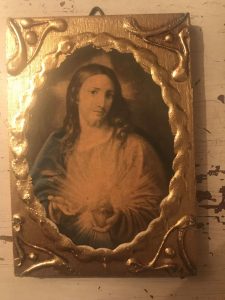
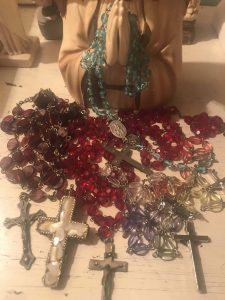
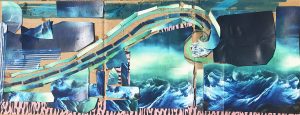
Photos: Original images by the writer of objects from the home of Mae Grigely, October, 2020.
The wind was blowing west so I decided to move in the same direction, in sync with the waves. It was like using a pedal-assist bike. Each time I pulled the water with my cupped hand I shot forward. The sea rocked and lifted my body, and I kept my senses immersed, timing breathing with the rolling swells. After several days of this daily ritual, I started to feel grounded, like I could let go of the stress and anxiety of the previous months and move into the oncoming stress and anxiety with less baggage.
Usually by the end of July I’m really starting to relax. I look my best and feel my best. But this year, as fall looms, my stress level is increasing rather than decreasing as I scramble to organize conditions for my ten-year-old son, Simon’s, schooling, and prepare for my own job, which is also in a school, during the ongoing pandemic.
Driving to Cape Cod with my Dad, we ranged through heavy topics, like the upcoming election and issues related to racial justice. I used an expression – I wish I could remember what it was now – and realized I had no idea about its origin. I shared that for all I knew, it could have racist roots and I should find out its history before I used it again. My Dad shared that he had recently heard an expression that definitely has racist roots, but was used in conversation without its original intention. He felt that if the original intention was lost, it was no longer problematic. I disagreed with him, and we also talked about whether or not the association of light with positive things, and of dark with negative things might have a racial implication. He felt like this was going too far, and expressed frustration. I said, “I’m not trying to shut anyone down or make it impossible for anyone to express themselves. But I’m very interested in mining language for clues about my unconscious and the culture I’ve been raised in. And everything seems like fair game for examination at this point.”
Something small triggered me one evening during the week, and I realized how sensitive I was. I took a break and went to the beach as sunset lit the sky. Walking west, I talked by phone with my brother, who advised me there had been a significant COVID spike in the area of Cape Cod where we were staying along with extended family for the week. Anxiety surged in my body.
Dusk and the sky’s full expression had my back as I headed toward home. Pausing a few beaches away, I decided to dance a 5Rhythms wave, which is to move in sequence in the energy of each of the 5Rhythms – Flowing, Staccato, Chaos, Lyrical, and Stillness.
There were still some lingering beach walkers, but (feeling slightly conspicuous) I drew a big circle in the packed sand close to the water, calling my ancestors, guides, and helpers to help make a space of safety and power, where I could work with the strong emotions that were coming and hear underneath what can be heard with my ears.
As I settled into the circling cadences of Flowing, I tried to avoid eye contact as a group passed by. “What are you dancing to?” a middle-aged white man in a baseball hat asked curiously. “To the waves and the wind,” I answered, trying for good humor. “Oh! And you made a circle!” “Yes, there’s a lot to move with lately,” I responded in a trying-for-bantering tone as they passed, though this probably made no sense whatsoever to them.
I settled deeper into Flowing, giving myself the space to express the obvious underpinning of anxiety: fear. My mind gushed with recent news items such as the local COVID spike, conversations, possible scenarios for fall, and ideas for how to protect Simon and myself. But I kept bringing my weight low, and bringing attention back to the feet and back to the senses, gathering mindfulness, and accepting the fear that has danced with me and so many others for months now.
I doubted I would ever move from the rhythm of Flowing into the second rhythm of Staccato. Instead, I rocked myself in motion, churning up the sand in every section of my inscribed circle, but staying inside its boundaries. I gave myself the space to settle my body – language emphasized by Resmaa Menachem, whose excellent book on embodied personal, generational, and racial trauma I read over the course of this healing week.
I finally did move into Staccato, but only for short intervals, noting the increased energy and activation, then settling the body back into Flowing again and again. I sensed or imagined that a presence joined me, a dark goddess, almost a pillar in the center of my circle, energetically overlapping with my body. I moved in and out of Flowing and Staccato, feeling her power and support.
I moved into the third rhythm of Chaos, again only for short intervals, again repeatedly returning to the first rhythm of Flowing. I let go softly as the sky drained of light, leaving only streaks of purple and blue on the west edge of darkness, feeling less conspicuous and more a tiny moving part of vast dynamic emptiness. “What do I need to hear?” I asked as I danced in shadows, and the sky whispered back.
I thought about Resmaa’s remarks on how important it is to know the difference between when we are productively settling the body, and when we are escaping into a calmly drugged state. This led me to reflect that intuition, conditioned responses, and trauma responses can look very similar, and how important it is to learn to discern between the three, especially as we are working to unravel racism in our bodies, minds, and cultures.
The next morning, I did my swim as usual, gently rocked by the sea as I moved along the shore. I went past the lifeguards, past the beachgoers, and nearly to a river in the town of Yarmouth. After some time, I emerged from the waves and walked back east.
I stopped at the beach I’d danced on the night before to pick up an exquisite piece of beach glass – with smoothed edges and frosted white surfaces – and held it in my hand.
I turned toward the ocean, remembering my dance of the night before, with tears streaming down my face. I could feel the entire universe in this one little piece of glass – the sand used to form it, the fire process that made it into glass, the person who used it and held it, the process by which it made its way into the sea, the vast body of the ocean and its endless motions smoothing the edges of things, and bringing this little piece of glass in with the tide, and now into my open hand.
***
Simon was already on the beach with my Mom when I finally made it back, so we got into the water together, playing at climbing onto an inflatable raft and trying to tip each other over, then letting the waves rock us and talking about the world and our place in it.
August 10, 2020, Cape Cod, Massachusetts
This blog consists of my own subjective experiences on the 5Rhythms® dancing path, and is not sanctioned by any 5Rhythms® organization or teacher.
Students may be drawn first to the calming impacts of mindfulness, but mindfulness can also be seen as empowerment – a way to eliminate the internal obstacles that stop them from stepping fully into their power, dignity, and creativity – essential tools on the path to racial justice, and essential tools on the path to real freedom and equality.
Over the four years since I started a mindfulness program at Cobble Hill High School in Brooklyn where I teach, I’ve watched student after student find their power by turning inside, where it was waiting all along. In the process, students learn to be strong advocates for themselves and for their communities.
During the Spring 2020 semester, more than one student wrote, “Mindfulness doesn’t mean you always have to be peaceful.”
Several students shared how mindfulness has helped them cope with the murders of George Floyd, Breonna Taylor, Ahmaud Arbery, and others, and also with the ongoing pandemic.
“What stood out was how much more this was affecting me than I realized, until I actually sat and broke down what I was really scared and worried about,” shared one student. Another wrote, “You have the right to be completely angry or sad, but mindfulness helps you break away and meditate to calm down.”
Students had a full semester of mindfulness before the pandemic, but I had no idea how it would play out once they were in remote learning and almost totally on their own. We started using a popular mindfulness app to support us, and many students dove deep, some understanding the benefits of mindfulness for the first time. One student shared that while every member of his household was sick with COVID, he would practice daily on his balcony to stay sane.
Teachers have been independently bringing mindfulness to NYC students for twenty years or more, but it wasn’t until 2017 that the New York City Department of Education placed their official stamp of approval on mindfulness instruction as a valid option for meeting the social and emotional needs of students, appointing Barnaby Spring as the first-ever Director of Mindfulness.
Mindfulness in Schools for Student Wellness & Equity
Mindfulness is learning to pay attention in a certain way. In the words of mindfulness pioneer Jon Kabat Zinn, “Mindfulness meditation is the awareness that arises from paying attention, on purpose, in the present moment and non-judgmentally.” Mindfulness training involves choosing a focus such as the breath, then calmly noticing whenever the attention shifts, and gently returning it. In this way, students build up the ability to concentrate and remain present with their experiences.
Mindfulness instruction has implications for helping students develop healthy relationships, resilience, empathy, motivation, the ability to make responsible decisions, and the ability to effectively regulate emotions.
These are important benefits for all students, but may be particularly important for students of color. Resulting from centuries of oppression, Black and Brown students disproportionately suffer from poverty and loss. Having to cope with racism on a daily basis also takes its toll. According to the Health and Human Services Office of Minority Health, African Americans are 20% more likely to experience mental health problems than White Americans. In addition, there are multiple barriers for Black and Brown people when it comes to receiving adequate mental health services despite the likely added stressors that many face.
Adrian Childress/Bklyner
Mindfulness training in schools can help to fill this urgent gap.
Mindfulness supports students in confronting internalized stereotypes and processing painful experiences when they have been marginalized, judged, or accused. In the words of a 9th grade student, “Mindfulness is beneficial because it relieves stress and anxiety and lowers chaos in your emotions.”
Dr. Donald Fennoy, superintendent of schools in Palm Beach County, Florida, created a division for Student Wellness & Equity after the start of the protests following the murder of George Floyd.
Fennoy is not the only school leader to connect wellness and equity.
In a 2019 interview, Brooklyn Borough President Eric Adams stated, “We put a greater level of emphasis on the academic stability of a child, and not the emotional stability, and that’s a big mistake.” Adams, himself a disciplined meditation practitioner, argued that teaching students mindfulness, a priority for Brooklyn schools, allows students to “become their own healers,” and begin to address PTSD, grief, the impacts of racism, and the stressors of daily life.
“The overwhelming number of our million plus children are living with trauma every day. We have become extremely successful at masking trauma and normalizing it. It’s not a black eye, it’s not a broken arm,” Adams shared. Rather, trauma and PTSD are internal, invisible injuries.
I asked, “Do you think that students of color might stand to benefit in particular from mindfulness because of the added burden of having to deal with racism?”
Adams responded, “The first step forward is to acknowledge the fact that we treat people differently based on how we see them because of our predispositions. Black and Brown students are dealing with an obstacle that’s larger than their White counterparts. And acknowledging that doesn’t mean their White counterparts are racist, it just acknowledges the fact that we come from a country with a history.”
Studies published between 2009-2020 in Psychological Bulletin, School Psychology Quarterly, and other journals indicate that students who receive mindfulness instruction tend to have better focus, more ability to self-regulate, less stress, healthier relationships, and less incidents that lead to disciplinary consequences, which is of particular significance since Black and Brown students tend to receive harsher punishments both in schools and the judicial system.
Unite NY Rally. Adrian Childress/Bklyner
Mindfulness Helps In Teaching, Too
Mindfulness can also positively impact the adults in school communities.
The first layer of mindfulness, decreased stress and improved mood, can support teachers in meeting students with patience and understanding.
Another layer, when practitioners naturally begin to examine the workings of their minds, has other implications. Practitioners begin to note self-talk and repetitive thoughts, to monitor the body’s feedback, and to examine underlying stories. For many, this leads to a decrease in the impacts of implicit bias.
Committed mindfulness practice leads to a key insight: that we are profoundly interconnected. The small-minded categories and distinctions we make crumble when subject to intense scrutiny. This realization leads to increased empathy and the knowledge that injustice anywhere affects every one of us – a counteragent to individual racism that can lead to systemic impacts.
In addition, when school leaders and teachers develop the ability to stay present with discomfort, a key component of mindfulness training, it may be easier to ponder difficult personal and systemic questions, and lead to greater transparency and accountability – important attributes for systems that are working toward anti-racist goals.
No one knows what the coming school year will look like, but even in the best case scenario, we will have to cope with stress, uncertainty, and powerful emotions. Mindfulness is an important ally as we weather these storms, and work toward a brighter future.
My earliest memory is of watching a summer parade from our big, second-floor apartment window in Chicopee, Massachusetts with my father. What I remember most was not watching, though. It was what I heard and felt. A passing marching band included a musician with a huge bass drum. When he slammed the instrument, the air vibrated. I was stunned, my little mouth wide open. I could feel the drum through my entire body.
Gabrielle Roth, the founder of the 5Rhythms practice said, “Rhythm is our mother tongue.” Lately, rhythm is holding me, even during this period of grueling pandemic uncertainty and intense racial reckoning.
Today I danced the same wave – the same song list – twice. In 5Rhythms, a wave is when we move through each of the 5Rhythms – Flowing, Staccato, Chaos, Lyrical, and Stilness – in sequence.
The first was at high noon, after a long bike ride with my ten-year-old son, Simon, and a period of sitting meditation. I slathered on sunblock and set up speakers in the backyard at my parents’ house in Northern Connecticut, where Simon and I are temporarily staying.
Thoughts circled in my brain as I settled down into Flowing. Thoughts about racial justice initiatives, red tape I need to attend to, the many challenges around Simon’s schooling for the fall, and challenges around my own work, which is also in a school, kept spiking even as I turned attention to the feet again and again, moving in unending circles in the dappled shade of a maple tree on the yard’s edge.
As the flowing songs I had planned ended, instead of a flowing staccato song to transition into Staccato, I put on a thick, twitchy, poetic track that moved me to shake and swoon, a mini moment of Chaos that set the tone for the rest of the wave.
For the second rhythm, Staccato, one of the songs in this playlist was a remix of a Paul Simon song. I thought at length about a conversation about how different songs had impacted different people; and how important it is to listen carefully to lyrics, to research the artists, to understand the context of a song, and to consider it through a lens of racial justice before playing it publicly. I find this remix irresistible, but because of issues of cultural appropriation (which may or may not be valid) with Paul Simon’s work in South Africa in the 1980’s, I would be hesitant about playing it publicly.
Still, I felt ferocious as song after staccato song ran me all over the yard.
Chaos surprised me. When I dance at high noon, I have to be under the shade of the big maple tree, and I’m much more visible than usual to my parents’ neighbors and passing cars. I tend to be less vocal and less explosive. Today, that was not the case. Some potent emotion came gripping my throat and I danced it before I could name it, throwing my head wildly, dropping low, vocalizing, and moving in a wild matrix.
The emotion that was presenting was rage.
In recent facilitated conversations during this moment of racial reckoning, I’ve tried to talk myself out of this emotion.
Who am I, a white woman, to feel or express rage now, of all times? At a time when Black and Brown voices should be centered, my place is to listen deeply, to be in service. But then what to do with this emotion, that is boiling over, that is taking over my body? It’s rage toward myself for the times I should have spoken up or taken action against racism but stayed silent. For the times I’ve been unskillful. And for the times I’ve caused harm.
Back in April, I had a conflict with a family member who wasn’t observing social distancing with my ten-year-old son, Simon, in a way that felt safe for me. And just last week, my sister came to visit with my niece. My niece wanted to see something in the garden, and without even thinking about it, I scooped her up and carried her over the fence, totally disregarding social distancing, and certainly upsetting my sister. I didn’t even realize I’d done it until the next day.
Some unexamined impulse that felt automatic came up and I just acted. Just like my own family member who I was so upset with. This is part of the inner work for me now, to deeply examine what feels automatic for underlying narratives of racial superiority, and its supportive underpinings.
This is not only a moral prerogative, but I also stand to personally benefit. Every time I identify and interrogate a story that makes me believe I am in any way separate, I move closer to truth, freedom, and a true sense of belonging.
And this rage that came up in the dance wasn’t just directed toward myself. It was also rage for the systems we are immersed in. For all the times I’ve brought things up and been gaslighted. For what I’ve seen and felt and known as the parent of a child of color. For all the instances of generalized oppression and othering that contribute to and create a basis for racism.
Who am I to feel all of this?
And yet I feel it and what to do. Where to put it, where to express it. Ouch ouch ouch ouch ouch. And this body, that is not separate from all bodies, is in pain. And this pain is problematic, but there it is, searing and tight.
I want to express this and I don’t. I don’t want to bog down collective forums with the individual work that I must take personal responsibility for. And at the same time, I answer to my body, above everyone else, and it is speaking loudly.
I love and respect the activists who are generous, patient, and committed to the long haul. But I’m not feeling that way right now.
Right now, I want to blow things up.
I’m tired. I’ve had a front row seat to oppression for too long now, as a white teacher in a segregated public school district; as a human being in a country that voted for Donald Trump; as a practitioner in a Buddhist tradition that basically detonated because of patriarchy and abuse, where I bumped into a wall of opacity again and again.
Please, please don’t tell me to put it into the practice. For more than a decade, I’ve been putting it into practice. And that has helped me to cope and to gain insight. But it can’t just end with personal practice. Now it’s time to move beyond just my personal reckoning, to a reckoning on a larger stage. To a systemic reckoning.
And all that was just the first wave.
Later in the day, I danced to the same wave. I had planned to join a group of dancers via zoom, but misinterpreted time zones and class invites and wound up on my own instead. I considered having a glass of wine and relaxing with my family, but decided to play the day’s earlier wave and move to it again instead.
Flowing was brief. I thought maybe I could half-ass it a little, cut out some of the songs, sort of move through the motions. I felt bad because my family was finishing up dinner, and I didn’t want the music to disturb them. I was clipped, noting the very hard, dry ground and wondering if I could even go all out without hurting myself.
Then that same thick, poetic song, which was “Let the Devil In” by TV on the Radio, exploded me again, giving me exactly what I needed – a peek into gigantic, poetic reality, a chance to shake myself to life. I thought about the folk belief of letting the devil in, the idea that you made this mess, you brought this on, you let it in, and I couldn’t help but relate it to American society as I now experience it, and my part in it.
I put on a lyrical-feeling staccato track, Jerusalema, bySouth African DJ and producerMaster KG featuring vocalist Nomcebo Zikode. I threw down in delighted engagement, at times doing my best to replicate the dance I’d seen on a youtube video, moving my hips for four counts, jumping my feet in scissors for four counts, dipping and turning, then repeating the sequence.
In staccato chaos, I fell out to a song by Tribe Called Red, which I’m embarrassed to say I only just learned is an Indigenous Canadian band. I sunk low, rocked hips in a planar experiment, and bounce-paused in rhythmic expression.
Chaos was, again, the centerpoint and critical mass of this dance, seducing me to explode with what I was carrying. I thought Chaos was over after a long, psy trance track, but the next song took me deeper still.
This was also a TV on the Radio Song, this one titled “Happy Idiot” – my version of a shadow lyrical song. It’s about a breakup, but also about shutting down and trying to convince yourself and others that you’re happy when you actually are not. It’s the same song I had put on after a long, formal conversation about racial justice the day before. It was like a demon took me over. I growled from the deep belly, occasionally acting as a “Happy Idiot” and waving enthusiastically, then switching back to a sarcastic rage I wasn’t fully aware lived in my body.
I put on one of my favorite lyrical tracks, then a beautiful stillness track, though I still wasn’t fully ready to wind down. I could have growled in Chaos for several more hours, but life called me back.
Tomorrow is another day of reckoning, another chance to be whole, another chance to remember that for all of us, rhythm is our mother tongue, calling us back to who we really are, calling us back to our birthright – which is love – and calling us to action.
July 29, 2020
“And someday when we do finish that long journey towards freedom, when we do form a more perfect union — whether it’s years from now or decades or even if it takes another two centuries — John Lewis will be a founding father of that fuller, fairer, better America.” –President Barack Obama
“All this dancing is bullshit if we aren’t taking it into the streets.” –Gabrielle Roth
This blog consists of my own subjective experiences on the 5Rhythms® dancing path, and is not sanctioned by any 5Rhythms® organization or teacher.
This is where indigenous Podunk people once lived during cold months, where my grandfather loved to fish, and where I’ve brought my ten-year-old son, Simon, to experience the changing seasons more closely. For months, since Simon and I have been staying with my parents in northern Connecticut, I’ve run nearly every day in the woods by the Scantic River, then found a place to do the 5Rhythms dance meditation practice. I’ve loved the flowing river, the soft ground, and the shaded seclusion.
Like many practices, it started with following my intuition, then as it felt right, turned into a daily (or nearly daily) practice. But as the river got summer-low and stagnant, I started to feel less inspired. Still I ran and danced there almost every day, and still I was grateful for this beautiful place.
For a week or more, dance didn’t feel good. Most of the time, dance feels good. Even when I’m coping with a lot of anxiety, I can often let it go and let go in movement. Sometimes it’s even cathartic. But at times, I don’t feel any better after dancing than I did before I started, and I stay mostly flat.
I was on such a streak.
Thankfully, after over a decade of practice, I know what to do when it doesn’t feel good: keep practicing regularly, embrace whatever arises (even if it sucks), and remind myself that the magic always comes back eventually.
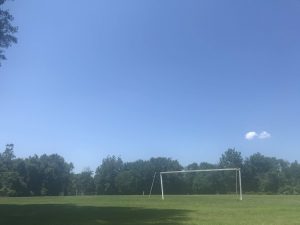
Yesterday, instead of turning right to head down the big hill to the woods and river, I turned left instead. This time, I ran one house down, then turned into the athletic grounds behind the town’s middle school. Here, rather than running in the dense, enclosed woods, I ran on a half-mile gravel track surrounding a wide open field. I relaxed, pausing frequently to gaze up and take in the open sky. After the first loop, I changed direction, so more of the time I would be facing the widest open space.
Practice is always a mix of discipline and flexibility. The teachings of Staccato teach us to apply intention and energy to our work, including holding our own feet to the fire in daily practice. The teachings of Flowing support us in following our intuition, and in being flexible and attentive to our own needs. As the Buddha taught, if practice is too loose, we could say with only flowing energy, it will not be effective. If practice is too rigid, we could say with only staccato energy, it will not be effective. It takes a balance of both of these energies to avoid stagnating or developing unskillful habits.
After four loops around, I decided to dance a 5Rhythms wave – which is to move in sequence through each of the 5Rhythms of Flowing, Staccato, Chaos, Lyrical, and Stillness.
I found a tucked away inlet of cut grass, off to the side of the field where there was a small platform for outdoor exercise like sit-ups. I stepped up onto it, immediately liking the low friction feel of the wood-like material, and sinking into the circling movements of Flowing. I sank low and swung my hips over the edge, moving in a big arc, curving up onto one heel and back in the other direction, with a gesture like an athlete coiling a heavy discus.
I felt no rush to move into the second rhythm of Staccato, instead feeling like I could keep doing this gentle circling all day. Eventually, the rhythm of Staccato did break through just as the humidity shifted to a thick, slow rain that rattled the leaves like a percussion instrument. The sky remained light and blue on the other side of the field as I moved with sharp edges and exhalation, sinking low in the hips, emphatic with my elbows and the outside ridges of my hands. Next I moved in Chaos, briefly, gently, my gaze flopping around and rushing through clouds, grass, trees, my own feet, my own hands, the blue edge of sun, a bit of a house across the field.
Then, for the first time in over a week, the rhythm of Lyrical visited. Lyrical is like a bird on your shoulder. If you make a loud noise or look directly at it, it flies away. If you stay porous and move gently, it might stay there and coo, maybe even dancing along with you. I fell upward into extensions, turning my smiling face to the sky again as I raised my hands up.
For a short time I moved with everything – the spirits of the woods, the rain, the changeable sky, the breathing trees.
There was something in me that needed to let in space this time. Maybe I will return to the woods. Or maybe dancing in the field will become a new practice. I don’t take ending the woods practice lightly. At the same time, I don’t need to cling to it if it is no longer serving.
Then a jogger joined me on the other side of the field and I knew it was a matter of time before she was right beside me on the gravel track. Not wanting to shift into being verbal just yet, I climbed down from the platform and walked back home in the attitude of walking meditation, loving the sensation of each foot touching down, feeling alive and reverent.
Walking, I barely thought about the difficult question of whether or not I will send Simon back to school in September. I barely thought about my own teaching job, and what the school’s hybrid teaching plan might look like. About the new science that’s showing that COVID may have significant long-lasting impacts and that people who die of it are riddled with blood clots. About how children may be vulnerable. About how having the disease once may not provide immunity. Notably, I barely thought about our foul, inept, self-serving president and all the blood he has on his hands. And I even took a break from thinking about the intricacies of racism in our country, and what would need to happen to eradicate racism, patriarchy, and all oppression, including what I could personally do to have an impact.
I just walked slowly along, stopping once to eat a wild blackberry, then making my way back home.
Individual practice is keeping me alive. Truly. But at the same time I recognize the need for collective work that goes beyond just working on ourselves. Inner work is absolutely critical, but if practice is just there to make us feel good, then it’s not practice. It is actually a sedative, a conditioned habit.
Practice is a tool to pierce through layers of illusion to the radical, shining truth, even if it is politically inconvenient, uncomfortable, challenges our personal views, or challenges existing power structures. I’m extremely grateful when practice feels good, but hope I can push myself toward the truest truths, even if it doesn’t feel good sometimes.
Later in the day, I brought speakers outside and danced in the yard. To my surprise, I again moved with engagement. In Flowing, I moved with a circular swing in the yard. I dipped low, rolling it around my hips and moving in a big circle around it, at times moving toward it and falling, then rising and arcing away. At first, my arms followed my body like sea kelp, but soon, I started holding the swing and pulling it to its curving edge, then falling back into circling. In Staccato, I stayed in the shade of a big maple tree, feeling creative and vibrant, finding new ways to rise and fall, advance and recede, and work with the kinetic energy of the moving hips. Chaos challenged me to explode and release, and I let my head go and moved in a fast matrix, going all out. I was surprised that I had two long Chaos songs in a row in the playlist, but decided to go with it, telling myself to release and release and release further.
A chaos-lyrical song started and I bounded over to the computer to change it, putting on one of my all-time favorite tracks instead of the one I had planned. Lyrical overtook me; and I found a whole new category of movement. This time, pointing a leg and rushing into one direction while leaning back from it, and somehow a wild skittering with the other leg covering 10 or 15 feet in a gushing, joyful gesture, then bounding, leaping and twisting, all with my face tilting upward, smiling.
I have no idea what’s coming, but I suspect that for some of us, this might be a blessed interlude, a raging storm’s quiet eye. I hope I can settle into it, be available for joy if it visits me, step up to help dismantle injustice in ways that are skillful and collaborative, and love the people around me to the best of my ability.
That’s the best I can do for now.
June 16, 2020, Broad Brook, Connecticut
This blog consists of my own subjective experiences on the 5Rhythms® dancing path, and is not sanctioned by any 5Rhythms® organization or teacher.

 My Auntie Mae survived 100 years and four months. She was an institution, holding one corner of a huge family together. And she was kind, good-humored, and deeply committed to her Catholic faith. Because of this strong faith, the family held a traditional funeral despite the ongoing pandemic. I traveled to join them in Northern Connecticut while maintaining social distance.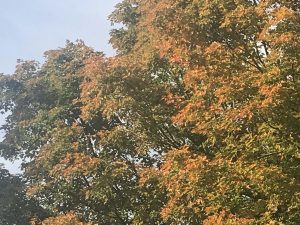

 Students may be drawn first to the calming impacts of mindfulness, but mindfulness can also be seen as empowerment – a way to eliminate the internal obstacles that stop them from stepping fully into their power, dignity, and creativity – essential tools on the path to racial justice, and essential tools on the path to real freedom and equality.

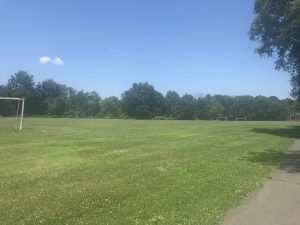 Yesterday, instead of turning right to head down the big hill to the woods and river, I turned left instead. This time, I ran one house down, then turned into the athletic grounds behind the town’s middle school. Here, rather than running in the dense, enclosed woods, I ran on a half-mile gravel track surrounding a wide open field. I relaxed, pausing frequently to gaze up and take in the open sky. After the first loop, I changed direction, so more of the time I would be facing the widest open space.
  I felt no rush to move into the second rhythm of Staccato, instead feeling like I could keep doing this gentle circling all day. Eventually, the rhythm of Staccato