by meghanleborious | Apr 1, 2020 | Notes on Practice
 Things I wrote even two or three days ago seem so dated now. The pandemic is intensifying in this region.
I’m in the eleventh day of a 14-day quarantine in an apartment attached to my parents’ house, along with my ten-year-old son, Simon. We are in quarantine because we just came from Brooklyn, NYC, the epicenter of the United States coronavirus plague, and I’m afraid to expose my parents.
Fear, sadness, and anxiety come in waves.
My work is to teach meditation to teens in a Brooklyn High School, and in a matter of days, like many other teachers, I had to make the pivot to online teaching. I’ve been working tirelessly to engage my students, but at this point less than half are actively participating in the online class. So I sent an email to their parents to let them know their students’ status. One parent responded that she is working 12 hour shifts and it is hard to keep up with her child’s assignments.
I realized how insensitive my email was, given the circumstances.
Some of the parents of my students are low wage health care workers. Many are working long shifts caring for people infected with coronavirus, seeing up close how horrific the disease can be. They are risking their lives, day after day after day. Some are doing it because of altruism and a deep calling to serve. Some are doing it because they absolutely have to work, and do not have the resources to take any time off. Many are single parents.
This is a slap in the face about the real impact of bias in our society, and one of the infinite ways coronavirus is disproportionately impacting communities of color. I thought about the privilege of being able to withdraw from NYC, and the fact that there are many people who don’t have the same option.
And I’m seriously bugging parents about their kids doing their classwork. Really?
Some of my students have a parent or grandparent who already has the virus.
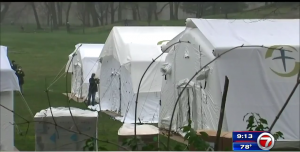
There is now an emergency tent hospital in the middle of central park. A US Navy hospital ship arrived Monday to help exhausted health care workers as they toil, often lacking even basic protective supplies.
 In answer to a writing prompt, “What is one thing you wonder?” One student wrote, “I wonder if it’s even safe to go outside and get a breath of fresh air.”
Every day, I start with a period of meditation, before the sun is even up. I transported my entire altar box and all of its contents to our new location, and re-created the exact altar that I had in Brooklyn right before we left. I also brought many of my cherished books, and arranged them beautifully near the altar.
Lately, my morning meditation feels more like prayer than meditation, as I focus energy and attention on wishing health and safety for everyone I love and for all beings, mixed with other meditation practices and contemplations.
I have to clock in to work at 8:15 but most days I start long before, after taking a shower, trying my best to get Simon oriented to his schoolwork, and having breakfast.
I make sure we get outside at lunchtime, and again after my workday ends at 2:50. We play on the swing in the yard and laugh. Sometimes I can even convince Simon to play soccer or take a bike ride with me.
Yesterday, I heard my mom crying through the wall, and learned that the son of one of her friends is in hospice.
Today, she told me that my cherished great aunt is not doing well, either. Her 100th birthday is this spring, but since she has been isolated and has no visitors, and therefore nothing to anchor her to this world, she has been dissolving into spirit. She lives next door to my parents’ house, in the same house that she and my paternal grandfather grew up in with their parents, my great grandparents.
I wanted to run next door to support her in her transition. I rushed out in the direction of the house, without even a coat, and just stood there, crossing my arms to hold my sides, knowing that I couldn’t go in. That I wouldn’t have a chance even to say good-bye.
I was crying, of course. And Simon wanted to know why I was crying. I told him and he started crying, too. We went for a walk, talking about what happens after you die and sharing jokes. I brought up Gabrielle Roth, the mother of the 5Rhythms practice, and told him I didn’t think dying was so bad for her. He said, “Yeah, but she was this crazy witch dancer…” I didn’t respond but had to smile, at least for a moment.
I don’t know what I would do if it weren’t for practice. Most days I do yoga, which helps me to feel grounded and flexible.
I also dance the 5Rhythms for at least one wave a day. And I’ve been recording myself, which is a new habit. I can’t even keep the videos because they take up too much space, but it is interesting to watch myself when I play it back in the evening.
Today, Flowing did not come easily. It was hard to settle down, and I noticed that I wanted to move into Staccato quickly. Maybe there was just too much to let in today.
I can hear Simon talking with his friends on video chat throughout the video as I play it back…One source of private guilt is that pretty much all of the time that I’m in formal practice, he’s on a screen chatting with friends or playing Roblox with them. He blows through his schoolwork in under two hours most days.
At the start of the video, I squat in front of the altar and dedicate my practice to my ailing great aunt, Mae Grigely, and acknowledge the power of practicing for someone else.
Staccato never fully ignites today, either.
In Chaos I come alive though, with speed, resistance, release, and wild surrender, spinning and letting momentum fling me to all kinds of edges. The gap when the beat drops out seems to be when I get the most creative.
The Chaos Lyrical song I chose is 165 beats per minute, and I twitter wildly, racing to express the layered, exploding sounds. I pause briefly and leave the room to address one of Simon’s questions, then resume this ultra fast dance, responding more and more to the melody and less to the wild rhythm and rising upward as the track evolves.
In the second Lyrical track I am transported, moving with soaring undulations, the afternoon sun in one vertical rectangle catching different parts of my body as I move.
In Lyrical Stillness I cry throughout the track, singing part of the lyric in jagged gasps. I cry again watching myself. I look so alive and so sad. My heart was broken in this part, is broken.
“Ewwwwww!” Simon screams from the other room, for some unknown reason.
I whisper-sob through the last song, sensing my grandfather, who once lived in the very room that I am dancing in. He loved the ocean, and would make the Christian sign of the cross as he waded into the sea. He would fold his hands behind his head, cross his ankles, and float on the bobbing waves for long periods with his face to the clouds. He was a man of few words, but I always thought this was a kind of prayer for him.
I end in a squat in front of the altar, as I had started, dedicating the merit of my practice to my aunt and to all beings everywhere.
Today, this period seems more like a time of survival than of possibility. One of my meditation teachers led an online practice and talk tonight, and he reminded us to do what we can to stay connected to our humanity. My practices encourage me to open to the reality I’m immersed in, knowing that every moment is a chance to deepen in my ability to be present, even when it is uncomfortable, stressful, painful, or sheer agony.
In the words of Pema Chӧdrӧn in Living Beautifully with Uncertainty and Change, “If you can stay present in even the most challenging circumstances, the intensity of the situation will transform you. When you can see even the worst of hells as a place where you can awaken, your world will change dramatically.”
May it be so. Blessed be.
March 31, 2020, Broad Brook, CT
(Photo1: military.com, photo2: News7)
by meghanleborious | Mar 31, 2020 | Notes on Practice
The stress is making me feel blurry. It is exhausting.
I’m in the third day of 14-day quarantine in an apartment attached to my parents’ house, along with my ten-year-old son, Simon. We are in quarantine because we just came from Brooklyn, NYC, the epicenter of the United States coronavirus plague, and I’m afraid to expose my parents.
 I know we are blessed and privileged to have somewhere we can withdraw while the virus seizes every corner of the world. Even here, in a small apartment in Northern Connecticut, I am afraid. For myself, for my son, for my near-elderly parents, for my family, for my friends, for the world. And feeling the weight of worldwide grief.
Simon and I walked on a beautiful path in the woods this morning, and resolved to watch the woods wake up in the coming weeks.
On the way, we found that a neighbor had put out several young adult books that appealed to him. We left the city quickly, and are out of new books. Thinking of the video games I wished to limit, I was tempted to gather some for him, but he insisted it was too much of a risk.
Later, I developed severe allergy symptoms, with a faucet-ing nose and powerful sneezing. I had a video appointment with my (exhausted) doctor who told me it was unlikely to be coronavirus. He prescribed antihistamines, which are so far not helping at all.
During the day, I struggled to do my high school teaching job, nurse my illness, and monitor and support Simon’s learning. I cried more times than I can count.
Tonight, my parents sat near the other side of the wall dividing us from the main house to listen to Simon play songs on the piano. We could hear them applauding each time he paused. We asked if they could throw any dessert food onto the deck, and though they were out of treats, they made chocolate chip cookies and put out a warm plateful.
Overall, though, despite these blessings, I felt sick, tired, down, discouraged. Impatient. Flat. Depleted.
After the work day and after taking care of multiple responsibilities, I found some time to dance a wave in my new makeshift dance studio–once my grandfather’s bedroom–while Simon played video games with his friends.
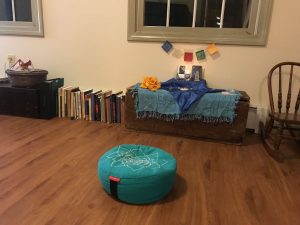 I decided to video this personal wave. I danced so vigorously that the camera kept migrating, and once fell onto the floor. I have not often recorded myself dancing, and I found it fascinating. To my surprise, I loved watching myself move. From this perspective, I seemed committed and creative. In the wave I danced before making the difficult decision to leave NYC, Staccato seemed blurry, hesitant. In this wave, it was ferocious. I couldn’t believe how much energy and force was released in Chaos. In Lyrical, I bounded, using every level, flinging up from the ground nearly to the ceiling, flexing my back, extending my arms. And I remember how it felt inside myself as I watched the Stillness section. I was spinning disks at all of my chakras, each a color of the spectrum, and then the room was crowded with spirits, helpers, and guides.
I ended with a prayer for health and safety for those I love and for all beings.
March 22, 2020, Broad Brook, Connecticut
(Photo 1: from grizly.com, Photo 2: by Meghan LeBorious)
by meghanleborious | Mar 22, 2020 | Notes on Practice
Pandemic. Coronavirus. Social Distance. Self-isolate.
In this time of worldwide fear and pain, practice is more important than ever. But what we usually do to practice the 5Rhythms is not safe at this time. So we are called on to be flexible, creative, and to test our ingenuity.
I admit that I miss dancing in big groups. I miss patient, belly-to-belly hugs on greeting. I miss the collective shifts of the crowd, like when a spontaneous chaos circle breaks out. I miss darting around into the empty spaces; I miss falling unexpectedly into partnership in perfect alignment; and I really, really miss dancing with my friends.
All of that said, I don’t think that practicing individually should only be considered as an austerity measure. In my experience, individual practice can also be a powerful teacher.
***
The first time I formally engaged in individual 5Rhythms practice was during a winter retreat at a Tibetan meditation center. I was seven months pregnant with my son, Simon, at the time. It was an eight-day retreat; and several powerful energetic teachings that are usually taught separately were taught consecutively.
It totally overloaded my circuits; and I took to the miles of rocky trails to process and integrate so much new energetic information at once. Flat wooden platforms used for tent camping during the warm seasons were interspersed throughout the woods; and I started using them as dance floors instead, throwing down my heavy coat as heat rose in my body and letting loose.
In Flowing one day, I danced on one of the platforms with one hand on a tall stick. I moved around it like it was an axis, dipping and spinning low, switching hands, curving my head, and threading my hips and spine around it.
Though I didn’t plan on it, before long, I decided to make practice formal, and I moved through all five rhythms in the woods at least once a day, often returning to the center windblown and red-cheeked, feeling like I had a glowing secret. One day, late afternoon sun blazed through the trees and through my body, dazzling in its intensity. On another day, I imagined that a pair of small dragons raced out of the woods to dance with me, both with a playful ardency, and with sinewy, powerful movements.
***
Like many, I’ve been practicing on my own a lot lately, as coronavirus locks down cities and countries. At this time, I’m very thankful for practice. It’s helped me to emotionally regulate, to integrate experiences, and to be connected to my communities.
There’s nothing like practicing in a room full of 5Rhythms dancers, where there are endless opportunities to explore relationship, and to see yourself as you are reflected in the people around you.
However, as rich as group practice is, there is also territory that can only be explored in individual practice.
Individual practice is also totally portable, free, and empowers you by allowing direct access to what we might call source–direct access to the depths of human experience–without the need for a teacher to act as a facilitator.
Gabrielle Roth, the creator of the 5Rhythms practice, conceived of the 5Rhythms as a way to relate to the creative process. She believed that rather than discovering or inventing something, she was creating a map for what was already inherent in human experience.
Working with a certified 5Rhythms teacher makes it easier to access deeper layers of reality, when we participate with full awareness in the dynamic, changing display of phenomena, but we actually have all the tools we need to connect with that same source even on our own, especially after we have already spent some time practicing in community.
Once, at my parents’ house when Simon was still an infant, nearly ten years ago, I was dancing a 5Rhythms wave with him in the living room. Within moments, I was filled with emotion. Though I had spent countless hours in the same room, dancing the rhythms there brought me to a layer underneath the mundane. It was like I was watching videos of infinite family moments inside the same room, where my own mother had been a child, and where I had been a child. I could sense and see my place in it, and see my son’s place in it, part of an unbroken line of human beings, the expression of countless acts of love and courage, and, too, of regret, grief, and unexpressed potential.
***
Creating some kind of an opening and closing ritual can support our practice, and provide cues to the unconscious that it is time to switch out of mundane gear. It can also be helpful to create some kind of visual or altar. One long-time dancer says, “My practice includes setting up at alter, which is usually a recent drawing. In the start of a practice, I think about all the giving beings I’ve ever danced with. I think about all the beautiful places I’ve danced. I try to do this at the start and end of every practice.”
Another dancer expressed that she finds it helpful to set an intention at the beginning of practice, and to return to that intention frequently, then to end with it.
***
During the summer of 2015, Simon and I traveled to Costa Rica. There, he went to camp during the days and I spent the time writing and dancing with the sea.

At first it was kind of boring.
I tried to seek out or set up informal dances with others, but it didn’t work out.
So there was no music blazing from high tech speakers, no interpersonal intrigue, no one to partner with and vibe off of, no one to take care of, no one to take care of me, and no external prompts from a teacher to pull me along.
That is to say, it was all up to me.
For the first few days, my dances were uninspired. I remained committed, though, and continued to spend the days dancing and writing. I began to go to a beach called Playa Pelada every day. It was remote enough that few people walked all the way there, but not so remote that getting there was impossible.
I sent some writing to one of the leaders of 5Rhythms, with the disclaimer,
“I know it’s not 5Rhythms practice if it isn’t led by a 5Rhythms teacher, but…”
She wrote back, “Actually, it can still be practice. It’s just that it’s individual practice.”
This validation helped me to believe in what was already unfolding, and I committed myself even more resolutely to practice–at minimum, to move through each of the 5Rhythms in sequence daily.
That brings up another benefit to individual practice–that it allows us to practice daily, even when schedule, geographic location, or, a worldwide health emergency make it impossible to get to a 5Rhythms class.
During low tide at Playa Pelada, warm tidal pools formed and I explored every crevice of the land, often moving in Flowing for long periods, and moving back into Flowing again and again, even as the other rhythms presented.
The first time that I danced the transition from low tide to high tide, I was cured of the problem of boredom.
Playa Pelada gave me so much to work with. There was a small island directly in front of the beach, and at high tide, the wild sea would rush around it on both sides, then meet in the center in a crashing tangle of waves. Shifting sand, rocks and debris would crash at my ankles and radically shift the very ground under me. I never tired of responding, arching, casting, turning over, flapping up fast, letting my hips recede as the waves pulled me, and coasting in circle after circle after circle.
Sopilote vultures arced and soared above the high cliff walls. Clouds shifted and raced. Rainbows appeared and dissolved. Iguanas, hermit crabs, and alligator-like caymen flashed in glimpses. Huge driftwood trees disappeared overnight. The sea rushed in and receded. And I witnessed this rich display and moved with all of it, leaving nothing out.
During our last week in Costa Rica, I danced from one low tide until the next–nearly twelve hours of moving–beginning before dawn. As the sun rose over the island and lit the sky, I immersed myself in a spontaneous ritual, using salt dyed with rainbow colors to create a giant spiral on the sand. I danced from its edge, where I felt I was in the relative, everyday world, along the path to its center, where I imagined I was in absolute reality, a place where different dimensions intersect. I moved back and forth through this spiral throughout the early morning hours as the ocean began to gather into a crescendo and eventually erased the spiral, gathering it back into herself.
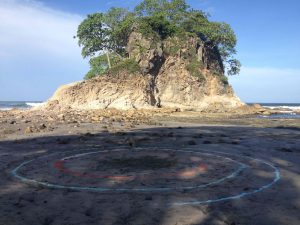
Practicing individually in beautiful, powerful places has expanded the possibilities in my own dance. I carry these experiences in my body, even when I enter back into dancing indoors in community. For example, dancing with a powerful river, I visited its deep, cold, dense, black river bed. Now, in Stillness, I can still connect with this experience and remind myself of my own depths, the dark, cool currents that run deep inside me.
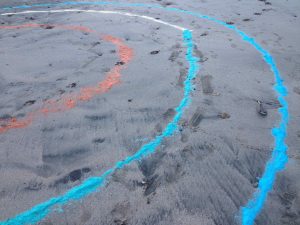
The year after Simon and I were in Costa Rica, we spent summer on the southeastern coast of Ireland. There again, Simon attended camp and I spent the days dancing with the sea, writing and making artwork.
The sea was indescribable. Gigantic. The tide goes out nearly a mile, then rushes back in at high tide to pummel everything in sight. 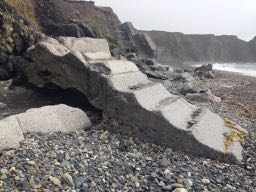 Slowly, as I danced with integrity over many sessions, this powerful place revealed itself to me, initiating me to its secrets.
In general, I have often felt that I needed to keep myself in Flowing longer than felt intuitive. This was so I could be responsible and find the ground beneath me before taking on any other investigation, especially when dancing with other people.
In Ireland, I learned that another benefit of practicing independently is that I can work with the mercurial shifts of energy as they arise. Instead of holding myself in Flowing at the beginning, I noticed that even once I did move into Staccato, I moved back into Flowing many times. It wasn’t an all-or-nothing thing. Even in Chaos, I still found myself going back to Flowing.
Here, the stakes were different. Attending to the many small subtle shifts of energy as I fluctuated between different rhythms allowed me to follow intuition in a new way, and to observe nuances that weren’t always apparent during a wild collective dance. One day a wave followed this pattern: Flowing, Staccato, Flowing, Staccato/Chaos, Staccato, Flowing, Flowing Chaos, Chaos, Flowing, Lyrical, Chaos, Lyrical, Chaos, Flowing, Flowing Lyrical, Stillness.
***
This week, as coronavirus rolls in crushing waves over the world, like many, I’ve been practicing independently in my own home. I would prefer for Simon and I to be fully quarantined, both to keep us safe and to not proliferate germs, but we have roommates who are still going in and out, so my obsessive cleaning and containment procedures might be for naught.
Yesterday, I danced a five-song wave, one song for each rhythm. It all seemed very mundane at first, with afternoon sun coming in the window and falling in angled squares on my worn living room rug and the cat sitting next to me on a rumpled couch blanket. But soon, it tore itself from my throat and broke open. I spun and angled and dipped in Flowing, letting in fear. In Staccato, I was fierce, expressive, decisive. In Chaos, I was gigantic, kinetic, powerful. In Lyrical, I expanded beyond my small conception of who I am. In Stillness, I offered the merit of my practice to my family and my friends all over the world, and the afternoon living room seemed crowded with spirit guides, ancestors, and deities.
This territory is totally uncharted and the stakes are high.
For 5Rhythms practitioners and to everyone who has a committed practice, now is the time to lean into it.
Early in New York’s wave, I noticed I was trying to bear down hard until the crisis passed. But soon realized that coronavirus might last for an extended period, and that bearing down and wishing time away will only cause me to wish away moments of this precious life, and to close ourselves down emotionally and energetically. Somehow I have to come to terms with it. Better to open to what is, even when it is uncertain, even when we are met with grave hardship, and even when we are forced to stand face-to-face with our deepest, most terrifying fears.
by meghanleborious | Jan 9, 2018 | Notes on Practice
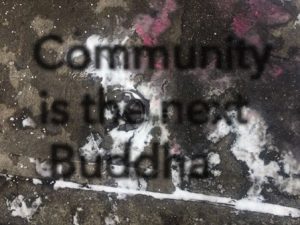
“Community is the next Buddha.” -Thich Nhat Hanh
I threw up in the car on the way to class while crossing the Manhattan Bridge from Brooklyn into Manhattan for Tammy Burstein’s Friday Night Waves 5Rhythms class last week. I think the extreme cold tightened all of my muscles, including the muscles of my stomach. Despite this, I arrived with time to spare. Huddling with a small group of heavily bundled dancers, I waited for the elevator at the Joffrey in the West Village, all of us blowing into our cupped hands, hunching our shoulders, and discussing the weather.
Stepping through the door into the spacious dance studio, I was annoyed to discover someone blocking my way into the room, apparently a member of the crew there to greet participants as they entered. I tried to step past him discreetly, but he moved toward me. I waved him away, moved to the side, and spent several extra moments allowing myself to arrive. The greeter approached me again, leaning toward me to speak, and I surmised that he probably wanted me to place my bag in the large mountain of bags and coats. Again, I waved him away, intending to place my things in the appropriate pile momentarily.
I don’t like to be greeted on entering, in general. Stepping in to a 5Rhythms room is a big deal for me. I undergo an energetic ritual to help me to leave the baggage of a sometimes-very-stressful-life at the other side of the threshold. I don’t want to have to encounter another person’s gaze at this moment, as my intention is to sidestep my own ego and enter naked, unadorned. I love to connect with people, but at this crucial moment having to respond, to project, to make a boundary, or in any way to consider someone else’s experience of me diminishes my ability to let go into my own depths.
After adding my bag to the high pile of coats, I fell easily into motion, sometimes on the floor, sometimes on my feet. I noticed that I was slightly edgy, tightening when a dancer near me seemed to totally ignore my existence and sprawl into “my” space. I reflected that although the holidays were filled with joy and blessings, they also held a fair share of afflictive emotion, including a painful dose of self-hatred, a fact that I kept trying to talk myself out of.
My Aunt Mae, who will turn 98 this year, hosted her annual Christmas Eve party, which has been going on at the same site, in pretty much exactly the same form for nearly 80 years. The big, brick house boarded teachers before my great-grandparents purchased it, and much of the décor remains consistent, including an exquisite red pincushion with assorted pins and thread sitting on a wooden bureau, images of the Sacred Heart and the Blessed Mother, crucifixes, painted religious statues, a coarse embroidery of the three wise men en route, pictures of my grandfather and his brothers on a tractor in the fields, a still-functional cuckoo clock from one of my great aunt’s ski trips to Switzerland, and a hand-colored photo of my great great grandparents.
It was still the first wave of class when the mishaps started. The first event was a falling glass vase, shaken off a little table by the bounding floor boards as the room moved into the rhythm of Chaos. I was halfway across the room, and, like many, paused to see what had happened. Four or five people who were in close proximity moved to clear the shattered glass, and the dancing continued.
“Yes, but regardless of what a test says, anything could happen at any time, Meghan. You never know,” my spiritually advanced atheist father once told me, as I explained about developments in genetic testing for pregnancy. This insight raced through my mind a few days after Christmas. My parents had taken my seven-year-old son, Simon, to a movie, while I met up with some friends from childhood. Coming home, there was a police roadblock. “Which way should I go?” I asked the officer, “I just need to get to Church Street, where my parents live.” “There’s a big accident on Church Street. You can’t go that way. You have to go around,” he said, indicating a detour. I pulled over to call my parents. This was just about the time they should be arriving. It was arctic cold. And Church Street is a small side street in a nearly rural town. There would be very few cars. What if it was them? “Don’t freak out,” I told myself. I called my mom’s phone. No answer. My Dad’s phone. No answer. The home phone. No answer. I started on the detour, a seven-mile loop, calling them again and again, still no answer. And by then I was starting to freak out. And starting to picture a gory accident. My son. My parents. Please Gods, let them be OK, I pleaded. I was driving too fast, but held myself back from maximum. Finally, I arrived at the intersection of Church and Main Streets, where a fire truck blocked the road in both directions. “Please, please let them be ok,” I prayed again and again, “And if it isn’t them, please let whoever it is be ok. Let them be ok.” I parked and ran to the site, my overactive mind full of horrific images.
The crushed cars were not theirs. I relaxed a little. I squeezed past the fire truck, parked at my parents, then ran back to the accident, sucking in huge breathfuls of frigid air. “Were there only two cars?” I asked a fire fighter. “Yes, just two.” It took me another hour to calm down and begin to release my muscles. I also kept thinking about how for someone somewhere this accident, when one of their family members was hurt, wasn’t just a projected nightmare, but was reality. I watched as a Life Star helicopter landed in a nearby field, praying silently.
The next mishap at Tammy’s class was more serious than the previous. A fellow dancer and friend slipped backward and hit her head on the corner of the heavy folding table where Tammy stages the music. There was a very loud clonking sound. Tammy had just instructed us to partner, but everyone paused in horror, realizing what had happened, forgetting about our partners. Seeing that the fallen dancer was in good hands, I realized that to rush over would not help the situation, would help only me, so I held back, my forehead constrained and furrowed. I caught my partner’s eye, trying to let go of constraint. We made an effort to move in tandem for a few moments.
Tammy shifted the group into a Tribal exercise, gathering everyone to one side of the room. She asked one experienced dancer to step forward and create a clear, simple gesture that everyone could follow. This had the effect of keeping us moving, and of taking the focus off of the dancer who had been injured, who was still sitting on the floor, holding her head. Though I historically have a hard time leading tribal movements, I stepped up to take a turn to lead. It was during a part of the song with no obvious beat and I was spastic. “With the beat,” Tammy said into the microphone, and I settled onto the most obvious beat as the song’s percussion returned, trying to keep it simple, relieved when the leader changed and someone else stepped up.
Soon, we switched back into moving throughout the entire room.
Just as the energy of the room was rising again, another mishap arose. This time, the table that the dancer had hit her head on, and that held Tammy’s computer and mixer, crashed to the ground, its legs crumpling on one side, dumping the equipment. Again, several people in close proximity moved to help and the situation was righted quickly. “What is happening? Are we cursed or something? Is there some prankster spirit messing with us?” I asked internally.
“Does anyone feel like stopping?” Tammy asked the room. “Yes,” I nodded softly. But instead of stopping, Tammy gathered us in another collective exercise, and kept instructing us to partner.
I wasn’t sure which rhythm we were in at a given time, but I moved in deep connection with Chaos when it came. Bounding, leaping, touching ground and soaring, “Softer, softer, softer,” I kept telling myself, letting any edges express, but not specifically intending to engage or explore them. Not having danced for two weeks because of the holidays, some of my ongoing experiments seemed to have evaporated, a gestural re-set button. I tried to find my recent big, pelvis-rocking, momentum-coiled back step but instead found new expressions, spinning in a matrix.
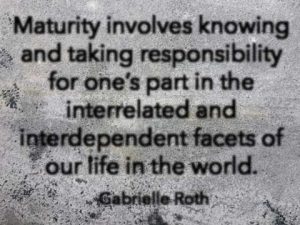
When the first wave finally concluded, I had another rush of Chaos and followed its impulse, with energetic arms and released head, moving to the edge of the group as Tammy gathered the class for an interim talk between the first and second waves. She addressed the multiple mishaps, and said that she knew the dancer who was injured was in good hands. She also expressed that each episode had been subject to causes and effects, and that individual members of the community responded appropriately in every instance. She went on to evoke the founder of the 5Rhythms practice, Gabrielle Roth, who emphasized again and again the importance of both individuality and community, especially in the final years of her life.
Just before Tammy’s Friday Night Waves class the following week, on January 5th, I was under a warm comforter with my son, Simon, watching the 1939 version of the Wizard of Oz, wincing occasionally at the 1939 representations of identity, yet singing along, even drowsing off at intervals. “Mommy, why do they have to sing a song for everything?” Simon complained. Instead of going to his after-school program, I had left work early and picked him up at school myself, so he wouldn’t have to walk the mile with his afterschool group in sub-zero windchill. We had dinner at a steamy café with dripping glass windows and wet floors in our Brooklyn neighborhood, then repaired to movie time. I couldn’t imagine how I would possibly have the energy to unfurl and move, but figured I could just go to class and lay down on the floor, perhaps moving a finger or an arm or an eyelid or something. I would probably keep my heavy coat on the whole time, too, I projected.
Dressing, I pawed through my big bin of crumpled dance clothes, looking for something that would enliven my cold mood. I pulled out an orange tank top, and a tiered orange skirt with sequins on the horizontal seams, much like the kind of skirt worn by the faded figurines topping display wedding cakes at low end bakeries. I nearly changed into black leggings and a black tank instead, but talked myself out of it in favor of the orange outfit, though I packed the discreet black articles in my dance bag in case I wanted to change once I got to class.
There were very few cars on the icy, grey-slushed roads in Manhattan, and I arrived at the Joffrey in the West Village within 20 minutes. On the way, I listened to an alarming interview with author Michael Wolff, who had published the book “Fire and Fury: Inside the Trump White House,” earlier that day, yet another presidential event that has caused anxiety and distress in recent months.
Joining as usual with a small group to wait for the elevator, we hunched our shoulders and remarked about the weather, noting the shared experience.
Stepping out at the fifth floor, one of the first people I encountered was my friend who had fallen and hurt the back of her head during the previous Friday class. “How is your head?” I asked. “It’s fine,” she answered, smiling. “I’m so glad,” I said, leaning forward and kissing her forehead.
Stepping into the studio, I noted with slight irritation that there was another crew member greeting people on entry, and was relieved that a distraction arose and I didn’t have to worry about how to manage our interaction.
Settling my bag, coat, hat, gloves and scarf by the already jacket-laden ballet bar in the corner, I began to move, still wearing three shirts, and was sucked immediately into a rhapsodic flowing track, the loud orange skirt twirling heavily around my ankles. Spinning low, I repeatedly brushed my fingertips onto the floor in an arc. Tammy left the teacher’s table and danced throughout the room. I felt her energetic self brush mine as we moved briefly in proximity, experiencing myself as a rotating matrix, undulating luxuriously into and across and out from the center line of my body, rising and falling in hoops, gracing the space above, touching the earth below, my shoulders open and generous.
I peeled off one shirt and then another, leaving them by an open window that was pouring in cold air, and revealing my entire bright-orange outfit. I noted a ferocious pain in my right heel. Flowing low and effortlessly again, I intersected painfully with another dancer, whose toenails dug into the top of my foot as he moved his own foot in a low circle. My face contorted, and I rushed to one side of the room and massaged it, hoping my pleasant flow had not been chased away. Soon, the pain passed and I regained a similar momentum, moving through the room.
I exhaled gratitude and lowed softly, the magic of being in a 5Rhythms room coiling around me and moving me, despite myself, once again.
During the week, I had heard two interviews, one a country music singer and the other a conservative pundit, both talking about white privilege. Both men expressed that before the election of President Trump, they had been blind to the kind of white privilege they enjoyed, and that they hadn’t realized the depths of racism in America. I could relate completely, and reflected on what a painful and important journey it has been, to begin to reckon with my own experience of white privilege. The conservative pundit expressed that he is no longer a member of the Republican party, as it is now characterized by “white nationalist populism,” and for the time being is politically “homeless.”
Tammy invited us to partner again and again, but challenged us to pair lightly, with the reminder that “it’s about being with everyone.” I stepped into several successive dances, many with people I hadn’t encountered before, moving in decisive lines between partnerships, embodying Staccato. Entering into Chaos, still in partnership, I stepped in to a man with glasses, and we moved in a low, carved Staccato Chaos, approaching and retreating, spinning, and presenting our inner knees, moving from the back of the pelvis, the heavy tailbone. “Give your partner your full attention,” said Tammy, and we met each other’s gazes, beaming. Meeting two friends of many years, I attempted a curved orbit, my head leading me, and hit a stopping point a few times before momentum flung me around it, in weightless, inspired circles.
In Lyrical, I moved with the same two friends, never out of breath, finding surprising twists and leaping from released inner legs. Tammy put on the tender, uplifted track “Follow the Sun” by Xavier Rudd and I soared without effort throughout the space, joining briefly with anyone who was open to me. Finding another new partner and settling in, I mirrored him, rolling my shoulders enthusiastically, and opening my throat and palms to the sky, unbridled, as he grinned with his mouth open, the arches of his feet smiling, and lifted off, too.
In Stillness, I traveled. I imagined that I walked up the stairs at my Aunt Mae’s house – the same site of the Christmas Eve party a short time before – turned left briefly, then right, then opened a door into a cold, disused hallway, and another door into a room that I have visited in dreams throughout my life. Inside the room, I passed through another door, and stood at the end of a diving board, gazing out at the cosmos, wondering if I had the courage to step off the board and into limitless space. A shadow-like male ancestor spirit who is familiar to me came to offer support, overlapping with me, encouraging me to move forward, though part of me wondered if I could actually die, could actually cease to be if I did. When I did take a step, my body seemed gigantic. Clouds swirled below eye level. A large flock of birds passed through my chest, calling out. I flickered back and forth between wondering about “my” experience and being subsumed by it.
Tammy gathered us around a lovely class centerpiece that one of the members of the crew had created, next to the room’s quietest wall. It featured transparent fabric with coils of light underneath it as though underground, a little elf-scaled tree that seemed above ground, and crevices of dried flowers tucked into the rolling curves of this tiny representation of earth. She couldn’t but speak about the strident cold, even remarking that the space heater in her office had broken down alarmingly that afternoon. She shared the insight that the state of being frozen significantly slows down the ground, and that some seeds need to freeze in order to be able to sprout at a later time, hinting that this moment of weather intensity is part of a natural cycle, and perhaps that dormancy does not imply the death of movement.
This was a welcome perspective, as news reports I had absorbed that day seemed more dire. For example, CNN reported that the cold is “causing frozen iguanas to fall from trees in Florida.” I also read a news story about thresher sharks getting trapped in the waters off of Cape Cod and washing up dead onto ice-crusted beaches.
By the end of Tammy’s talk I was cold again and didn’t feel like moving more. I stepped out to use the bathroom, and when I came back the room was already transitioning from the first rhythm of Flowing into Staccato. I was disengaged, a little hesitant, and afraid that I might crash someone or that someone might crash me, noticing how different I feel when I am not grounded.
I wandered distractedly for a few moments, then a man I hadn’t danced with before engaged me in partnership. He was very enthusiastic, and I found a little bit of movement with him, visiting some of the gestures I learned while dancing at house music events in the 1990’s. From there, I gathered momentum, and was able to come back into myself and into the room. I joined with a friend in a quirky Staccato dance, tucking my thumbs into my hip creases, jigging my hips, with fully available energy. A community Chaos erupted and I continued to change partnerships, still occasionally letting loose on my own. In Lyrical, I again found a cherished friend, and was overtaken by delight, smiling to my edges. Later, she told me, “I was so happy when you came over in the last wave. It was like, ‘OK, the light can come out and play now!”
In Stillness, I again passed through the door beyond the door beyond the door at my Aunt Mae’s house, merging with limitless space.
Tammy invited us to set an intention. I closed my eyes and thought of my seven-year-old son, Simon, wishing that he would live long, be happy, and know his own goodness. Without contriving it, I also wished that every mother’s seven-year-old would thrive, just as I hoped for my own child – a new default I am noticing recently, as with the car accident scare at my parents’ house, that even in the throes of strong emotions, awareness can automatically consider the collective experience.
In both of these classes, Chaos presented itself again and again, a beautiful marble to inspect every aspect of, not simply catharsis, but too, patient, deep and luminous, demonstrating perhaps that with the help of community we can endure and thrive even in this decidedly tumultuous era.
“It is probable that the next Buddha will not take the form of an individual. The next Buddha may take the form of a community, a community practicing understanding and loving kindness, a community practicing mindful living. This may be the most important thing we can do for the survival of the earth.” -Thich Nhat Hanh
January 6, 2016, Brooklyn, NYC
This blog consists of my own subjective experiences on the 5Rhythms® dancing path, and is not sanctioned by any 5Rhythms® organization or teacher.
by meghanleborious | Nov 22, 2017 | Notes on Practice

“Dance like this is your last dance,” Ray Diaz, who is teaching this morning’s Sweat Your Prayers class at the Joffrey in the West Village, tells us. “Because you never know when that last dance could be.”
Stepping in to the studio, the room is very full. People are sprawled all over the floor, beginning to stretch and unfurl. A little current of wind turns me right away, and I rise and fall, one hand touching ground the other reaching to sky, my shoulder rolling open and turning me in the opposite direction – big, weighted circles on the ground’s plane and on every diagonal, my head blissfully released.
Ray encourages us to move slowly and softly, and to begin to “fill up the inner reservoir.” I find a spot near the middle of the room and stretch to my full length, rolling over the back of my head, stretching my hips, leg muscles, pressing my chest down to stretch the front of my shoulder. Before long I am on my knees, with a raised leg that crosses behind me and drags me into a spin, sinking to the ground again, coming up onto my shoulder blade and using its momentum to pull back up into my hip and raise my heel high up behind me, undulating back again, and beginning to move toward rising.
Before class, I filled myself with inspiration. I listened to a Buddhist talk on stillness, that included the idea that although the positive behaviors and habits we cultivate are an important part of the path, ultimately, even these are a mask, and if we are to fully wake up, we have to let go of even these positive stories that we tell ourselves. In the morning also, I read some selected excerpts on Dzogchen, a spiritual system that emphasizes opening to bare, naked, luminous, absolute reality, on the spot. Here. Now.
Staccato’s appearance is unmistakable, and Ray encourages us to let go of the hips. The room is wild, expressive. I move around, connecting with many successive dancers, including my favorite dance partner of all time, who I circle in a twittering lasso, my hands grazing the ground as I greet him, entreating him to dance. After my first turn with him, I partner with a young woman who I haven’t seen before, and she teaches me a new way to engage my knees, opening possibilities for moving. “Go even deeper, with breath,” Ray offers. Next, I join with an exuberant dancer who seems to move from her inner thighs. I imagine that I am moving in her body, exchanging myself for her, exchanging self for other.
Chaos appears exactly when it should; and it is everything. Sometimes it is hard work for me to be in Flowing and leave the edges out. I am grateful to be in Chaos, where anything goes, and I can be as sharp as I want to be, as soft, as tense, as released, as gigantic, as minute. The room continues to be dynamic, with some people dancing in a given spot, and others moving quickly around the space. A thought comes and I say “thinking” and return to awareness, moving totally creatively and as part of the entire organism at once. I imagine that I remove my skin, hang it on one of the room’s center columns and dance around in my bones. The outer boundaries of me are not so clear, the other bodies might be my body, too. I dance my friend’s heart, feeling the pain of her heartbreaks, feeling her incredible tenderness, her magic, her power. Chaos and Lyrical dance back and forth with each other as the wave finds its closing expression. In Stillness, cold wind from the window causes a strong sensation on my exposed skin; and I turn to dance with it, beginning with the rocking and bouncing tree branches below the height of the window, then with the wind itself. Turning toward the room again, I move with inner winds that swirl around inside and near my body, especially along the sides of the spine.
After the first wave, Ray pauses us only briefly, not calling us to sit around him, but instead inviting us to stay where we are and just turn toward him for a moment. “We have to dance like this could be our last dance,” he says, “because you never know.” He goes on to say, “I’m going to share something with you. Almost exactly twelve years ago, I lost my wife.” He shares that this tragedy is what compelled him to step over the line into 5Rhythms. He goes on to say, “Hold nothing back. Just give it all you’ve got,” and “I invite you to dance, too, with those who are no longer with us.”
Ray appears to be in a place of humility and strength, of vulnerability and clarity, and capable of transmitting this clarion call, this urgent message, in a way that we can hear. Hold nothing back, his entire self communicates, hold nothing back, you have no time to lose, you might not get another chance to give more, to give better, to give fully, this could be your only chance.
I feel a gasp of sadness rise up into my throat and the woman next to me starts to sob. I don’t know her and I don’t want her to think I’m trying to fix her, but after a momentary hesitation, I reach out and put my hand behind her upper spine. She turns and hugs me, still shaking. She smiles through her tears, eyes shining, mouth closed, and puts her palm on my cheek.
I think of a work colleague who died this summer, young, in a car crash. In a circle discussion at work, we each had a chance to offer our thoughts. “If my time comes,” I said, “I only pray that I have emptied my whole self out. That I have been of service. That I have offered everything that I have in me to offer.” Breath snagged on something inside; and I cried for several aching heaves.
Ray starts the music again, and I check out for a few short moments, then say “thinking” and come back in. Energy flags slightly, I note slight inertia in Flowing. We glance through Staccato and then dive fully into Chaos again. “Release!” Ray cries out from the teacher’s table, and the room explodes. Chaos keeps going and going and going, rings of a tree, going back to its start as a sapling, as an acorn, when the tree was already contained in it. I connect with a dancer I’ve never seen before, delighted by her unique expression. I remember my maternal grandmother and cry, wishing I could have loved her better. I think of my paternal grandmother, who just died this past spring, and how she left in a whisper. Friends of similar age to me who have died come next. My friend Gerard, who died at 36, tells me again, you just have to do it, Meg, just open up, step up, let it in, you don’t need anything but what you already have. Howard, another dear friend, who died just a few weeks before Gerard also comes to mind. When I got the phone call about Howard’s death, I was with my son Simon, then an infant, dancing to the flights of birds from a rooftop pigeon coop who swoop in a rolling loop over Wythe Avenue in Williamsburg, Brooklyn, while Simon watched me from his stroller, the reflections of clouds rushing over the planes of my eyes, my arms raised and turning all of the planes of me.
As I move through the room, the energetic bodies that extend beyond the skin pass through me.
The sky beckons me. I ache for it. I start to climb up over the ballet bar, but am sure it’s against the rules and withdraw my leg. A new friend seems to think I need help and holds my elbow, unwittingly encouraging me. I know I’m going to get into trouble, but I just have to. I mean I have to, so I climb up over the bar, through the window, onto the cold metal fire escape. I keep my feet planted and soar up into the sky. I think of the Dzogchen teaching of open sky, the principle of space, of unrestricted awareness. My movements are unmoored from intentionality, totally intuitive. Tears pour down my face, drawing around the curve of my chin and neck. I am barely visible, with my back to the bricks, my feet on the cold metal, but a member of the crew spies me and comes and says, “This is not safe. Sorry, but you have to come down from there.” I climb down into the room and continue to move, near the window, to the wind, the sky, with space. I move again throughout the room, whispering through, not separate. I find one dancer sitting in meditation, and lower myself down next to him. Thoughts come but awareness dominates. I reflect that I can wake up fully in this lifetime, that I am destined to, that all of us are. The room is luminous, bodies alive. Ray mixes a tonal track with a recording of Gabrielle Roth, the revered creator of the 5Rhythms practice, speaking. She says, we believe that if we keep dancing, over years and hundreds of dances, we can shed what doesn’t serve, we can let go of what no longer serves. Tears are a river down the whole front of me.
Ray brings us all into a circle that completely fills the spacious studio, and enacts a closing ritual that allows each person to be heard and seen, re-membered after having been shattered and scattered and taken apart during the course of this Sunday morning 5Rythms class.
If this was my last dance ever, I know that I stepped up with everything I had to give. What else is there, really? Nothing but boundless love, the cessation of all that blocks it, and the chances we are given to live it. Nothing but this tiny life and what we choose to fill it with. Ojala, gods-willing, let me choose well, let me not die wishing I hadn’t held back during my very last dance, let me empty out my whole heart first, in service and in love.
This blog consists of my own subjective experiences on the 5Rhythms® dancing path, and is not sanctioned by any 5Rhythms® organization or teacher. Unedited Image “Riskall” copyright Meghan LeBorious
