by meghanleborious | Mar 31, 2020 | Notes on Practice
The stress is making me feel blurry. It is exhausting.
I’m in the third day of 14-day quarantine in an apartment attached to my parents’ house, along with my ten-year-old son, Simon. We are in quarantine because we just came from Brooklyn, NYC, the epicenter of the United States coronavirus plague, and I’m afraid to expose my parents.
 I know we are blessed and privileged to have somewhere we can withdraw while the virus seizes every corner of the world. Even here, in a small apartment in Northern Connecticut, I am afraid. For myself, for my son, for my near-elderly parents, for my family, for my friends, for the world. And feeling the weight of worldwide grief.
Simon and I walked on a beautiful path in the woods this morning, and resolved to watch the woods wake up in the coming weeks.
On the way, we found that a neighbor had put out several young adult books that appealed to him. We left the city quickly, and are out of new books. Thinking of the video games I wished to limit, I was tempted to gather some for him, but he insisted it was too much of a risk.
Later, I developed severe allergy symptoms, with a faucet-ing nose and powerful sneezing. I had a video appointment with my (exhausted) doctor who told me it was unlikely to be coronavirus. He prescribed antihistamines, which are so far not helping at all.
During the day, I struggled to do my high school teaching job, nurse my illness, and monitor and support Simon’s learning. I cried more times than I can count.
Tonight, my parents sat near the other side of the wall dividing us from the main house to listen to Simon play songs on the piano. We could hear them applauding each time he paused. We asked if they could throw any dessert food onto the deck, and though they were out of treats, they made chocolate chip cookies and put out a warm plateful.
Overall, though, despite these blessings, I felt sick, tired, down, discouraged. Impatient. Flat. Depleted.
After the work day and after taking care of multiple responsibilities, I found some time to dance a wave in my new makeshift dance studio–once my grandfather’s bedroom–while Simon played video games with his friends.
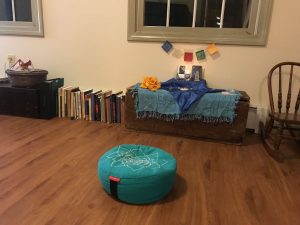 I decided to video this personal wave. I danced so vigorously that the camera kept migrating, and once fell onto the floor. I have not often recorded myself dancing, and I found it fascinating. To my surprise, I loved watching myself move. From this perspective, I seemed committed and creative. In the wave I danced before making the difficult decision to leave NYC, Staccato seemed blurry, hesitant. In this wave, it was ferocious. I couldn’t believe how much energy and force was released in Chaos. In Lyrical, I bounded, using every level, flinging up from the ground nearly to the ceiling, flexing my back, extending my arms. And I remember how it felt inside myself as I watched the Stillness section. I was spinning disks at all of my chakras, each a color of the spectrum, and then the room was crowded with spirits, helpers, and guides.
I ended with a prayer for health and safety for those I love and for all beings.
March 22, 2020, Broad Brook, Connecticut
(Photo 1: from grizly.com, Photo 2: by Meghan LeBorious)
by meghanleborious | Mar 22, 2020 | Notes on Practice
Pandemic. Coronavirus. Social Distance. Self-isolate.
In this time of worldwide fear and pain, practice is more important than ever. But what we usually do to practice the 5Rhythms is not safe at this time. So we are called on to be flexible, creative, and to test our ingenuity.
I admit that I miss dancing in big groups. I miss patient, belly-to-belly hugs on greeting. I miss the collective shifts of the crowd, like when a spontaneous chaos circle breaks out. I miss darting around into the empty spaces; I miss falling unexpectedly into partnership in perfect alignment; and I really, really miss dancing with my friends.
All of that said, I don’t think that practicing individually should only be considered as an austerity measure. In my experience, individual practice can also be a powerful teacher.
***
The first time I formally engaged in individual 5Rhythms practice was during a winter retreat at a Tibetan meditation center. I was seven months pregnant with my son, Simon, at the time. It was an eight-day retreat; and several powerful energetic teachings that are usually taught separately were taught consecutively.
It totally overloaded my circuits; and I took to the miles of rocky trails to process and integrate so much new energetic information at once. Flat wooden platforms used for tent camping during the warm seasons were interspersed throughout the woods; and I started using them as dance floors instead, throwing down my heavy coat as heat rose in my body and letting loose.
In Flowing one day, I danced on one of the platforms with one hand on a tall stick. I moved around it like it was an axis, dipping and spinning low, switching hands, curving my head, and threading my hips and spine around it.
Though I didn’t plan on it, before long, I decided to make practice formal, and I moved through all five rhythms in the woods at least once a day, often returning to the center windblown and red-cheeked, feeling like I had a glowing secret. One day, late afternoon sun blazed through the trees and through my body, dazzling in its intensity. On another day, I imagined that a pair of small dragons raced out of the woods to dance with me, both with a playful ardency, and with sinewy, powerful movements.
***
Like many, I’ve been practicing on my own a lot lately, as coronavirus locks down cities and countries. At this time, I’m very thankful for practice. It’s helped me to emotionally regulate, to integrate experiences, and to be connected to my communities.
There’s nothing like practicing in a room full of 5Rhythms dancers, where there are endless opportunities to explore relationship, and to see yourself as you are reflected in the people around you.
However, as rich as group practice is, there is also territory that can only be explored in individual practice.
Individual practice is also totally portable, free, and empowers you by allowing direct access to what we might call source–direct access to the depths of human experience–without the need for a teacher to act as a facilitator.
Gabrielle Roth, the creator of the 5Rhythms practice, conceived of the 5Rhythms as a way to relate to the creative process. She believed that rather than discovering or inventing something, she was creating a map for what was already inherent in human experience.
Working with a certified 5Rhythms teacher makes it easier to access deeper layers of reality, when we participate with full awareness in the dynamic, changing display of phenomena, but we actually have all the tools we need to connect with that same source even on our own, especially after we have already spent some time practicing in community.
Once, at my parents’ house when Simon was still an infant, nearly ten years ago, I was dancing a 5Rhythms wave with him in the living room. Within moments, I was filled with emotion. Though I had spent countless hours in the same room, dancing the rhythms there brought me to a layer underneath the mundane. It was like I was watching videos of infinite family moments inside the same room, where my own mother had been a child, and where I had been a child. I could sense and see my place in it, and see my son’s place in it, part of an unbroken line of human beings, the expression of countless acts of love and courage, and, too, of regret, grief, and unexpressed potential.
***
Creating some kind of an opening and closing ritual can support our practice, and provide cues to the unconscious that it is time to switch out of mundane gear. It can also be helpful to create some kind of visual or altar. One long-time dancer says, “My practice includes setting up at alter, which is usually a recent drawing. In the start of a practice, I think about all the giving beings I’ve ever danced with. I think about all the beautiful places I’ve danced. I try to do this at the start and end of every practice.”
Another dancer expressed that she finds it helpful to set an intention at the beginning of practice, and to return to that intention frequently, then to end with it.
***
During the summer of 2015, Simon and I traveled to Costa Rica. There, he went to camp during the days and I spent the time writing and dancing with the sea.

At first it was kind of boring.
I tried to seek out or set up informal dances with others, but it didn’t work out.
So there was no music blazing from high tech speakers, no interpersonal intrigue, no one to partner with and vibe off of, no one to take care of, no one to take care of me, and no external prompts from a teacher to pull me along.
That is to say, it was all up to me.
For the first few days, my dances were uninspired. I remained committed, though, and continued to spend the days dancing and writing. I began to go to a beach called Playa Pelada every day. It was remote enough that few people walked all the way there, but not so remote that getting there was impossible.
I sent some writing to one of the leaders of 5Rhythms, with the disclaimer,
“I know it’s not 5Rhythms practice if it isn’t led by a 5Rhythms teacher, but…”
She wrote back, “Actually, it can still be practice. It’s just that it’s individual practice.”
This validation helped me to believe in what was already unfolding, and I committed myself even more resolutely to practice–at minimum, to move through each of the 5Rhythms in sequence daily.
That brings up another benefit to individual practice–that it allows us to practice daily, even when schedule, geographic location, or, a worldwide health emergency make it impossible to get to a 5Rhythms class.
During low tide at Playa Pelada, warm tidal pools formed and I explored every crevice of the land, often moving in Flowing for long periods, and moving back into Flowing again and again, even as the other rhythms presented.
The first time that I danced the transition from low tide to high tide, I was cured of the problem of boredom.
Playa Pelada gave me so much to work with. There was a small island directly in front of the beach, and at high tide, the wild sea would rush around it on both sides, then meet in the center in a crashing tangle of waves. Shifting sand, rocks and debris would crash at my ankles and radically shift the very ground under me. I never tired of responding, arching, casting, turning over, flapping up fast, letting my hips recede as the waves pulled me, and coasting in circle after circle after circle.
Sopilote vultures arced and soared above the high cliff walls. Clouds shifted and raced. Rainbows appeared and dissolved. Iguanas, hermit crabs, and alligator-like caymen flashed in glimpses. Huge driftwood trees disappeared overnight. The sea rushed in and receded. And I witnessed this rich display and moved with all of it, leaving nothing out.
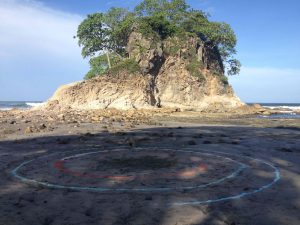
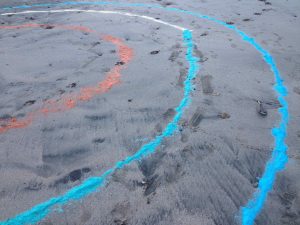
During our last week in Costa Rica, I danced from one low tide until the next–nearly twelve hours of moving–beginning before dawn. As the sun rose over the island and lit the sky, I immersed myself in a spontaneous ritual, using salt dyed with rainbow colors to create a giant spiral on the sand. I danced from its edge, where I felt I was in the relative, everyday world, along the path to its center, where I imagined I was in absolute reality, a place where different dimensions intersect. I moved back and forth through this spiral throughout the early morning hours as the ocean began to gather into a crescendo and eventually erased the spiral, gathering it back into herself.
Practicing individually in beautiful, powerful places has expanded the possibilities in my own dance. I carry these experiences in my body, even when I enter back into dancing indoors in community. For example, dancing with a powerful river, I visited its deep, cold, dense, black river bed. Now, in Stillness, I can still connect with this experience and remind myself of my own depths, the dark, cool currents that run deep inside me.
The year after Simon and I were in Costa Rica, we spent summer on the southeastern coast of Ireland. There again, Simon attended camp and I spent the days dancing with the sea, writing and making artwork.
The sea was indescribable. Gigantic. The tide goes out nearly a mile, then rushes back in at high tide to pummel everything in sight. 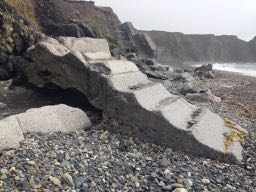 Slowly, as I danced with integrity over many sessions, this powerful place revealed itself to me, initiating me to its secrets.
In general, I have often felt that I needed to keep myself in Flowing longer than felt intuitive. This was so I could be responsible and find the ground beneath me before taking on any other investigation, especially when dancing with other people.
In Ireland, I learned that another benefit of practicing independently is that I can work with the mercurial shifts of energy as they arise. Instead of holding myself in Flowing at the beginning, I noticed that even once I did move into Staccato, I moved back into Flowing many times. It wasn’t an all-or-nothing thing. Even in Chaos, I still found myself going back to Flowing.
Here, the stakes were different. Attending to the many small subtle shifts of energy as I fluctuated between different rhythms allowed me to follow intuition in a new way, and to observe nuances that weren’t always apparent during a wild collective dance. One day a wave followed this pattern: Flowing, Staccato, Flowing, Staccato/Chaos, Staccato, Flowing, Flowing Chaos, Chaos, Flowing, Lyrical, Chaos, Lyrical, Chaos, Flowing, Flowing Lyrical, Stillness.
***
This week, as coronavirus rolls in crushing waves over the world, like many, I’ve been practicing independently in my own home. I would prefer for Simon and I to be fully quarantined, both to keep us safe and to not proliferate germs, but we have roommates who are still going in and out, so my obsessive cleaning and containment procedures might be for naught.
Yesterday, I danced a five-song wave, one song for each rhythm. It all seemed very mundane at first, with afternoon sun coming in the window and falling in angled squares on my worn living room rug and the cat sitting next to me on a rumpled couch blanket. But soon, it tore itself from my throat and broke open. I spun and angled and dipped in Flowing, letting in fear. In Staccato, I was fierce, expressive, decisive. In Chaos, I was gigantic, kinetic, powerful. In Lyrical, I expanded beyond my small conception of who I am. In Stillness, I offered the merit of my practice to my family and my friends all over the world, and the afternoon living room seemed crowded with spirit guides, ancestors, and deities.
This territory is totally uncharted and the stakes are high.
For 5Rhythms practitioners and to everyone who has a committed practice, now is the time to lean into it.
Early in New York’s wave, I noticed I was trying to bear down hard until the crisis passed. But soon realized that coronavirus might last for an extended period, and that bearing down and wishing time away will only cause me to wish away moments of this precious life, and to close ourselves down emotionally and energetically. Somehow I have to come to terms with it. Better to open to what is, even when it is uncertain, even when we are met with grave hardship, and even when we are forced to stand face-to-face with our deepest, most terrifying fears.
by meghanleborious | Jul 20, 2019 | Other Writings
“It’s 2019. Just thought I’d let you know that,” jokes Tanya Goldman, who is leading the first Sunday Sweat Your Prayers 5Rhythms class of 2019 in New York City. She doesn’t specifically mention New Year’s resolutions, but she does say, “One thing I’ve learned is if you want to change, you have to move. Physically, mentally and emotionally. It doesn’t just happen.”
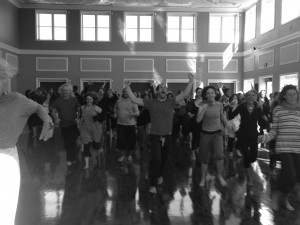
Tanya doesn’t talk much during class but somehow manages to bring out the best in people. For this Sunday morning class, the big dance studio is jam-packed and notably porous, the many selves melting in and out of each other, part of a big, collective self.
As the class begins, Tanya leads us in a long, patient Flowing. She seems confident that we’ll stay with her, even if she doesn’t rush to entertain us. In Staccato and a wild Chaos, I dance with a friend who’s seated in a chair, bringing me down low. I also share several dances with a friend who has been a frequent partner over ten or more years. In contrast to our usual ebullient, wide-ranging partnership, we tuck into a pocket, sustainable, riding energy patiently. In Lyrical, I join with another friend, leaping into flight with my shoulders and chest wide open, tears streaming down my face.
At the height of joyful intensity, Tanya plays the 90’s club anthem ’Last Night a DJ Saved My Life with a Song‘. I recognize it immediately, sinking low in a pumping warrior cry as the room explodes.
Tanya has a way of doing this. Of building things up and building things up, then dropping the exact perfect song at the exact perfect moment; and if I had had any sort of conscious thought, it probably would have been: This is heaven. Life could not possibly get better than this.
At the end of the class, I pause to chat with one of the friends I’d partnered with. “That was just amazing,” he says, wide-eyed. I nod. “She is incredibly trustworthy. I feel like it’s safe to totally let go. Like she is holding space and witnessing what is unfolding in, like, a clean way, or something.”
***
I think back to a Heartbeat workshop that Tanya and I both attended ten years before. I was having a joyful and pleasant experience, but it shifted when we were placed into groups of three for an exercise. One person was to move with a certain prompt in mind and the other two would witness the person who was moving, then we would change roles. One of my partners was this very expressive woman who had a huge dance. I had cheerfully joined her in partnership many times during the workshop, but this time when she was supposed to witness me, I didn’t feel like she was seeing me at all. Like she was just totally wrapped up in her own awesomeness. I’m pretty extroverted and don’t feel invisible very often, but somehow this really hurt me.
Thankfully, Tanya was my other partner. Curiously, it wasn’t until I reflected later, still nursing wounds from the experience, that I realized that although one partner had failed to see me, Tanya had very much seen me. I realized what a valuable friend she is and hoped that I could return the favor of her clear-seeing, something I continue to try to live up to.
***
Tanya, who has been a 5Rhythms teacher since 2014, sat down with me last spring to share some thoughts on her life and process. We planned to get together after a different Sweat Your Prayers class in the West Village for this interview. I hadn’t really thought through where we would set up but considered a few local restaurants without fully appreciating how much Tanya has to think things through in advance. Tanya has a disability that affects motor ability and uses a walker to get around, so accessibility is an issue, and she also let me know that she is not able to eat solid food. So instead of a restaurant, we went to a smoothie place at the corner, then sat down together at the closest Starbucks.
Once settled, Tanya patiently blinked her clear, blue-green eyes, and sipped at her smoothie, inviting the first question.
“When did you start practicing the 5Rhythms and what brought you to 5Rhythms for the first time?” I asked.
“I started practicing in 2008,” she began. “I’d already been doing Contact Improv for many years, since college.”
Tanya shared that she went to Oberlin, where Contact Improv was invented, and in fact practiced in the very studio where Contact Improv originated.
“I loved it, and learned that I could really be there, could really be in it despite my limitations. As my disability progressed, it got harder to do Contact Improv. It’s really all about partnering. In partnering, it was like my partner shared my disability, so it would limit what they could do, and not everyone was ok with that.”
She also shared that she didn’t always feel like she was included in the community, and added, “I decided I needed to find another dance community where it would be ok to dance on my own.”
Next, she became part of the Dance New England community and someone there suggested she try the 5Rhythms.
“For my first class, Jonny (Jonathan Horan, the director of 5Rhythms and son of its creator, Gabrielle Roth) was teaching. I didn’t understand it at all, but I felt accepted. Then, it was many years before I started to learn what it was all about.”
The next question I asked was, “How has your practice changed over time?”
“Well, my body has changed. The biggest change is that I now use a walker. That’s been in the last six-to-eight months. In the beginning, my balance was so much better. I could skip and run. Particularly after I got the walker, I was aware that my balance was really changing. For a while, I was falling all the time. My mind wanted to dance faster than my body could handle. The mind doesn’t want to accept the body’s limitations, but once you can go with the changes, then it’s so much easier. And now I’m not falling! But I’m definitely still moving.”
“Do you feel more comfortable with being off balance?”
“I don’t feel out of balance. I’ve come to accept and find the grace within my own dance. But it’s not a definite. One day it’s there and the next it’s like ‘where is it?’”
Then, I asked, “Do you have a ‘home’ rhythm?”
“Not really. For me, it’s all about change. We’re always changing and life is always changing.”
“Tanya, what made you decide to become a 5Rhythms teacher?”
“I did a class with Sylvie Minot and she talked about teaching 5Rhythms to inmates in prisons. I thought that was amazing. Not that she was teaching in prisons, but that she was bringing the work to disadvantaged people. I’m trained as a social worker. I always wanted to help people, to change lives for the better. In fact, when I started the teacher training, I was still working as a social worker. Halfway through the teacher training, I got laid off from my job, along with my social worker colleagues. After, I was too exhausted to go back to work, but I feel like being a 5Rhythms teacher is my offering, my contribution.”
“Did you have to overcome significant obstacles to undergo the teacher training?”
“I definitely had to overcome obstacles. The first was financial, especially after being laid off after the first module. Maybe even more significant were the mental obstacles. I had an internal story that I wasn’t even fully aware of that I had nothing special to offer. At an Open Floor workshop with Andrea Juhan this story came out and I was finally able to deal with it. That was a big turning point for me.”
“While I was going through this, though, I felt supported by Jonny (Jonathan Horan). During the training, we had to learn a kind of two-step pattern, which was obviously pretty hard for me, but I did it.”
She also shared that Jonathan said, “When you do this with Tanya, hold her hands,” and how much she appreciated that Jonathan seemed to get her needs.
“What, in your opinion as a 5Rhythms teacher, is the essence of 5Rhythms practice?”
“For me, it’s about permission and possibility; and it’s about getting out of your own way.”
“What, if anything, makes your perspective on the 5Rhythms unique?”
“I think as a person with a disability, I give a lot of permission to people in general. And, as a person with a disability, I also bring a lot about being willing to be vulnerable. My experience is about being very vulnerable every day. I wear my vulnerability on the outside.”
***
Tanya and I shared a workshop this weekend that was focused on the 5Rhythms emotional map, Heartbeat. At one point, we were working with the emotion of anger, and the room was explosive. We were instructed to line up at one end of the room and several sets of partners at a time would cross the floor to the other side, expressing the emotion of anger with our bodies.
One issue I’ve personally been working with is how to know when to help people and when not to, and how I relate internally to those two options. In fact, in a Sunday class the week before, a man had come in with a walker and paused at the side of the dance floor. I happened to be near him and asked if he wanted a chair. He was irate: “Why would I need a chair? There’s nothing wrong with me!”
Although I have never discussed it with Tanya, I wonder if, because of her disability, she has to contend constantly with people projecting their ideas of what her experience is and should be onto her. When I was pregnant in 2009-2010, I struggled with the visibility of my pregnant body and how much people wanted to tell me about my experience. I felt like a walking screen for everyone’s projections, and that if I heard one more birth horror story I might possibly harm someone.
With Tanya, I want to be available to help, but also don’t want to insult her by offering, and sometimes I get myself tangled in stories about helping/not helping instead of simply trusting myself to communicate effectively and do what’s needed. When we were lining up in the anger exercise, Tanya, who happened to be next to me, turned to me and shook her head, blinking her eyes and looking unhappy. “Does this feel like too much?” I asked. She nodded. “Do you want me to get you a chair?” She nodded again. I carried a chair over, placed it off to the side, and she sat down. The week before, I’d shared a dance with a broken-ankled friend who needed to stay seated, and, deep in a vigorous chaos, she had traveled laterally at least ten feet without harming the floor surface at all. Recalling this, I asked,
“Tanya, do you want me to push you across in the chair?”
Her eyebrows raised and her face lit up. “Really?”
She gave a clear “Yes” nod, so I moved behind the chair and pushed her forward. Tanya seemed delighted as I gently zigged and zagged across. My own dance had vigor and specificity, a Staccato I’ve been searching for lately – a self I’ve been searching for lately –especially as my roles in the world become more complex and I step into more positions of leadership. When we were almost to the end, I signaled to another dancer to please take over and she got the message immediately. I ran back to the first side of the room and crossed again, on my own this time, in an individual anger dance, unselfconsciously ferocious, owning my power without insisting on it.
The next time across, I asked a mutual friend to join Tanya and me. We were just as wild, zigzagging across both in partnership and as a trio, and changing roles halfway across.
I’m sure I benefited much more than Tanya in this exchange, and remain grateful to her for her willingness, courage, and openness.
The next and final day of the workshop, when we greeted each other, Tanya took the time to say, “I feel seen.” I recalled my resolution following a Heartbeat workshop more than a decade before to return the favor of Tanya’s clear-seeing when I had felt painfully unseen by one dancer, but seen by Tanya.
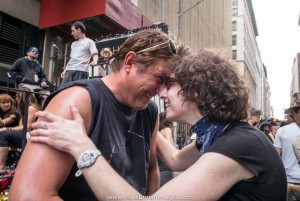
I don’t know if she meant specifically seen by me, but however she meant it, I looked at length into her light eyes and my heart flooded up. So many of the lessons Tanya teaches me are the ones that we already know deep down but conventionally forget, such as the fact that one of the deepest human needs is to feel seen, and that one of the greatest gifts we can offer is to see each other.
***
“Do you have any advice for new dancers?” I asked as our interview drew to a close.
“Have fun! Try not to take yourself too seriously and don’t worry if you don’t ‘get it’ at first. I tried to read one of Gabrielle Roth’s books in the beginning and I didn’t understand it. I couldn’t really hear what the teachers were saying at first, either. I’m very kinaesthetic; I learn through the body. I had to practice before I could get it intellectually.”
“And do you have advice for experienced dancers?
“Same thing! And also keep your mind open, keep your eyes open, and don’t get fixed on a certain idea.”
The final question was, “In closing, do you have a favorite quote or passage from Gabrielle’s teachings?”
“Waves move in patterns. Patterns move in rhythms. A human being is just that – energy, waves, patterns, rhythms. Nothing more. Nothing less. A dance.”
by Meghan LeBorious, based on an interview with 5Rhythms teacher Tanya Goldman on May 27, 2018, and journal notes from 2008-2019.
Originally published in the 5Rhythms Tribe newsletter on April 16, 2019. Photographs courtesy of Tanya Goldman and Jonathan Horan.
by meghanleborious | Jul 15, 2018 | Notes on Practice
“Mommy I hear a glow on you,” my eight-year-old son, Simon, told me when I spoke with him for the first time after three days of silence. I had been in the woods, wondering at the complex root systems of the trees underneath the forest path I walked on, sitting at length in a meditation hall, eating in silence, and noting the intensity of a thick heat wave.
When I spoke with him, I was in the middle of a week-long retreat with 90 other educators who are entering an intensive, yearlong program for teaching Mindfulness to youth. The retreat center, Garrison Institute, was formerly a Franciscan monastery, but has been repurposed for use by groups of any and all spiritual traditions.
The meditation hall was once a cathedral, and still has inlaid wood floors, soaring, curved heights with a circular narrative of symbols in stained glass, and an overlooking balcony that may have once housed the pipes of a resonant organ. Half of the space was populated with meditation cushions and chairs, arranged in a semicircle facing the four teachers.
During the first morning of practice, the teachers provided considerable physical instructions and we did sitting and walking meditation throughout the morning. In stages, they described three fundamental “anchors,” or places to hold the attention, including breath, body sensations, and sound, suggesting finally that we pick one anchor to work with. I chose breath, and so returned my attention again and again to the physical feeling of breathing.
Before lunch, one of the teachers, Kaira Jewel Lingo, gave instructions for mindful eating. “Eating is a celebration,” she said in her remarkably gentle voice. I heard, We can consider all of the many people and conditions that had to come together in order for this meal to come to us. We can really take the time to notice all of the flavors and textures of each bite. We can chew until the food is really liquid before we swallow it.
Despite my increasing mindfulness, lunch seemed kind of bland. To remedy this, I shook a bottle of tobasco sauce vigorously over my plain brown rice. Within a few bites, my eyebrows raised in shock and my tongue and lips burned. I had also spooned on a considerable amount of chunky salt, and after the first wave of heat started to normalize, a salt crystal landed on the tip of my tongue. I raised my eyebrows still further, continuing a roller coaster of culinary sensation. I got up to investigate the label on the tobasco sauce, my lips still on fire. Surely this must be a special edition, habanero, extra spicy tobasco sauce? It couldn’t possibly be the same tobasco that I regularly douse my food with? I was surprised to learn that it was in fact regular, standard tobasco sauce, the exact same.
Setting out for a walk in the woods after lunch, I chose the only path that seemed available. After a short time, I chose to veer left from the path and crossed a bridge over railroad tracks. To my delight, this path emptied onto a big rock formation at the edge of the Hudson River. I felt slightly tired, but hoped I could dance a wave, moving through each of the 5Rhythms – Flowing, Staccato, Chaos, Lyrical and Stillness – in sequence, the fundamental ritual of my core practice. Instead, after moving with noise in my ears for a few moments, I clicked into a groove and entered directly into Stillness, moving gently with breath, expressing the different currents of the river and ribbons of energy as they reached me. It was as though someone had turned the sound off on the world. I moved closer to the edge of the water, descending to where waves created by passing boats touch the rock. A gentle Staccato found me, the rhythm that has had the most to teach me lately – the rhythm of form, expression, direction, and of making things in the world. I moved with my arms and hips to the flips and curves and edges and advances and retractions of the relationship between water and rock.
Back in the meditation hall in the afternoon, I felt slightly sick, constricted through the diaphragm, and hot at the level of the face. Lately I have recognized the need to be able to release energy when I am overfull, like a pressure valve. How to do this hasn’t been exactly clear, however. It seems that the energy of mindfulness has its own strong momentum. Once I’m in the stream of mindfulness, I can’t just say, “OK, I’m not going to be mindful anymore.” Then, I just start being mindful of trying not to be mindful. In this case, I stepped briefly out of the meditation hall, letting go of the attitude of concentration, and that seemed to regulate me.
Reflecting later, I considered this progress in my practice. I’ve been reluctant to back off of my edges in the past, occasionally resulting in depression and ill ease. After these few short moments of casual attitude in the foyer, I re-entered the hall and took my seat among my peers in a more relaxed state.
Another of the four teachers, Erin Woo, presented a talk that evening on the topic of authenticity, and the many limiting stories we tell ourselves that diminish authenticity. She included personal examples of a story that has impacted her own experience, the story of “not good enough.”
During the final walking period of the evening, the early July sky lit with sunset. I stood on an overlook, facing the Hudson river and a wide field. I gasped as the field and bordering woods shimmered, alive with fireflies. I was concerned about seeming like a show-off, and of hogging the space of the overlook, but I slipped into motion, tracking the fast appearing and disappearing lanterns of the little bugs, again in Still Staccato, spine released, and long, ranging gestures with sudden stops and dips, and with occasional twitters in the hands and fingers, expressing the tiny dots and pauses of light that danced in the field below.
Silence wrapped luxuriously around me. Part of the instructions for silence were to avoid even eye contact. I felt too meek with my eyes cast down, so I held my head up instead, occasionally meeting people’s gazes and lighting up slightly. In the past, I have inhabited silence with a hard line, entering so deeply into my own small space that I might even feel the need to defend it if someone spoke with me or made beseeching eye contact. In this case, although I was in silence and very much turning in to the experience of my own inner body, I was still part of the collective field, and remained energetically porous and connected to the people around me.
A moving bell at 6.45AM mingled with my dream state and woke me on the third day of the retreat, which happened to be the 4th of July. After a morning stretch, meditation period, and breakfast, I walked in the woods again. I felt enveloped by the tunnel of trees, and imagined the deep and complex root systems which allow the trees to communicate, even crossing under the very path on which I walked. This time, I cried at length, thinking about the current state of the country. I reflected especially on the fact that its current prosperity is due in large part to the labor and subjugation of enslaved peoples, and to the land taken without remorse from its original inhabitants. An extra painful history to consider at this time, especially as racism and xenophobia have increased exponentially.
The teachers offered a taste of many different practices, and during the afternoon session, another teacher, Robert Thomas, offered a practice that involves open awareness, letting go of a reference point or anchor and hanging out in open space. As we prepared to move out of the meditation hall to practice walking meditation, he suggested that we consider gazing upward toward sky.
I made my way to a hallway of tucked away classrooms, but finding them already occupied continued on to a covered walkway between two second-floor sections of the main building. Three people were already there, arms resting on the balustrade, gazing upward. After some moments, a low growling began to emerge from the darkening sky.
At the end of the walking period, I made my way back to the main hall and took my seat again as the sky continued to rumble. After longer than I expected, rain began to pelt the high ceiling, creating a loud hush. After some moments of meditation, the retreat manager announced that there was an emergency weather advisory, suggesting that some might wish to leave the big cathedral and move to the basement level. No one seemed inclined, but the teachers suggested a five-minute break in case people wanted to close windows or decline to practice in the main hall during the storm.
Along with several others, I made my way to the front steps, where the sweeping vista of the Hudson River was blurred by heavy rain. The heavy wooden doors were each held by one retreatant. Without hesitation, I stepped out into the rain, tipping my head back and letting rain pour over me, grateful after several days of grueling heat. Acknowledging the frequent lightning, I returned to the stone steps under cover, and sat in silence. A woman next to me ate an apple with decisive crunching bites. Two enthusiastic birds continued to sing in the bushes to the right of the doorway. Mist from the rain landed on my forearms and cheeks. Across the wide river, a cliff waterfall I hadn’t noticed before swelled to three times its size, crashing with white water.
A bell summoned us back to the meditation hall, but some of us lingered on the steps, breathing the storm in.
Returning to our seats, the storm continued to activate the big room. I found myself rapt, counting the spaces between the thunder and lightning, aware of the dynamic, dimensional space of the sky around the building and of its intersection with the inside. At one point, I felt terror approach from the left, from the direction of a simultaneous flash of lightning and crack of thunder. My vision got weird and I felt terrified: heat, sick, rising. For a moment I was afraid I might be having a stroke. The words of an Indian master to one of her students came to mind, “Don’t worry, if you can just stay with it, you will accumulate great merit.” The experience rushed through me, arising, peaking and concluding in less than a minute.
In the evening, after a patient, slowly-chewed, silent dinner and evening sit, Kaira Jewel gave a talk on how to cultivate mindstates that lead to happiness, and discourage mindstates that lead to suffering. She called these processes “The Art of Happiness” and “The Art of Suffering.”
Kaira Jewel began her talk with a reflection on “Interdependence Day” and the fact that there is no thing that is only America or American, but there are many phenomena that make up what we know as America. Some include the enslavement of human beings and the experience of being enslaved, and the genocide of the people who originally inhabited the land. Walking in the woods earlier, I felt strongly that July 4th needed to be formally addressed, and I was grateful for Kaira Jewel’s words.
After Kaira Jewel’s talk, we headed out of the meditation hall again for the final walking meditation period of the day.
Instead of staying on the overlook, this time I headed down the stone path straight into the heart of the firefly field. I hesitated briefly, afraid some part of me might want to show off.
Within moments, however, I was immersed, moving through a full 5Rhythms wave, the fundamental ritual of my core spiritual practice. I moved in Flowing, feeling and honoring my feet on the forgiving grass, then began to move in the direction of every firefly I perceived in the expansive field, exhaling forcefully, sinking low into the knees, using the pinky sides of my forearms like swords, rising and falling, building heat in the body, watching the edges of my vision for a new flicker, responding to three nearly simultaneous lanterns, then waiting with full lungs during a brief pause in flashing. The precision of Staccato attention built to the fever of Chaos, and I let my head go, the pricks of light in the air around me blurring as I spun, dipping and coiling inward and away from my own axis, and in and out of my own field. Breathing erratically and sweating heavily, I began to notice the individual fireflies around me, lifting up onto the toes and reaching toward a rising light with the fingertips, leaping and falling, beaming unreservedly, in an expression of pure delight.
Finally, sound fell away again, as I moved with one tiny bug at a time. Lightning bugs tend to hover and linger, so they make excellent dance partners. Still dusk, I could see and track an individual even when it was not lit, and I cupped my palm, letting it lead me, rising and opening my hands in a slowly turning gesture, delighting in its slow transition into illumination, bowing my head to its tiny expression of majesty, part of the unified whole and spectacularly unique at once.
Still pulsing with life, I sat with my peers for the final meditation period of the evening. Every time I half-lowered my eyes, I saw shimmering lights both inside and outside of me.
The next day passed in a river of sensations, challenges and joys. We moved out of silence and began to consciously build community through a variety of exercises and shifting constellations. Kaira Jewel led us in an optional movement session, introducing us to the practice of Interplay.
Another of our teachers, Alan Brown, offered a talk, making a compelling case for the importance of self-regulation, especially for teachers. “Attention is a form of love. Embodiment is a form of safety,” he said as he described how young people can regulate themselves and can learn to self-regulate through the adults they are in contact with. “Just being a self-regulated adult in the classroom, before we’ve even taught anything about Mindfulness, is already a powerful intervention.”
He opened his talk with an astonishing story about his own path, which includes a diagnosis with Tourette’s syndrome. “Mindfulness was literally a medical miracle for me,” he shared, as he summarized the insights of many years of practice. In his case, deep investigation and inquiry into the body, along with some strategic questions posed by his teachers at opportune moments, lead to a radical decrease in the symptoms of Tourette’s and enduring faith in the power of Mindfulness practices.
Following an afternoon of community building which included tears and howling laughter, Alan was also very, very funny, and the room roared with good humor. The teachers also shared several games we could use with students in our classrooms, including a competitive game that physically modeled the paths of neurotransmitters through a line of bodies, and a game that involved passing a full cup of water around a circle.
At one point, Kaira Jewel led us in a structured Lovingkindness practice within a smaller group we will work closely with throughout the entire year of the course. At its conclusion, we offered Lovingkindness to all beings everywhere, without exception. I saw a pulsing dome of energy high above us, into the sky and beyond, twisting light ribbons edging moving planes of energy: powerful, building, resonating. The woman to my right perfectly described my own vision, saying she could see it through me somehow. “We should consider teaming up in card games,” I joked.
The retreat formally ended with writing prompts and shared reflections in our small cohort groups, inspiring words from each of the four teachers, and a ritual of passing a string around the gigantic circle. At its conclusion, the teachers cut a tiny section for each of us, and we tied it around our wrists, a way to remember our experience and to recall our purpose as we re-enter the streams of our lives outside the container of the retreat.
During the days after we let go of silence and engaged in speaking, at least ten people commented on my dance with the fireflies. “Are you a Tai Chi master?” one generous woman asked. “Was that Brazilian fight dancing you were doing in the field?” asked another. I smiled and said with some effusion, “I was just dancing with the fireflies.” If pressed, I would describe the dance in more detail, and if pressed further, shared information about the 5Rhythms dance and movement meditation practice. Many said they thought it was great that I wasn’t afraid to let go, something that never crossed my mind, though I did hesitate because I feared that part of my intention was to show off.
What most said was something along the lines of “That was so beautiful! I just stood there watching you. Your joy was enormous! I love your energy. It made me feel so happy.” Some even said it inspired their own joy. I inevitably choked up, touched that the people in this new community were so unreservedly happy for my happiness. Had I given in to self doubt and kept myself contained, I would have missed an opportunity to experience joy, and in the process of suppression would also have missed a chance to share joy.
I’m not surprised that you “hear a glow” on me, my dear son. This week has lit me from the inside. The path, at least for the moment, rises to meet me, showing itself a little at a time, tiny increments of light, moving in a collective field.
This blog consists of my own subjective experiences on the 5Rhythms® dancing path, and is not sanctioned by any 5Rhythms® organization or teacher.
by meghanleborious | Jan 16, 2018 | Notes on Practice
I wasn’t sure if would attend today’s Sweat Your Prayers class or if I would practice yoga closer to home instead. When I learned that the class would be held at Martha Graham studio in the West Village, rather than at its usual home at the Joffrey, and that 5Rhythms teacher Ray Diaz would be leading, I decided to make the trek. At the last Sunday Sweat Your Prayers class that Ray taught, I was thoroughly transported, windswept to different dimensions, and I was eager to see where class might lead me today.
Parking on Bethune Street right in front of the Westbeth Arts Building, where the Martha Graham studio is located, I briefly considered bringing in the laundry detergent that I would need later in the day, wondering if the strident cold might cause the detergent to freeze as it had the last time I attempted to use it.
There was a short delay with letting people enter the 11th floor dance studio, and it had the effect of pooling water behind a damn before a high water release. One friend embraced me, picking me up off my feet and cracking my back enthusiastically as she shook me from side to side, her own pony tail bouncing animatedly. Many ebullient conversations intersected and wove together in the foyer space while we waited for the door to open, inviting us into the studio.
When the door opened, we streamed inside, lodging our bags and backpacks on the wooden bench by the west wall. I paused for a moment on the low floor before taking a breath and stepping up onto the much-beloved, forgiving, sprung dance floor. Then I moved through an energetic ritual to help me arrive, closing it with a low bow and moving into the wide room. I began to lightly drag my feet over the soft grey linoleum. The dance floor at Martha Graham is a shaped like a large square, with no columns or impediments of any kind in the middle. There are big industrial windows on the east and west sides, opening to a spacious vistas of New York City.
The big room was at maximum capacity; and I found a spot on the floor to luxuriate in circles, beginning to stretch and wind up. A cherished friend who I had spent meaningful time with the previous day appeared upside down in the frame of my vision as I stretched, and as I shifted to one leg and began to right myself, she knelt down and curved herself around my back, embracing me and laughing delightedly. I rubbed her forearm and her ankle, and made a sound like a contented baby, touching my cheek to her lower leg. Before long, my attenuated circles, sometimes expressing the maximum plane of my prone body, led me to move through the room.
A friend who I had greeted excitedly in the foyer with a twittering, shimmy-stepping “I’m-so-happy you’re-here-and-I-will-get-to-dance-with-you” dance crossed my path and we began to move together in Flowing. For some time I continued to engage from the floor, though he was upright, curling and rising up onto the back of my head, or up into my raised heel, curving and arcing. I have been exploring the limits of possibility with this friend for ten years now. For the first many years, we joined most often in Chaos, following each other in the most erratic and creative of patterns, then bursting into an entirely new expression, wordlessly supporting and encouraging one another to be wholehearted, free and wild. Today, for the first time ever, as I got to my feet, we joined in a soft version of Flowing, tiptoeing and placing our feet down with the utmost mindfulness as we crept in circles around each other. Before long, we began to trust that we had paid significant homage to the ground, and let ourselves lift off, in a booming and articulate Staccato, with leaping, marching, lateral gestures, and expressive elbows and upper arms. When the song shifted, he made a gesture like tipping a cup up to drink, and took his leave.
Noticing how much heat I had raised with the breath, I began to move throughout the space, joining with anyone who seemed open to it, testing out many different people’s movements for myself. I joined two friends and, observing the character of their dance, began to roll forward from the shoulders, moving my upper body in an angular plane, then moved to bouncing and coiling from the knees, dipping them sideways like a skier working moguls on challenging terrain.
In Chaos I let loose, occasionally slowing to Still Chaos as I passed through different pockets in the room, often ferocious, delighting in many brief partnerships. I let myself find edges, sometimes even awkward, clipped resistance; sometimes expansive and swirling. Occasionally, I would raise my rolling and released head to observe the room, breathing it in, this big energy, this surrender, this gorgeous, sweat-drenched ugliness that feeds me, that feeds the world.
In Lyrical I grazed my hands on the ground, sinking low, then glided and soared, sometimes slipping between the tiniest of openings between bodies, between knees, in the triangular spaces of curved elbows, above heads.
In Stillness I joined with three others, soft and porous. I saw sky and clouds beyond the ceiling, then the four of us grew large, rising to the level of the clouds. I let the bottoms of my feet go and soon we moved among the clouds. Cloud forms coalesced as castles, as dragons, as pathways, my second grade teacher, my son’s second grade teacher, an image from a film–the ever-shifting display, form and its opposite, dispersing again as mist, returning to formless space, my body boundless, extending far beyond its tiny edges, overlapping with everything.
Ray called us together, and I softly thanked this little group before moving away, nuzzling them and kissing fingertips, touching our foreheads together. On this day before the holiday to honor Dr. Martin Luther King, Ray rattled off his impressive bio. “I came to this country in 1974,” he began. “I’ve been earning six figures since I was 25 years old; and I’m in the 48% tax bracket…and yet I still come from a ‘shithole country.” This phrase, as most are well aware by now, is a direct quote from the current president of the United States, who, in the context of an immigration policy meeting this week, described Haiti and African nations as “shithole countries.”
Two days before, I had been taken apart in a conversation about code switching by a person of color. He challenged me to both act to end racism, and to be sure to act with precision and sensitivity. He also challenged me to get past my own ego so I would be able to see more clearly.
On the note of letting go of my ego constructions—even the positive and productive constructions I have created for myself—I thought about an incident that took place during a meditation retreat I was staffing several years ago. We were sitting on meditation cushions in a small group of perhaps ten people, engaged in a formal discussion. We were talking about aversion—the Buddhist concept of pushing away what is unpleasant or uncomfortable. In response to one of the comments about the aversive energetic shell humans create to keep ourselves safe, I said, “Well, you know. It would be one thing if shutting down or pushing away actually worked to make us happier or keep us safe. The thing is that it really doesn’t work. If it did I would be all for it, but it doesn’t.” I’m not exactly sure how it was framed, but I said something about, “It’s not like it’s the subway in the South Bronx at 2AM in the late 1980’s, when you might actually need a shell around you.” A flash of raw anger shot around the circle; and every single person felt it before even a word was said. One woman spoke up, expressing that she felt that what I said was racist. Man, that hurt. Shame of the most intense possible quality flooded me. My heart started beating like crazy. My partner of many years at the time was a black and latino man. We had shared hundreds of hours in discussion about racism, ranging through many different levels. Secretly, I had always been terrified that on some deep level I was actually a racist. Though I was afraid, I approached the woman during the next break and asked her to talk with me about her feelings. She was very receptive; and after, I understood how she could see my comment as racist. She also thanked me, saying that she was always calling people out for racist comments; and that I was the first person who had ever come and asked her to talk about it.
This terribly painful experience gave me great insight; and a rush of relief flooded me with another set of powerful chemicals. I realized I had been afraid that there was some essential part of me that was racist. Every other *essentialist part of my psyche had been rigorously interrogated, but this part remained hidden, obscured by shame and fear. I realized that just as there is no essential self; too, there is no essential racism. As I currently understand it, racism is a process—one that affects every single person who lives in this culture. Fundamentally, it is our flawed human tendency to separate the world into “us” and “them” that lays the foundation for racism, not an intrinsic hidden evil; though there is no denying the intensity and complexity of racism as it now functions.
It would be impossible to overstate the importance of this insight for my personal path. Even my firmly-held idea that I was a not-racist was limiting my perception of phenomena, and, as such, needed to be interrogated, as much as any other part of me, in the interest of uncovering the deepest truth.
Since Donald Trump was elected, I have been forced to reckon with my naïve underestimation of the power of white privilege.
I looked around the room as Ray spoke, and although I can’t necessarily know how people identify just by looking, it was apparent that a very small percentage of the class participants were people of color.
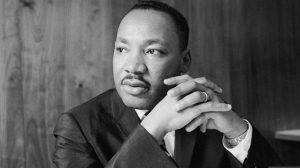
Before last November, on some level I believed in the fundamental vision of this country, that eventually, incrementally, everything would shake out fairly. I no longer hold that view. In the past two weeks, I have heard a white male conservative pundit and a white male country music singer speak on white privilege, phenomena I found heartening, though still small steps on the national reckoning we must undertake.
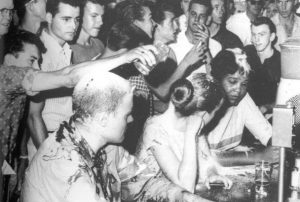
Ray shared that he had done a workshop with a movement teacher during which the participants had examined many documents from the Civil Rights Era. I thought of a historic photo of the lunch counter protests, of two activists seated at a lunch counter, totally surrounded by jeering white men, who were pouring food and drinks onto the heads of the protestors. These images are not symbolic. People were hurt and abused. Some went to prison. Some gave their lives.
In one of the photos Ray had examined with his teacher, there was a bearded white-seeming man who Ray had taken the time to research. It turns out that the man was Rabbi Abraham Heschel, a devoted Jewish Civil Rights activist. According to Ray, at one point, the Prime Minister of Israel asked Rabbi Heschel what he was doing, given the danger he was placing himself in. “I’m praying with my feet,” was his response, and he continued to walk resolutely forward.
Ray used this an example to demonstrate that racism is a human problem, not just a matter for people of color. Emotion rose through my throat, gasping upward in pockets of air.
The ebullience of the first wave gave way to subtle reverence, as Ray put on one of Dr. King’s famous speeches mixed with a dance track. Erratic gasps arose now and I made no effort to hide my tears. One woman who danced deep in her hips looked into my eyes, and it was not easy to return her gaze, as I felt raw and vulnerable. I continued to move through the room, but felt more private, energetically overlapping but psychologically contained, coping with the grief, fear, profound sadness, anxiety and anger that coursed up through me from the ground, a boiling geyser.
Ray also played a song with lyrics about how the measure of a country is how its women and girls are treated, then a closing song with a plaintive call to action.
Gabrielle Roth, the mother of 5Rhythms, believed that movement could heal us both individually and collectively. I think she would have approved of Rabbi Heschel’s explanation to the Israeli Prime Minister, “I’m praying with my feet.” As we enter this new year, there can be no question about the need for all of us to step up for justice and fairness, beginning first with what’s inside, but not stopping there. Let us all take a lesson from Ray and from Rabbi Heschel. Let us all pray with our feet!
*As you probably know, from the perspective of some Buddhist philosophy “essentialism” is the belief that there is a separate and definable “self” and too, implies that reality has some logical kind of coherence or definability.
This blog consists of my own subjective experiences on the 5Rhythms® dancing path, and is not sanctioned by any 5Rhythms® organization or teacher.
