by meghanleborious | Apr 13, 2020 | Notes on Practice
I had just broken up with the love of my life. The first time we embraced, our heartbeats had shifted to match each other, beating in sync. This was the first of many times that we broke up before it would eventually stick. I had built a whole identity around being part of this relationship, then it caved in instantly.
 I called my sister, heartbroken, consumed, wanting to talk and talk, to be reassured, to believe it would all be ok, to stay on the line so I wouldn’t have to face the painful feelings, groundlessness, and uncertainty on my own.
Thankfully, a few months before, I had started intentionally studying the workings of my own mind.
My sister seemed exasperated, and suddenly I realized that escaping myself in times of uncertainty was no longer a pattern I wanted to continue.
I hung up the phone and stayed out of contact for several days. I was at the cheapest motel in South Beach, Miami. I scream-cried for two days, slamming my face into the pillows, probably frightening the neighbors, and occasionally pausing to cross the street for the beach and float in the ocean, a tiny being, bereft in the great mother sea.
For the first time since I could remember, I let the full force of my emotions in. It was agony, but it was also beautiful. Somehow, I knew I could face it, though I wasn’t yet sure if there was any way to get through it alive.
Patterns. Strong Emotions. Uncertainty.
As the world grinds to a halt, time slows, and perspective shifts in favor of reflection, I’m forced to confront my patterns, the deeply rooted habits that have hummed along beneath the surface of me for years and years.
It hurts.
I’ve often made the resolution to participate in facebook more often, but have rarely kept it. In the last few weeks, as coronavirus has descended on the United States, I’ve been checking it a lot more, especially since I was in strict quarantine in Northern Connecticut with my ten-year-old son, Simon, for two weeks.
I’m a teacher, and when NYC Department of Education made a sudden pivot (from what now looks like a well-oiled machine) to remote learning to decrease the spread of the deadly coronavirus, I suddenly had to learn a whole new way of teaching for a group of teens who urgently need support and consistency at this time, a role that, sadly, despite my best efforts, I was unable to assume completely at that point.
At once, I was suddenly and without training in charge of Simon’s home schooling, which also meant learning a whole new set of skills and competencies.
I found that I was checking facebook at least once a day. I even started to feel sad that few friends had replied to one of my posts. “Can I get a little love?” I wrote, with a joking tone that was at once needy, stuck. In part, the solitude was getting to me. Also, something in me wanted the reassurance of knowing I was seen and approved of. As this habitual pattern arises, this need to seek reassurance in the face of uncertainty, I have the opportunity to work with it in a new way, to break the habits that keep me trapped in a small sense of self, and blind to my infinite power.
Instead, in the face of grave uncertainty, I think the best policy is to acknowledge and tolerate the discomfort that arises. Otherwise we engage the habitual patterns that we’ve ingrained to keep uncertainty at bay, and in the process re-enforce the small, limited box we’ve forced ourselves into.
That is to say, shit is painful right now. For a lot of us.
And we basically have two options. We can scramble and squirm and try to escape the pain and uncertainty of our situation, through mindless entertainment, overeating, overbusying, worrying, obsessing, complaining, and countless other activities. Or we can stop. We can pause. We can notice the uncertainty. We can feel it in the body as a sour stomach, a clenched jaw, raised shoulders, tightened belly, tensed hips, sweat, breath, heartbeat.
I’ve been practicing a lot, of necessity.
Sometimes it is mundane, a matter of course. Sometimes it is cosmic, earth-shattering.
It seems like truth-guarding layers are peeling themselves away now. I think that if I continue to be diligent, this could be a unique opportunity to open more fully to reality, and to expand my human capacity.
***
Yesterday, I opened the window to the backyard at my parents’ house, where Simon and I are staying, and pointed the speaker out the window so I could hear the music and dance on the soft earth at the same time.
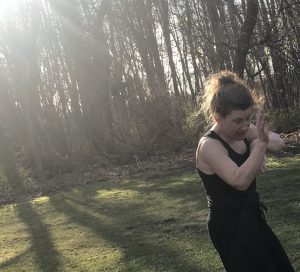 The yard is a mix of uneven dirt, new grass, and moss. I wasn’t sure if I would be inspired, but as soon as I stepped in to this unorthodox dancefloor, I was gathered into movement. In Flowing, I moved around and around, feeling the give of the dirt where underground moles have carved tunnels, the rise and fall of subtle inclines, the bumps and divets of the yard. I moved gently at first, trying to baby my knees, but as Staccato emerged, I lost my hesitation, moving with vigor and inspiration, at moments partnering with my own shadow in the late afternoon light.
In Chaos, I found a new way to shake–putting most of my weight on one foot and freeing the other side of the body, flapping the hip until the motion richocheted from my center to my edges and flung me into powerful motion.
Yesterday, I danced all day. I did yoga for a while, then danced part of a wave. I danced on zoom for a short time with a friend who, like many, is struggling with grief and rage. I went into the woods and danced a wave by a river that my grandfather loved, ending in Stillness with the currents of the river and the wind passing through me. At night, I danced as a participant in a zoom class that was facilitated by a senior 5Rhythms teacher.
Sad news kept rolling in, keeps rolling in.
I feel guilty for having afflictive emotions, when so many are facing the worst kinds of losses and I’ve been so lucky and so privileged. This is its own pattern, of course. The emotions knock at my front door regardless, and, though I squirm, I don’t go as far as barring them from entering.
One day this week, I felt left out, in a pervasive sense. I felt like no one was answering my emails or comments at work. And many of my friends outside of work seemed to be engaging seamlessly with each other, but I didn’t feel like I really knew how to be part of a digital group, how to participate in friendships this way. The isolation is getting to me. And recently I’ve noticed that I have some fear and resistance around group friendships.
Another pattern rearing up in the face of uncertainty.
In a moment of parent-child discord with Simon, I glanced over my shoulder out the window. A bluejay had landed on a small flowering tree in the yard. A white blob of birdshit escaped him and he moved on.
I turned my attention back to Simon as he resisted my efforts to get him into a creative activity, defaulting to a video game. I pushed harder, he resisted more. I pushed harder. He lashed out. I lashed back. He stormed off, then hid his face, waiting for me to find him, to apologize, to lure him back to good humor. I won’t say that I shortcircuited the pattern this time, but at least I saw it, this habit, yet another habit, that has emerged with extra force in the face of the current uncertainty.
 Today is my birthday. Still feeling left out, I (mostly) resisted the temptation to seek reassurance. Instead, I reached out to two friends and asked them to help me plan a zoom dance party and learn the sound tech needed to pull it off. They were incredibly generous, and a number of cherished friends joined. I felt loved and seen. Later, I hosted a family zoom dance party. Some had trouble with the technology, but many danced with good humor, including Simon. In this case, instead of asking to be reassured, I found a way to connect that would allow me to feel included. And I resolved to give more, even in group friendships, so I don’t set myself up to feel left out.
For weeks, I’ve more or less been thinking that if we just get through a certain period of time, there will be a point when things are ok again, are relatively safe, at least from the standpoint of germs. It’s only just now sinking in that there probably won’t be a clear moment, but rather it will be a jagged process that involves considerable risk. The president’s rhetoric concerns me immensely, and I’m afraid of another surge of cases if everyone is given a green light to continue business as usual. Even more uncertainty.
***
Today I reflected that practice itself can be a habit that interferes with practice.
Playing with Simon on a swing in the backyard, I noticed a tendency to think about what I would do after the swing session, ironically wishing to get back to practice. Then brought my attention to the texture of the swing, the movement of my body as I pushed Simon, Simon’s smile, the feeling of my voice vibrating in my throat, the soft ground, the wind rushing the just-budding branches.
I assigned an article on dealing with uncertainty to the high school students I teach. In it, the author argues that accepting the reality of uncertainty is essential for freeing our minds. She claims that when we are stuck on the impossible effort to establish certainty, our minds are fixed and rigid, but that “an uncertain mind is curious, interested, reflective and malleable.” (Headspace, 2015) From a practice perspective, I explained to them, uncertainty, though often painful, can also be seen as an advantage.
In practice, by staying present with what arises, we notice the patterns and habits that emerge when we are not present–our efforts to establish certainty. In 5Rhythms, we practice continually interrupting our patterns by moving in new ways: an in-the-moment laboratory for uncertainty studies.
If we can acknowledge and tolerate the discomfort that arises without grasping for certainty, we have a chance to disengage the habitual patterns that we’ve ingrained to keep uncertainty at bay. And to meet our lives in the process. Even in the face of chaotic emotions, even in the face of overwhelming fear, even in the face of devastating losses.
In the words of Pema Chödron,“It’s not impermanence per se, or even knowing we’re going to die, that is the cause of our suffering.. Rather, it’s our resistance to the fundamental uncertainty of our situation. Our discomfort arises from all of our efforts to put ground under our feet, to realize our dream of constant okayness..But when we can completely let go and not struggle against it, when we can embrace the groundlessness of our situation and relax into its dynamic quality, that’s called enlightenment..freedom from struggling against the fundamental ambiguity of being human.” Living Beautifully with Uncertainty and Change
April 11, 2020, Broad Brook, Connecticut
by meghanleborious | Apr 6, 2020 | Notes on Practice
I’m listening to a livestream piano concert now given by a teen named Donny, who is the nephew of a friend. She shared that he has blastoma and autism, and just lost his mother. As I join the stream, Donny opens with three of my lounge-singer-grandmother’s favorite songs: Smoke Gets in Your Eyes, Misty, and Unforgettable.
***
I’ve been crying intermittently all day.
After 14 days of strict quarantine, my ten-year-old son, Simon, and I were able to join the household of my parents, in their house in Northern Connecticut yesterday.
***
Now Donny is playing Somewhere Over the Rainbow. He’s not reading any sheet music, and he’s really good and really into it. He mentions playing something “just like mom used to play it” and a male voice off the screen says, “You played that song at her service.”
***
Yesterday, Simon was very excited, got up super early, and raced to my parents’ room to climb into their bed and hug them. We had planned a whole coming out party, with dance and singing.
But this morning, Simon and I struggled. He seemed resistant to everything and uncooperative. He didn’t want to sing, dance, or help his Nana make a giant chalk drawing in the street to express thanks to health care workers.
Simon’s father, who was officially my partner for eight years, and has been my not-husband and close friend for another ten, decided to stay in Brooklyn, rather than come to stay at an apartment nearby we were able to arrange for him.
***
Every time Donny finishes a song, the off-camera person (his father?) claps enthusiastically.
***
I took a break from parent-child volatility to dance the Sunday Sweat Your Prayers 5Rhythms dance class at 11AM, happy to connect with community. Before joining, I took an emotional call from a family member I’ve been worried about.
I started late because of the call and caught only the tail end of the rhythm of Flowing. Today I cried hard as soon as I started to move, especially during a song with lyrics about loss. Lately, I’ve been recording myself when dancing for my own interest; and on the video my feet seemed a little hesitant in this beginning part. In Staccato, I had no trouble finding expression and inspiration, but with so much yoga and dance lately, my knees are a little tender, and it’s like I was trying to avoid stomping, a tiny bit aversive. In Chaos, I moved quickly, coiling and shaking. In Lyrical, my hands seemed to take over, but my arms didn’t seem to be fully extending. Overall, I was kind of flat today, compared to my usual athleticism.
Near the end of the Sweat Your Prayers class, Simon’s came in and said, “Mom! Get. Me. Socks!” Another period of challenging exchanges was set off.
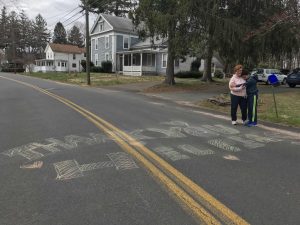 While I was dancing, my Mom created a giant chalk drawing across the street that says, “Thank you, helpers!” She tried to engage Simon, but he was resistant. Challenging because the reason she designed the project was specifically to engage Simon. A motorcyclist went out of his way to avoid damaging her cheerful drawing. Another passing driver beeped and waved, smiling.
Everyone in the house seemed to be having a hard time.
Now? When we’re faced with so much danger, so much uncertainty? How can we be anything but overjoyed to be together? Unceasingly loving and kind? I know connecting with the people we love is the top priority now, and felt dismayed that it wasn’t going well.
Eventually this wave of unrest managed to work its way through, and we agreed to sing a few karaoke songs together.
Singing is very emotional for me. My Dad loves to sing, and we’ve been singing together like this for my entire adult life. It’s easier for me to sing with him because I can follow him. On my own, it’s much harder to carry the tune. When we sing, I feel the mixed happiness of being together in joy, and pain of knowing how much this will hurt if there is a time I don’t have him any more. Also, my Dad is the most tender-hearted person I know, and it comes through in his singing voice.
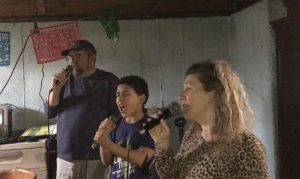 All four of us were smiling and dancing. Simon, though still young, is a trained musician with a strong, clear voice, and belts out a few of his favorite songs. I put on a hot pink tutu that I found near the karaoke studio in the basement. I was having a little trouble because sadness kept bubbling up; and it’s hard to control your voice when your heart wells up into your throat, but still sang with feeling. My Mom alternated between singing and dancing–at one point waltzing with Simon–and she took a video of Simon, my Dad, and me singing a melodramatic 80’s song.
My Dad had a heart attack two years ago, and was recently diagnosed with diabetes. My Mom and my Dad will both turn 70 this year. As we sing, I think again and again of how precious these moments are, and how grateful I am to have them.
***
Now my mom is sitting with me, watching and listening as Donny plays Ave Maria.
***
In Stillness of the 5Rhythms wave in the Sweat Your prayers class, I sink deeper inside myself, imaging that I’m channeling light, and sending it out one hand, around the entire world where it pours out white fire, then back into the other hand after a trip around the world. Soon, I imagine the entire world engulfed in purifying flame, flickering with spirit fire.
***
Donny ends with Danny Boy, a song my both my grandmother and my great grandmother loved, and we are in tears, sobbing along to the lyrics.
At the end of the concert, Donny walks toward the camera and takes a formal bow, then signs off.
***
I didn’t want surprises tomorrow morning right before I have to work, so I checked my work email right before posting this. I learned that another student I’m close with has lost a family member.
My heart breaks. So many people are suffering now, most especially those who are vulnerable because of poverty.
For now, there is nothing to do but practice, and pray, and try our best to love the people who are close to us as skillfully as we are able.
April 5, 2020, Broad Brook, CT
by meghanleborious | Mar 31, 2020 | Notes on Practice
 “Mommy, why do you cry so much?”
That’s the quote I remember most from this week.
I was trying so hard to step up for my students. I kept spending hours creating materials and assignments, then realizing I had done everything wrong and having to start over. I spent almost an entire day trying to figure out how to use google hangouts. I also created usernames and passwords for countless websites, trying to learn everything at once.
I felt an enormous amount of work pressure, and have been asking myself hard questions about if it’s being put on me, or if it’s pressure I’m actually putting on myself.
At the same time, I’m managing Simon’s learning, cringing with the fear that he will lose half a year of learning, and cringing more at all the video games he has been logging hours on, as a way to connect with his friends. And feeling the pain and sadness and grief of so much societal loss, and fearing personal loss, too.
Today is day 8 of 14 days of quarantine. It’s Saturday, and I slept until 9, instead of waking up at 6:15, as on weekdays. After breakfast, I did yoga practice for nearly two hours while Simon chatted online and played video games with friends.
Simon and I tried to do the online zoom version of the NYC Sweat Your Prayers 5Rhythms class, but by the time we logged on the class was already wrapping up. Instead, I put on a wave I’d played a few days before. Simon was half-hearted at first, feeling pulled by his video games and friend chats, but we started a dancing game of throwing a shirt at each other and trying to dodge it, and he managed to stay engaged throughout the wave.
Living 24-7 in quarantine in the apartment attached to my parents’ house that was created for my grandparents has been tender. I have always had hesitant excursions to this place, sitting to talk at length with my grandmother when she was frail and with limited mobility, crossing through to retrieve something from the refrigerator when the main house was full and we were cooking for a holiday. Most of life seemed to happen next door, at my parents’ though.
Now, as we are in quarantine, I have a whole new perspective. It is a beautifully designed four-room apartment that is easy to keep clean, and I am grateful for how it has held us. I feel close to my grandmother, my grandfather, and also to my brother, who lived here for a period. And though it hasn’t always been easy, I’ve been grateful for the time with my son, who will enter the teen years soon.
In terms of dream analysis, previously unused rooms now put to use represent finding new layers of consciousness, and new layers of potential.
The world is shifting.
We are in a parenthesis.
It is a period of chaos, fear, and reckoning. As painful as it is, especially for those grieving personal losses, it is also a time of great possibility. A time when we can remember what really matters, when we can collaborate on a new vision, one in which the earth is revered as sacred, where presence is valued above achievement, and where we can prioritize love and community as our greatest wealth.
March 28, Broad Brook, Connecticut
(Photo: dataisbeautiful on reddit)
by meghanleborious | Jul 15, 2018 | Notes on Practice
“Mommy I hear a glow on you,” my eight-year-old son, Simon, told me when I spoke with him for the first time after three days of silence. I had been in the woods, wondering at the complex root systems of the trees underneath the forest path I walked on, sitting at length in a meditation hall, eating in silence, and noting the intensity of a thick heat wave.
When I spoke with him, I was in the middle of a week-long retreat with 90 other educators who are entering an intensive, yearlong program for teaching Mindfulness to youth. The retreat center, Garrison Institute, was formerly a Franciscan monastery, but has been repurposed for use by groups of any and all spiritual traditions.
The meditation hall was once a cathedral, and still has inlaid wood floors, soaring, curved heights with a circular narrative of symbols in stained glass, and an overlooking balcony that may have once housed the pipes of a resonant organ. Half of the space was populated with meditation cushions and chairs, arranged in a semicircle facing the four teachers.
During the first morning of practice, the teachers provided considerable physical instructions and we did sitting and walking meditation throughout the morning. In stages, they described three fundamental “anchors,” or places to hold the attention, including breath, body sensations, and sound, suggesting finally that we pick one anchor to work with. I chose breath, and so returned my attention again and again to the physical feeling of breathing.
Before lunch, one of the teachers, Kaira Jewel Lingo, gave instructions for mindful eating. “Eating is a celebration,” she said in her remarkably gentle voice. I heard, We can consider all of the many people and conditions that had to come together in order for this meal to come to us. We can really take the time to notice all of the flavors and textures of each bite. We can chew until the food is really liquid before we swallow it.
Despite my increasing mindfulness, lunch seemed kind of bland. To remedy this, I shook a bottle of tobasco sauce vigorously over my plain brown rice. Within a few bites, my eyebrows raised in shock and my tongue and lips burned. I had also spooned on a considerable amount of chunky salt, and after the first wave of heat started to normalize, a salt crystal landed on the tip of my tongue. I raised my eyebrows still further, continuing a roller coaster of culinary sensation. I got up to investigate the label on the tobasco sauce, my lips still on fire. Surely this must be a special edition, habanero, extra spicy tobasco sauce? It couldn’t possibly be the same tobasco that I regularly douse my food with? I was surprised to learn that it was in fact regular, standard tobasco sauce, the exact same.
Setting out for a walk in the woods after lunch, I chose the only path that seemed available. After a short time, I chose to veer left from the path and crossed a bridge over railroad tracks. To my delight, this path emptied onto a big rock formation at the edge of the Hudson River. I felt slightly tired, but hoped I could dance a wave, moving through each of the 5Rhythms – Flowing, Staccato, Chaos, Lyrical and Stillness – in sequence, the fundamental ritual of my core practice. Instead, after moving with noise in my ears for a few moments, I clicked into a groove and entered directly into Stillness, moving gently with breath, expressing the different currents of the river and ribbons of energy as they reached me. It was as though someone had turned the sound off on the world. I moved closer to the edge of the water, descending to where waves created by passing boats touch the rock. A gentle Staccato found me, the rhythm that has had the most to teach me lately – the rhythm of form, expression, direction, and of making things in the world. I moved with my arms and hips to the flips and curves and edges and advances and retractions of the relationship between water and rock.
Back in the meditation hall in the afternoon, I felt slightly sick, constricted through the diaphragm, and hot at the level of the face. Lately I have recognized the need to be able to release energy when I am overfull, like a pressure valve. How to do this hasn’t been exactly clear, however. It seems that the energy of mindfulness has its own strong momentum. Once I’m in the stream of mindfulness, I can’t just say, “OK, I’m not going to be mindful anymore.” Then, I just start being mindful of trying not to be mindful. In this case, I stepped briefly out of the meditation hall, letting go of the attitude of concentration, and that seemed to regulate me.
Reflecting later, I considered this progress in my practice. I’ve been reluctant to back off of my edges in the past, occasionally resulting in depression and ill ease. After these few short moments of casual attitude in the foyer, I re-entered the hall and took my seat among my peers in a more relaxed state.
Another of the four teachers, Erin Woo, presented a talk that evening on the topic of authenticity, and the many limiting stories we tell ourselves that diminish authenticity. She included personal examples of a story that has impacted her own experience, the story of “not good enough.”
During the final walking period of the evening, the early July sky lit with sunset. I stood on an overlook, facing the Hudson river and a wide field. I gasped as the field and bordering woods shimmered, alive with fireflies. I was concerned about seeming like a show-off, and of hogging the space of the overlook, but I slipped into motion, tracking the fast appearing and disappearing lanterns of the little bugs, again in Still Staccato, spine released, and long, ranging gestures with sudden stops and dips, and with occasional twitters in the hands and fingers, expressing the tiny dots and pauses of light that danced in the field below.
Silence wrapped luxuriously around me. Part of the instructions for silence were to avoid even eye contact. I felt too meek with my eyes cast down, so I held my head up instead, occasionally meeting people’s gazes and lighting up slightly. In the past, I have inhabited silence with a hard line, entering so deeply into my own small space that I might even feel the need to defend it if someone spoke with me or made beseeching eye contact. In this case, although I was in silence and very much turning in to the experience of my own inner body, I was still part of the collective field, and remained energetically porous and connected to the people around me.
A moving bell at 6.45AM mingled with my dream state and woke me on the third day of the retreat, which happened to be the 4th of July. After a morning stretch, meditation period, and breakfast, I walked in the woods again. I felt enveloped by the tunnel of trees, and imagined the deep and complex root systems which allow the trees to communicate, even crossing under the very path on which I walked. This time, I cried at length, thinking about the current state of the country. I reflected especially on the fact that its current prosperity is due in large part to the labor and subjugation of enslaved peoples, and to the land taken without remorse from its original inhabitants. An extra painful history to consider at this time, especially as racism and xenophobia have increased exponentially.
The teachers offered a taste of many different practices, and during the afternoon session, another teacher, Robert Thomas, offered a practice that involves open awareness, letting go of a reference point or anchor and hanging out in open space. As we prepared to move out of the meditation hall to practice walking meditation, he suggested that we consider gazing upward toward sky.
I made my way to a hallway of tucked away classrooms, but finding them already occupied continued on to a covered walkway between two second-floor sections of the main building. Three people were already there, arms resting on the balustrade, gazing upward. After some moments, a low growling began to emerge from the darkening sky.
At the end of the walking period, I made my way back to the main hall and took my seat again as the sky continued to rumble. After longer than I expected, rain began to pelt the high ceiling, creating a loud hush. After some moments of meditation, the retreat manager announced that there was an emergency weather advisory, suggesting that some might wish to leave the big cathedral and move to the basement level. No one seemed inclined, but the teachers suggested a five-minute break in case people wanted to close windows or decline to practice in the main hall during the storm.
Along with several others, I made my way to the front steps, where the sweeping vista of the Hudson River was blurred by heavy rain. The heavy wooden doors were each held by one retreatant. Without hesitation, I stepped out into the rain, tipping my head back and letting rain pour over me, grateful after several days of grueling heat. Acknowledging the frequent lightning, I returned to the stone steps under cover, and sat in silence. A woman next to me ate an apple with decisive crunching bites. Two enthusiastic birds continued to sing in the bushes to the right of the doorway. Mist from the rain landed on my forearms and cheeks. Across the wide river, a cliff waterfall I hadn’t noticed before swelled to three times its size, crashing with white water.
A bell summoned us back to the meditation hall, but some of us lingered on the steps, breathing the storm in.
Returning to our seats, the storm continued to activate the big room. I found myself rapt, counting the spaces between the thunder and lightning, aware of the dynamic, dimensional space of the sky around the building and of its intersection with the inside. At one point, I felt terror approach from the left, from the direction of a simultaneous flash of lightning and crack of thunder. My vision got weird and I felt terrified: heat, sick, rising. For a moment I was afraid I might be having a stroke. The words of an Indian master to one of her students came to mind, “Don’t worry, if you can just stay with it, you will accumulate great merit.” The experience rushed through me, arising, peaking and concluding in less than a minute.
In the evening, after a patient, slowly-chewed, silent dinner and evening sit, Kaira Jewel gave a talk on how to cultivate mindstates that lead to happiness, and discourage mindstates that lead to suffering. She called these processes “The Art of Happiness” and “The Art of Suffering.”
Kaira Jewel began her talk with a reflection on “Interdependence Day” and the fact that there is no thing that is only America or American, but there are many phenomena that make up what we know as America. Some include the enslavement of human beings and the experience of being enslaved, and the genocide of the people who originally inhabited the land. Walking in the woods earlier, I felt strongly that July 4th needed to be formally addressed, and I was grateful for Kaira Jewel’s words.
After Kaira Jewel’s talk, we headed out of the meditation hall again for the final walking meditation period of the day.
Instead of staying on the overlook, this time I headed down the stone path straight into the heart of the firefly field. I hesitated briefly, afraid some part of me might want to show off.
Within moments, however, I was immersed, moving through a full 5Rhythms wave, the fundamental ritual of my core spiritual practice. I moved in Flowing, feeling and honoring my feet on the forgiving grass, then began to move in the direction of every firefly I perceived in the expansive field, exhaling forcefully, sinking low into the knees, using the pinky sides of my forearms like swords, rising and falling, building heat in the body, watching the edges of my vision for a new flicker, responding to three nearly simultaneous lanterns, then waiting with full lungs during a brief pause in flashing. The precision of Staccato attention built to the fever of Chaos, and I let my head go, the pricks of light in the air around me blurring as I spun, dipping and coiling inward and away from my own axis, and in and out of my own field. Breathing erratically and sweating heavily, I began to notice the individual fireflies around me, lifting up onto the toes and reaching toward a rising light with the fingertips, leaping and falling, beaming unreservedly, in an expression of pure delight.
Finally, sound fell away again, as I moved with one tiny bug at a time. Lightning bugs tend to hover and linger, so they make excellent dance partners. Still dusk, I could see and track an individual even when it was not lit, and I cupped my palm, letting it lead me, rising and opening my hands in a slowly turning gesture, delighting in its slow transition into illumination, bowing my head to its tiny expression of majesty, part of the unified whole and spectacularly unique at once.
Still pulsing with life, I sat with my peers for the final meditation period of the evening. Every time I half-lowered my eyes, I saw shimmering lights both inside and outside of me.
The next day passed in a river of sensations, challenges and joys. We moved out of silence and began to consciously build community through a variety of exercises and shifting constellations. Kaira Jewel led us in an optional movement session, introducing us to the practice of Interplay.
Another of our teachers, Alan Brown, offered a talk, making a compelling case for the importance of self-regulation, especially for teachers. “Attention is a form of love. Embodiment is a form of safety,” he said as he described how young people can regulate themselves and can learn to self-regulate through the adults they are in contact with. “Just being a self-regulated adult in the classroom, before we’ve even taught anything about Mindfulness, is already a powerful intervention.”
He opened his talk with an astonishing story about his own path, which includes a diagnosis with Tourette’s syndrome. “Mindfulness was literally a medical miracle for me,” he shared, as he summarized the insights of many years of practice. In his case, deep investigation and inquiry into the body, along with some strategic questions posed by his teachers at opportune moments, lead to a radical decrease in the symptoms of Tourette’s and enduring faith in the power of Mindfulness practices.
Following an afternoon of community building which included tears and howling laughter, Alan was also very, very funny, and the room roared with good humor. The teachers also shared several games we could use with students in our classrooms, including a competitive game that physically modeled the paths of neurotransmitters through a line of bodies, and a game that involved passing a full cup of water around a circle.
At one point, Kaira Jewel led us in a structured Lovingkindness practice within a smaller group we will work closely with throughout the entire year of the course. At its conclusion, we offered Lovingkindness to all beings everywhere, without exception. I saw a pulsing dome of energy high above us, into the sky and beyond, twisting light ribbons edging moving planes of energy: powerful, building, resonating. The woman to my right perfectly described my own vision, saying she could see it through me somehow. “We should consider teaming up in card games,” I joked.
The retreat formally ended with writing prompts and shared reflections in our small cohort groups, inspiring words from each of the four teachers, and a ritual of passing a string around the gigantic circle. At its conclusion, the teachers cut a tiny section for each of us, and we tied it around our wrists, a way to remember our experience and to recall our purpose as we re-enter the streams of our lives outside the container of the retreat.
During the days after we let go of silence and engaged in speaking, at least ten people commented on my dance with the fireflies. “Are you a Tai Chi master?” one generous woman asked. “Was that Brazilian fight dancing you were doing in the field?” asked another. I smiled and said with some effusion, “I was just dancing with the fireflies.” If pressed, I would describe the dance in more detail, and if pressed further, shared information about the 5Rhythms dance and movement meditation practice. Many said they thought it was great that I wasn’t afraid to let go, something that never crossed my mind, though I did hesitate because I feared that part of my intention was to show off.
What most said was something along the lines of “That was so beautiful! I just stood there watching you. Your joy was enormous! I love your energy. It made me feel so happy.” Some even said it inspired their own joy. I inevitably choked up, touched that the people in this new community were so unreservedly happy for my happiness. Had I given in to self doubt and kept myself contained, I would have missed an opportunity to experience joy, and in the process of suppression would also have missed a chance to share joy.
I’m not surprised that you “hear a glow” on me, my dear son. This week has lit me from the inside. The path, at least for the moment, rises to meet me, showing itself a little at a time, tiny increments of light, moving in a collective field.
This blog consists of my own subjective experiences on the 5Rhythms® dancing path, and is not sanctioned by any 5Rhythms® organization or teacher.
by meghanleborious | Jul 12, 2018 | Notes on Practice
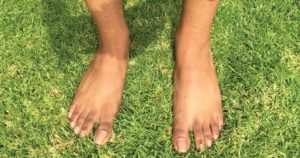
“Yeeaaah, definitely heel spurs. Both feet. See?” The doctor points at a section in the middle of my right foot on the x-ray that really should be shadowy black, but instead shows white, almost as dense as nearby bones.
As early as February, when I participated in the five-day heartbeat workshop “Anatomy of Emotions,” pain in my feet has been excruciating. They kept getting worse and worse, but I told myself I would only have to tolerate it until I finally manage to become enlightened, at which point pain would have much less influence on me. Just keep practicing, I told myself. If I practice with devotion, if I am relentless in interrogating the stories that limit me, and if I stay connected to raw, unfiltered presence, things will shift radically and this foot pain won’t be such a big deal. Some days, I winced through every step, but still managed to find freedom and inspiration. I even saw the pain as helpful, in that it brought me right into my feet and into the body.
After the “Elemental” workshop in April, my feet got still worse. It would have been difficult to spot, as I still swooped and soared, but I knew I had to seek help, not just hope that enlightenment would eventually free me. A friend suggested I visit an orthopedic doctor who specializes in working with extreme athletes.
After months of trying to get an appointment and waiting for it to arrive, I finally found myself in his office. He explained the x-ray, “When the muscles and fasciae of the foot are very tight, they pull on the heel bone, inside the arch. In response, the heel creates a little spur of bone for them to hang onto. It is essentially made up of calcium deposits.” He connected me with a physical therapist to would could teach me the MELT routine for working with painful feet, and proposed that if I could get the fasciae to relax, the pain from the heel spurs might decrease.
The doctor also noted that my feet, indeed my muscles generally, are very tight. “I know. Massage therapists always say that. I do stretch, though; and I do a lot of work to release tension from the body…” “Oh, yeah, that’s just how some people are. It’s genetic, to a large extent.” “Really? That’s super helpful. I’ve always secretly thought it was some sort of character flaw.” “No, that’s just how some people are built,” he re-iterated.
On the way into class about 10 days after starting the MELT routine, I saw Tammy Burstein, the teacher. “Tammy, I have heel spurs! I just wanted to let you know. That’s why I’ve been leaving early the last couple of weeks. I’m trying to get them to calm down a little.” She spoke as she moved across the threshold, “Work with the ground. There is a lot to learn there.” “Yeah, I know that’s right,” I said, still wondering if it might not be better to leave a little early.
After my appointment with the orthopedic doctor, I decided it would be wise to wear dance shoes to cushion my heels, at least for a little while. I love being barefoot; and this pained me. I also felt old. And I feared that the injury would be permanent, that for the rest of my career as a dancer I would be gimped with pain.
I arrived to Tammy Burstein’s Friday Night Waves class on time. My neck ached fiercely, perhaps from a few straight days of writing feverishly, working on several projects. Some seeds that I planted in years previous have come up and it is with great delight that I set about watering and tending the young plants.
I reflected that people who dance 5Rhythms regularly seem almost inevitably to find their path–their unique, fully realized contribution. It is remarkable, really. I thought I was on one path, of being an artist, pushing the boundaries of artmaking, sacrificing, expanding, challenging and risking. But life has revealed something entirely different. And, to my great surprise, this one is perfect, too!
A couple of weeks after the doctor’s appointment, I finally met with the MELT practitioner to learn the routine. She explained that MELT is a kind of massage you do for yourself, and that once I learned the foot routine and got a set of MELT balls I would be on my own. Alternating between four balls of varying hardness and size, I pressed, rolled and wiggled strategic parts of my feet. “This is really going to help me get to know my feet better,” I said as I rolled the largest, hard ball down each knuckle line of my right foot. “There is something about the feet, the ground. There is a humility to it,” I pontificated to my captive audience. “I haven’t always been so good at humility. To be honest, I’ve always preferred to soar.”
I thought about the experience of doing walking meditation, particularly when I am on a meditation retreat. Sometimes to keep my mind engaged, I shift my attention from toe to toe in sequence and then to different parts of the foot. Never had I so thoroughly articulated the different parts of the foot as I did on this day, however. “How do you feel?” She asked. “Do your feet seem a little flatter?”
After the MELT routine, she showed me some physical therapy exercises to help with general foot strength, including separating the toes and moving each one separately. It was like trying to bend a spoon with the power of my mind. As I bent over toward them and squinted my eyes in focus, the toes quivered with effort, then moved in unison. Only the big toe could really move independently. She assured me that I could develop the ability over time.
I spoke with my Dad by phone, and he reported that for the first time ever in his small, semi rural Connecticut town, a budget referendum had passed on the first try. In an aging, politically red town, it was for several education reforms and improvements. He explained, with an exclamation point in his previously discouraged voice, that a group of parents had banded together to demand change and it had worked. He and his allies on the Democratic Town Committee, a group that grooms and promotes socially conscious political candidates, wasted no time in meeting with the group, encouraging them to consider working together, and maybe to consider public office in the future.
Tammy’s Friday Night Waves class has been my Friday night appointment every week for the last ten years. On this night, nearly a quarter of participants were dancing the 5Rhythms for the first time. Tammy instructed us to partner, then said “change” again and again, re-configuring partnerships, perhaps in part to move some chatty newcomers away from their BFF’s and deeper into the dance.
Because of the heel pain, I felt sorry for myself for a good 5, maybe 10 minutes and even sobbed briefly, dejected by the side of the room, moving only slightly. Then it wasn’t so bad. I could still move. I still got a good groove and had all the energy I needed. I let go of the story I was telling myself about the pain and it didn’t bother me as much.
Curiously, I was reminded of a period when I had lower back pain. I loved to grind into the deepest edges of my back, to flip and coil, to roll and twist with vehemence. Eventually, I realized that I had to back away from the edges in my back, to deeply soften. In following years, I’ve learned to find precision and work with the same edges in a different way, and rarely experience pain. Similarly, I realized that I have to back out of the edges in my feet. A tiny, shrewd little pivot in the foot that catalyzes an epic, syncopated gesture throughout my entire body causes pain at the moment unless the heel is already fully released back and down.
Throughout the class I danced on my own and in partnership, with abundant energy and engagement. The fierce neck pain totally disappeared; and I made it all the way through class, even surprised to learn that time went slightly over. I moved with joy and ease, working with the ground periodically even during energetic experiments, jiggling and vibrating my hips with one partner, moving in blocked parts with a smiling, heavily muscled man, and moving in joyful, collective Chaos, creating my dance from the feet up, from the grass roots, from the foundation.
June 23, 2018, Brooklyn, NY
This blog consists of my own subjective experiences on the 5Rhythms® dancing path, and is not sanctioned by any 5Rhythms® organization or teacher.
