by meghanleborious | May 1, 2020 | Notes on Practice
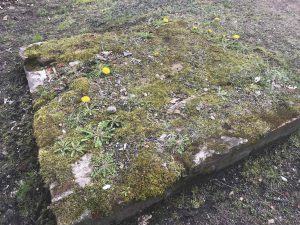 A lone duck appeared while I was meditating on the bank of the modest Scantic River. The duck was industriously chugging her little head back and forth like a small child on a big wheel, letting out a periodic call of “quack” as she floated by. I was touched by her efforts, smiling and internally cheering her on.
It’s been over five weeks since I left NYC along with my ten-year-old son, Simon, to join my parents in Northern Connecticut and try to wait out the pandemic.
In the beginning I practiced ferociously. Every day, every spare minute. Zoom 5Rhythms classes, individual waves, dancing on the grass in the backyard, dancing in the woods, dancing in the little practice space in my temporary home.
Every session started to blend together. My knee started to hurt. I started feeling generally left out and isolated. Simon started to act up, no doubt suffering from the loss of contact with people his age, and the pervasive sadness and uncertainty.
Yesterday, I decided to lighten up for a few days, and give myself a little distance from practice.
I juggled my afternoon options: should I go for a run? Meditate? Do yoga? Dance a wave? What did I most feel like doing?
Since the day was lovely and several not-lovely days were forecast, I settled on a run in the woods. I felt safe going hard on the soft trail, and lost myself in moving. I paused to take photos along the way, loving the visual narrative the images were revealing.
I came to my favorite spot, the convergence of a small river and a large stream, with a grassy point between the two. There, I decided to dance a wave. Easing into the rhythm of Flowing, I moved up and down a small hill, dipping and casting into low circles. 
At a workshop once, in Flowing, the teacher advised us to work with gravity as though we were dancing on a hill. Being on a hill, I played with rising and falling, and the shifts of gravity as I moved up and down it in hoops and arcs, to a soundtrack of babbling water splashing over a fallen tree.
Someone appeared in the woods on the opposite bank, and I tried not to meet his eye. Staccato crept up, then drifted back into Flowing. I moved back into Staccato, with punctuated exhalations, low-sunk gestures, and emphatic movement declarations. 
It took me a while to warm up to Chaos, but it eventually presented itself. I jumped and leapt, releasing my head and encouraging myself to go all out, despite the person across the river who might be watching, and who I was pointedly avoiding.
I practically skipped the rhythm of Lyrical, as suddenly the hum of the woods brought me straight to Stillness. I consciously called on Lyrical, though, and found several minutes of light, creative movement. It wasn’t until then that I noticed the person across the river had gone. It was possible I’d been alone for most of the time, so apparently I’d wasted my energy in purposefully ignoring him and psyching myself up to go all out even if he thought I was weird.
This place calls me to Stillness, and I was content as I finally settled into it. In Lyrical, I danced with everything that was moving. The small animals, the wind in the trees, the passing cars, the complex currents in the river. I even started to move with sound waves like bird calls, the rush of trees, and the sounds of the water. 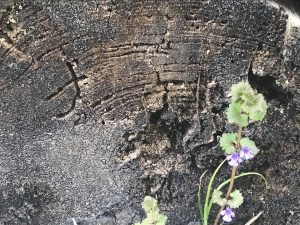
I remembered an experience at an underground dance party many years ago. Thousands of partyers were crowded into an old warehouse, and giant bass speakers shook the architecture. At this party, they also had complex light projections that twisted and morphed. I spent the entire night in rapture, dancing to the light show. As an artist, realizing that I could dance to visual cues, not just music, blew my mind.
Since then, I’ve learned that I can dance to anything, to everything. A passing train. A sequence of feelings. An announcement over a loudspeaker. The receding tide. One of my neighbors in Williamsburg, Brooklyn kept pigeons, and I used to dance with the swirling, diving flock as they raced around in response to his direction. Today, moving to everything in the woods reminded me of that first opening. 
Curiously, though I was in the woods alone, it started to feel hectic. I decided to let go of the hectic feeling, but to continue to move with everything around me, including wind; and the curves, intersections, and complexities of currents. Nothing changed but suddenly I was enveloped by silence.
Later, I spent time doing yoga, but I wasn’t trying to get a workout in, wasn’t trying to be as present as possible, wasn’t doing anything except following my inclinations and feeling the joy of having a body.
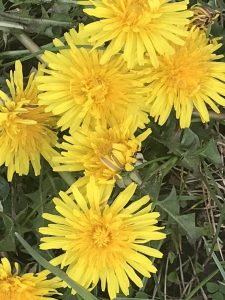 Today, after a full day of online work, I decided to join an afternoon 5Rhythms Zoom class.
I had to get Simon settled into an activity, so I joined the class a little bit late, then fell happily into the rhythm of Flowing. I’ve really been into grounding lately, much more than usual, and I exhaled as noisy energy poured down my legs into the ground. Today, I picked up a weighted meditation cushion, and started using it much like I used the hill yesterday, to experiment with gravity and momentum, at times dropping it around me in circles, passing it hand to hand. When I wasn’t holding the cushion, I let my arms be soft and fall around me as I moved in endless circles.
I discovered that the meditation cushion had a sewn-on handle as the music transitioned into the rhythm of Staccato, and I continued to play with weight and momentum, now pausing with the cushion on my side, on my back, at times letting it pull me through emphatic movements, my elbows sharp. I also experimented with holding the cushion in front of me, dropping it, then using its momentum to rush me straight across the small circle I was dancing inside of.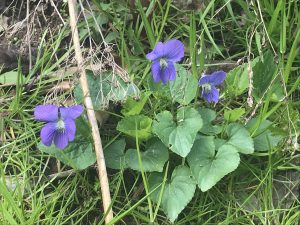
This, too, reminded me of my experiences in the underground dance world of the 1990’s. I was a fast and athletic dancer, and would imagine I had weight in my hands and feet to source power from the ground: to land, coil, and fling myself into all sorts of dramatic gestures. Once a group of people told me they had come from a neighboring state to see me dance this style at a local club’s jungle music night. It was a cool compliment, but by then I was trying to detox and withdrawing from club dancing. Shortly after, I withdrew from dance altogether for several years.
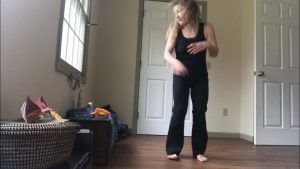
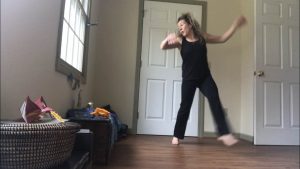
In the practice video I made for my own curiosity, I seemed very committed in this part, though I remember that thoughts of work were occasionally distracting me. I paused to give an instruction to Simon. Watching it I acknowledge the reality that it’s rare for me to be able to take a full break from parenting to practice, especially since we’ve been staying at home and I am now his parent, teacher, and playmate all-in-one. 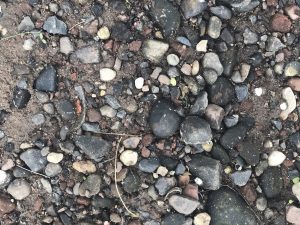
I thought I was flat in Chaos, but watching is fascinating today. My head rolls me around on my shoulders, hips released after a long yoga stretch session before dancing, sending movement through the spine and into this lolling head. I pause again to say something to Simon, then drop my head again, and bounce back and forth, then fall into side twisting and spinning.
At the outset, Lyrical was elusive again today. But I started spinning my hips around, almost like rolling a hula hoop and followed it into motion around one leg and then the other, and soon into pauses and full extensions. 
My hands look like two beautiful racing creatures in Stillness, then I shift into simply stretching. I paused again to say something to Simon, then in one final shape before clicking “leave meeting.”
I was hoping some revelation would come through before finalizing this text, but sometimes it isn’t so obvious. Sometimes the revelations aren’t epic or picturesque, but come in tiny increments, in daily practice, in patient engagement.
Good thing I took a break from practice. It helped me to feel more responsive and curious, though truthfully, I don’t think I actually “practiced” any less.
April 29, 2020
by meghanleborious | Apr 18, 2020 | Notes on Practice
 For the last two nights, I’ve slept on my back. This despite being a side-sleeper for pretty much my whole life. I have a certain way of tucking the pillow into the side of my neck, settling in, and nestling my back up to a pillow or another body. But my shoulders suffer, and the asymmetry sets me up for all kinds of misalignments. I’ve tried re-training myself many times, but I let myself go back to what’s comfortable when sleep has eluded me. This time, I think I’m on track to finally interrupt this persistent habit.
Yesterday, I logged into a zoom class that a friend led. I love his facilitation style, but I just couldn’t get into it this time. I was already feeling shut-down and discouraged, possibly because of many coronavirus deaths in my work community. Then, during the afternoon something I said contributed to disequilibrium in a whatsapp group. I apologized, but it was too late. I wasn’t wrong, exactly, but it really wasn’t my business. I wished I had stayed quiet or been more supportive. Even my ten-year-old son, Simon, felt I was in the wrong.
For a minute, I started to make a case against the person, but that fell apart pretty quickly. Then I started to make a case against myself. How I’m a bad person, how no one really likes me anyway. I started to visit past experiences, focusing on my many regrets. And I thought about all the recent emails I’ve sent that haven’t been answered, seeing it as a sign that I’m not really included or approved of, totally disregarding the fact that many people are grieving, or intolerably stressed, or have their hands overfull and answering their emails isn’t a top priority.
I really wanted to quit the group. They probably don’t want me anyway, I reasoned. But I made a recent resolution to be more present and available in group friendships–something I have struggled with–and I decided to stick it out for awhile.
In Flowing, I rolled and stretched on the floor, keeping as much of me touching the ground as possible as I curled and flipped over, at times rolling over the back of my skull or laying flat, arms and legs outstretched, on my belly or back. On my feet, I let my arms gently follow and rub against the rest of me. I let my weight down into one foot at a time, seeing if I could connect with the center of the earth. During all of this, I was also thinking about feeling left out at work, and how to approach some of my tasks. These kinds of thought processes continued into Staccato, though I could see the pattern my mind was insisting on. In Chaos, I was more energetic, but still felt lackluster in terms of engagement. Lyrical found me briefly disengaged from persistent thinking, but still uninspired. I disconnected from the session as we moved into Stillness, and made a video for the students I teach.
The video was about how our habitual fear stories can build up and cause us to feel overwhelmed, and how it is important that we learn to cut through our thoughts by coming back to the present when we start to make a case against ourselves.
In the evening, I avoided the temptation to drink wine to have a break from the difficult feelings I was experiencing. Instead, I wrote, then meditated at length, wrapped in a blanket in a dark room, lit only by one candle from my altar. I watched related thoughts arise and fall away, still making a case against myself, still feeling shut down, but gaining a little distance, and was able to sleep peacefully.
Today, things felt a little easier.
Again, I was drawn into exchanges with the same whatsapp group, but I didn’t feel disliked or disincluded. In fact, I found the people who contributed very supportive and receptive. I shared that I had been tempted to quit the group, but decided to ride it out. In the past, I’ve been inclined to shut down quickly in group relationships, but this time I wanted to try something different. I’m curious to see where it will lead, and excited about another strong community to learn from and grow with.
My biggest block in practice yesterday was in Staccato, but today I felt more connected as I joined a group of close friends on a zoom dance.
The livestream class was very clear and direct, with the teacher naming each form of each rhythm as it arose. In Flowing, I spent some time creating a perfect white circle around my home dance floor, and casting a circle spell. Then, I lost myself in weighted spins, following my intuition even if it didn’t look like typical flowing movements. The teacher offered a challenge that engaged me and I reflected that good teaching is a process of refining attention by offering hooks and challenges for students to engage with, and eventually supporting them to create refinements and challenges for themselves.
 In Staccato, I found edges and definition, sinking low in a howling yoga-goddess-pose again and again. In Chaos, spin was my thread, and I followed coiling, moving like a matrix, and flapping my head wildly as the expression of the spine in perpetual motion. In Lyrical I noticed that different dancers were highlighted on the zoom screen, and I moved in partnership with that specific dancer, assuming they, too, were seeing me. In Stillness I moved into vast space, noting the movements of clouds, the many birds I could see from the window, and wondering about arcane languages.
After Stillness drew to a close, we came together in conversation. My newly-created zoom pattern is that I bail as soon as the music stops. Often Simon is drawing me, but it might also be that I’m uncomfortable in this kind of group friendship. Today I enjoyed the conversation, contributing and listening patiently.
Why might it be helpful to interrupt our persistent habits? In general, defaulting to our rehearsed patterns (and the mind-stories that support how we currently see ourselves) functions to keep up trapped in our small sense of self, and our painful, futile efforts to sustain our fragile ego. At this time, our patterns are rocked, and we have the choice to either dig in and insist on them, or to see them in the clear light of day and change our way of relating to them.
If there is any value to be gathered from this time–though any consideration of value in the face of such devastation is surely an expression of privilege–it is that it is an opportunity to confront and interrupt our habits, certainly on an individual level, and I hope, I pray, I intend, on a societal level, that we may establish new habits, new ways to share resources, and new ways to value our myriad contributions.
April 16, 2020, Broad Brook, Connecticut
by meghanleborious | Apr 13, 2020 | Notes on Practice
I had just broken up with the love of my life. The first time we embraced, our heartbeats had shifted to match each other, beating in sync. This was the first of many times that we broke up before it would eventually stick. I had built a whole identity around being part of this relationship, then it caved in instantly.
 I called my sister, heartbroken, consumed, wanting to talk and talk, to be reassured, to believe it would all be ok, to stay on the line so I wouldn’t have to face the painful feelings, groundlessness, and uncertainty on my own.
Thankfully, a few months before, I had started intentionally studying the workings of my own mind.
My sister seemed exasperated, and suddenly I realized that escaping myself in times of uncertainty was no longer a pattern I wanted to continue.
I hung up the phone and stayed out of contact for several days. I was at the cheapest motel in South Beach, Miami. I scream-cried for two days, slamming my face into the pillows, probably frightening the neighbors, and occasionally pausing to cross the street for the beach and float in the ocean, a tiny being, bereft in the great mother sea.
For the first time since I could remember, I let the full force of my emotions in. It was agony, but it was also beautiful. Somehow, I knew I could face it, though I wasn’t yet sure if there was any way to get through it alive.
Patterns. Strong Emotions. Uncertainty.
As the world grinds to a halt, time slows, and perspective shifts in favor of reflection, I’m forced to confront my patterns, the deeply rooted habits that have hummed along beneath the surface of me for years and years.
It hurts.
I’ve often made the resolution to participate in facebook more often, but have rarely kept it. In the last few weeks, as coronavirus has descended on the United States, I’ve been checking it a lot more, especially since I was in strict quarantine in Northern Connecticut with my ten-year-old son, Simon, for two weeks.
I’m a teacher, and when NYC Department of Education made a sudden pivot (from what now looks like a well-oiled machine) to remote learning to decrease the spread of the deadly coronavirus, I suddenly had to learn a whole new way of teaching for a group of teens who urgently need support and consistency at this time, a role that, sadly, despite my best efforts, I was unable to assume completely at that point.
At once, I was suddenly and without training in charge of Simon’s home schooling, which also meant learning a whole new set of skills and competencies.
I found that I was checking facebook at least once a day. I even started to feel sad that few friends had replied to one of my posts. “Can I get a little love?” I wrote, with a joking tone that was at once needy, stuck. In part, the solitude was getting to me. Also, something in me wanted the reassurance of knowing I was seen and approved of. As this habitual pattern arises, this need to seek reassurance in the face of uncertainty, I have the opportunity to work with it in a new way, to break the habits that keep me trapped in a small sense of self, and blind to my infinite power.
Instead, in the face of grave uncertainty, I think the best policy is to acknowledge and tolerate the discomfort that arises. Otherwise we engage the habitual patterns that we’ve ingrained to keep uncertainty at bay, and in the process re-enforce the small, limited box we’ve forced ourselves into.
That is to say, shit is painful right now. For a lot of us.
And we basically have two options. We can scramble and squirm and try to escape the pain and uncertainty of our situation, through mindless entertainment, overeating, overbusying, worrying, obsessing, complaining, and countless other activities. Or we can stop. We can pause. We can notice the uncertainty. We can feel it in the body as a sour stomach, a clenched jaw, raised shoulders, tightened belly, tensed hips, sweat, breath, heartbeat.
I’ve been practicing a lot, of necessity.
Sometimes it is mundane, a matter of course. Sometimes it is cosmic, earth-shattering.
It seems like truth-guarding layers are peeling themselves away now. I think that if I continue to be diligent, this could be a unique opportunity to open more fully to reality, and to expand my human capacity.
***
Yesterday, I opened the window to the backyard at my parents’ house, where Simon and I are staying, and pointed the speaker out the window so I could hear the music and dance on the soft earth at the same time.
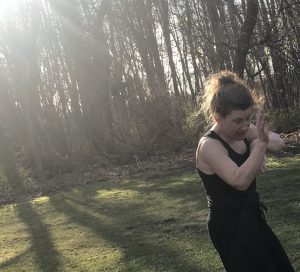 The yard is a mix of uneven dirt, new grass, and moss. I wasn’t sure if I would be inspired, but as soon as I stepped in to this unorthodox dancefloor, I was gathered into movement. In Flowing, I moved around and around, feeling the give of the dirt where underground moles have carved tunnels, the rise and fall of subtle inclines, the bumps and divets of the yard. I moved gently at first, trying to baby my knees, but as Staccato emerged, I lost my hesitation, moving with vigor and inspiration, at moments partnering with my own shadow in the late afternoon light.
In Chaos, I found a new way to shake–putting most of my weight on one foot and freeing the other side of the body, flapping the hip until the motion richocheted from my center to my edges and flung me into powerful motion.
Yesterday, I danced all day. I did yoga for a while, then danced part of a wave. I danced on zoom for a short time with a friend who, like many, is struggling with grief and rage. I went into the woods and danced a wave by a river that my grandfather loved, ending in Stillness with the currents of the river and the wind passing through me. At night, I danced as a participant in a zoom class that was facilitated by a senior 5Rhythms teacher.
Sad news kept rolling in, keeps rolling in.
I feel guilty for having afflictive emotions, when so many are facing the worst kinds of losses and I’ve been so lucky and so privileged. This is its own pattern, of course. The emotions knock at my front door regardless, and, though I squirm, I don’t go as far as barring them from entering.
One day this week, I felt left out, in a pervasive sense. I felt like no one was answering my emails or comments at work. And many of my friends outside of work seemed to be engaging seamlessly with each other, but I didn’t feel like I really knew how to be part of a digital group, how to participate in friendships this way. The isolation is getting to me. And recently I’ve noticed that I have some fear and resistance around group friendships.
Another pattern rearing up in the face of uncertainty.
In a moment of parent-child discord with Simon, I glanced over my shoulder out the window. A bluejay had landed on a small flowering tree in the yard. A white blob of birdshit escaped him and he moved on.
I turned my attention back to Simon as he resisted my efforts to get him into a creative activity, defaulting to a video game. I pushed harder, he resisted more. I pushed harder. He lashed out. I lashed back. He stormed off, then hid his face, waiting for me to find him, to apologize, to lure him back to good humor. I won’t say that I shortcircuited the pattern this time, but at least I saw it, this habit, yet another habit, that has emerged with extra force in the face of the current uncertainty.
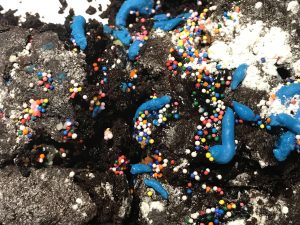 Today is my birthday. Still feeling left out, I (mostly) resisted the temptation to seek reassurance. Instead, I reached out to two friends and asked them to help me plan a zoom dance party and learn the sound tech needed to pull it off. They were incredibly generous, and a number of cherished friends joined. I felt loved and seen. Later, I hosted a family zoom dance party. Some had trouble with the technology, but many danced with good humor, including Simon. In this case, instead of asking to be reassured, I found a way to connect that would allow me to feel included. And I resolved to give more, even in group friendships, so I don’t set myself up to feel left out.
For weeks, I’ve more or less been thinking that if we just get through a certain period of time, there will be a point when things are ok again, are relatively safe, at least from the standpoint of germs. It’s only just now sinking in that there probably won’t be a clear moment, but rather it will be a jagged process that involves considerable risk. The president’s rhetoric concerns me immensely, and I’m afraid of another surge of cases if everyone is given a green light to continue business as usual. Even more uncertainty.
***
Today I reflected that practice itself can be a habit that interferes with practice.
Playing with Simon on a swing in the backyard, I noticed a tendency to think about what I would do after the swing session, ironically wishing to get back to practice. Then brought my attention to the texture of the swing, the movement of my body as I pushed Simon, Simon’s smile, the feeling of my voice vibrating in my throat, the soft ground, the wind rushing the just-budding branches.
I assigned an article on dealing with uncertainty to the high school students I teach. In it, the author argues that accepting the reality of uncertainty is essential for freeing our minds. She claims that when we are stuck on the impossible effort to establish certainty, our minds are fixed and rigid, but that “an uncertain mind is curious, interested, reflective and malleable.” (Headspace, 2015) From a practice perspective, I explained to them, uncertainty, though often painful, can also be seen as an advantage.
In practice, by staying present with what arises, we notice the patterns and habits that emerge when we are not present–our efforts to establish certainty. In 5Rhythms, we practice continually interrupting our patterns by moving in new ways: an in-the-moment laboratory for uncertainty studies.
If we can acknowledge and tolerate the discomfort that arises without grasping for certainty, we have a chance to disengage the habitual patterns that we’ve ingrained to keep uncertainty at bay. And to meet our lives in the process. Even in the face of chaotic emotions, even in the face of overwhelming fear, even in the face of devastating losses.
In the words of Pema Chödron,“It’s not impermanence per se, or even knowing we’re going to die, that is the cause of our suffering.. Rather, it’s our resistance to the fundamental uncertainty of our situation. Our discomfort arises from all of our efforts to put ground under our feet, to realize our dream of constant okayness..But when we can completely let go and not struggle against it, when we can embrace the groundlessness of our situation and relax into its dynamic quality, that’s called enlightenment..freedom from struggling against the fundamental ambiguity of being human.” Living Beautifully with Uncertainty and Change
April 11, 2020, Broad Brook, Connecticut
by meghanleborious | Apr 6, 2020 | Notes on Practice
I’m listening to a livestream piano concert now given by a teen named Donny, who is the nephew of a friend. She shared that he has blastoma and autism, and just lost his mother. As I join the stream, Donny opens with three of my lounge-singer-grandmother’s favorite songs: Smoke Gets in Your Eyes, Misty, and Unforgettable.
***
I’ve been crying intermittently all day.
After 14 days of strict quarantine, my ten-year-old son, Simon, and I were able to join the household of my parents, in their house in Northern Connecticut yesterday.
***
Now Donny is playing Somewhere Over the Rainbow. He’s not reading any sheet music, and he’s really good and really into it. He mentions playing something “just like mom used to play it” and a male voice off the screen says, “You played that song at her service.”
***
Yesterday, Simon was very excited, got up super early, and raced to my parents’ room to climb into their bed and hug them. We had planned a whole coming out party, with dance and singing.
But this morning, Simon and I struggled. He seemed resistant to everything and uncooperative. He didn’t want to sing, dance, or help his Nana make a giant chalk drawing in the street to express thanks to health care workers.
Simon’s father, who was officially my partner for eight years, and has been my not-husband and close friend for another ten, decided to stay in Brooklyn, rather than come to stay at an apartment nearby we were able to arrange for him.
***
Every time Donny finishes a song, the off-camera person (his father?) claps enthusiastically.
***
I took a break from parent-child volatility to dance the Sunday Sweat Your Prayers 5Rhythms dance class at 11AM, happy to connect with community. Before joining, I took an emotional call from a family member I’ve been worried about.
I started late because of the call and caught only the tail end of the rhythm of Flowing. Today I cried hard as soon as I started to move, especially during a song with lyrics about loss. Lately, I’ve been recording myself when dancing for my own interest; and on the video my feet seemed a little hesitant in this beginning part. In Staccato, I had no trouble finding expression and inspiration, but with so much yoga and dance lately, my knees are a little tender, and it’s like I was trying to avoid stomping, a tiny bit aversive. In Chaos, I moved quickly, coiling and shaking. In Lyrical, my hands seemed to take over, but my arms didn’t seem to be fully extending. Overall, I was kind of flat today, compared to my usual athleticism.
Near the end of the Sweat Your Prayers class, Simon’s came in and said, “Mom! Get. Me. Socks!” Another period of challenging exchanges was set off.
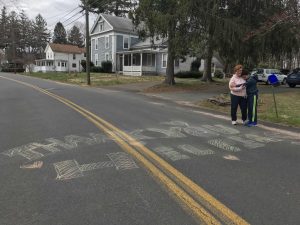 While I was dancing, my Mom created a giant chalk drawing across the street that says, “Thank you, helpers!” She tried to engage Simon, but he was resistant. Challenging because the reason she designed the project was specifically to engage Simon. A motorcyclist went out of his way to avoid damaging her cheerful drawing. Another passing driver beeped and waved, smiling.
Everyone in the house seemed to be having a hard time.
Now? When we’re faced with so much danger, so much uncertainty? How can we be anything but overjoyed to be together? Unceasingly loving and kind? I know connecting with the people we love is the top priority now, and felt dismayed that it wasn’t going well.
Eventually this wave of unrest managed to work its way through, and we agreed to sing a few karaoke songs together.
Singing is very emotional for me. My Dad loves to sing, and we’ve been singing together like this for my entire adult life. It’s easier for me to sing with him because I can follow him. On my own, it’s much harder to carry the tune. When we sing, I feel the mixed happiness of being together in joy, and pain of knowing how much this will hurt if there is a time I don’t have him any more. Also, my Dad is the most tender-hearted person I know, and it comes through in his singing voice.
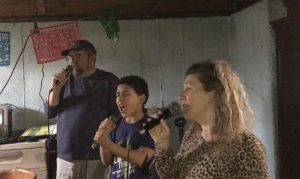 All four of us were smiling and dancing. Simon, though still young, is a trained musician with a strong, clear voice, and belts out a few of his favorite songs. I put on a hot pink tutu that I found near the karaoke studio in the basement. I was having a little trouble because sadness kept bubbling up; and it’s hard to control your voice when your heart wells up into your throat, but still sang with feeling. My Mom alternated between singing and dancing–at one point waltzing with Simon–and she took a video of Simon, my Dad, and me singing a melodramatic 80’s song.
My Dad had a heart attack two years ago, and was recently diagnosed with diabetes. My Mom and my Dad will both turn 70 this year. As we sing, I think again and again of how precious these moments are, and how grateful I am to have them.
***
Now my mom is sitting with me, watching and listening as Donny plays Ave Maria.
***
In Stillness of the 5Rhythms wave in the Sweat Your prayers class, I sink deeper inside myself, imaging that I’m channeling light, and sending it out one hand, around the entire world where it pours out white fire, then back into the other hand after a trip around the world. Soon, I imagine the entire world engulfed in purifying flame, flickering with spirit fire.
***
Donny ends with Danny Boy, a song my both my grandmother and my great grandmother loved, and we are in tears, sobbing along to the lyrics.
At the end of the concert, Donny walks toward the camera and takes a formal bow, then signs off.
***
I didn’t want surprises tomorrow morning right before I have to work, so I checked my work email right before posting this. I learned that another student I’m close with has lost a family member.
My heart breaks. So many people are suffering now, most especially those who are vulnerable because of poverty.
For now, there is nothing to do but practice, and pray, and try our best to love the people who are close to us as skillfully as we are able.
April 5, 2020, Broad Brook, CT
by meghanleborious | Apr 1, 2020 | Notes on Practice
 Things I wrote even two or three days ago seem so dated now. The pandemic is intensifying in this region.
I’m in the eleventh day of a 14-day quarantine in an apartment attached to my parents’ house, along with my ten-year-old son, Simon. We are in quarantine because we just came from Brooklyn, NYC, the epicenter of the United States coronavirus plague, and I’m afraid to expose my parents.
Fear, sadness, and anxiety come in waves.
My work is to teach meditation to teens in a Brooklyn High School, and in a matter of days, like many other teachers, I had to make the pivot to online teaching. I’ve been working tirelessly to engage my students, but at this point less than half are actively participating in the online class. So I sent an email to their parents to let them know their students’ status. One parent responded that she is working 12 hour shifts and it is hard to keep up with her child’s assignments.
I realized how insensitive my email was, given the circumstances.
Some of the parents of my students are low wage health care workers. Many are working long shifts caring for people infected with coronavirus, seeing up close how horrific the disease can be. They are risking their lives, day after day after day. Some are doing it because of altruism and a deep calling to serve. Some are doing it because they absolutely have to work, and do not have the resources to take any time off. Many are single parents.
This is a slap in the face about the real impact of bias in our society, and one of the infinite ways coronavirus is disproportionately impacting communities of color. I thought about the privilege of being able to withdraw from NYC, and the fact that there are many people who don’t have the same option.
And I’m seriously bugging parents about their kids doing their classwork. Really?
Some of my students have a parent or grandparent who already has the virus.
There is now an emergency tent hospital in the middle of central park. A US Navy hospital ship arrived Monday to help exhausted health care workers as they toil, often lacking even basic protective supplies.
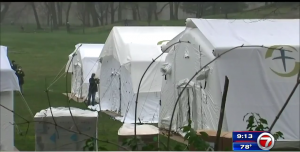 In answer to a writing prompt, “What is one thing you wonder?” One student wrote, “I wonder if it’s even safe to go outside and get a breath of fresh air.”
Every day, I start with a period of meditation, before the sun is even up. I transported my entire altar box and all of its contents to our new location, and re-created the exact altar that I had in Brooklyn right before we left. I also brought many of my cherished books, and arranged them beautifully near the altar.
Lately, my morning meditation feels more like prayer than meditation, as I focus energy and attention on wishing health and safety for everyone I love and for all beings, mixed with other meditation practices and contemplations.
I have to clock in to work at 8:15 but most days I start long before, after taking a shower, trying my best to get Simon oriented to his schoolwork, and having breakfast.
I make sure we get outside at lunchtime, and again after my workday ends at 2:50. We play on the swing in the yard and laugh. Sometimes I can even convince Simon to play soccer or take a bike ride with me.
Yesterday, I heard my mom crying through the wall, and learned that the son of one of her friends is in hospice.
Today, she told me that my cherished great aunt is not doing well, either. Her 100th birthday is this spring, but since she has been isolated and has no visitors, and therefore nothing to anchor her to this world, she has been dissolving into spirit. She lives next door to my parents’ house, in the same house that she and my paternal grandfather grew up in with their parents, my great grandparents.
I wanted to run next door to support her in her transition. I rushed out in the direction of the house, without even a coat, and just stood there, crossing my arms to hold my sides, knowing that I couldn’t go in. That I wouldn’t have a chance even to say good-bye.
I was crying, of course. And Simon wanted to know why I was crying. I told him and he started crying, too. We went for a walk, talking about what happens after you die and sharing jokes. I brought up Gabrielle Roth, the mother of the 5Rhythms practice, and told him I didn’t think dying was so bad for her. He said, “Yeah, but she was this crazy witch dancer…” I didn’t respond but had to smile, at least for a moment.
I don’t know what I would do if it weren’t for practice. Most days I do yoga, which helps me to feel grounded and flexible.
I also dance the 5Rhythms for at least one wave a day. And I’ve been recording myself, which is a new habit. I can’t even keep the videos because they take up too much space, but it is interesting to watch myself when I play it back in the evening.
Today, Flowing did not come easily. It was hard to settle down, and I noticed that I wanted to move into Staccato quickly. Maybe there was just too much to let in today.
I can hear Simon talking with his friends on video chat throughout the video as I play it back…One source of private guilt is that pretty much all of the time that I’m in formal practice, he’s on a screen chatting with friends or playing Roblox with them. He blows through his schoolwork in under two hours most days.
At the start of the video, I squat in front of the altar and dedicate my practice to my ailing great aunt, Mae Grigely, and acknowledge the power of practicing for someone else.
Staccato never fully ignites today, either.
In Chaos I come alive though, with speed, resistance, release, and wild surrender, spinning and letting momentum fling me to all kinds of edges. The gap when the beat drops out seems to be when I get the most creative.
The Chaos Lyrical song I chose is 165 beats per minute, and I twitter wildly, racing to express the layered, exploding sounds. I pause briefly and leave the room to address one of Simon’s questions, then resume this ultra fast dance, responding more and more to the melody and less to the wild rhythm and rising upward as the track evolves.
In the second Lyrical track I am transported, moving with soaring undulations, the afternoon sun in one vertical rectangle catching different parts of my body as I move.
In Lyrical Stillness I cry throughout the track, singing part of the lyric in jagged gasps. I cry again watching myself. I look so alive and so sad. My heart was broken in this part, is broken.
“Ewwwwww!” Simon screams from the other room, for some unknown reason.
I whisper-sob through the last song, sensing my grandfather, who once lived in the very room that I am dancing in. He loved the ocean, and would make the Christian sign of the cross as he waded into the sea. He would fold his hands behind his head, cross his ankles, and float on the bobbing waves for long periods with his face to the clouds. He was a man of few words, but I always thought this was a kind of prayer for him.
I end in a squat in front of the altar, as I had started, dedicating the merit of my practice to my aunt and to all beings everywhere.
Today, this period seems more like a time of survival than of possibility. One of my meditation teachers led an online practice and talk tonight, and he reminded us to do what we can to stay connected to our humanity. My practices encourage me to open to the reality I’m immersed in, knowing that every moment is a chance to deepen in my ability to be present, even when it is uncomfortable, stressful, painful, or sheer agony.
In the words of Pema Chӧdrӧn in Living Beautifully with Uncertainty and Change, “If you can stay present in even the most challenging circumstances, the intensity of the situation will transform you. When you can see even the worst of hells as a place where you can awaken, your world will change dramatically.”
May it be so. Blessed be.
March 31, 2020, Broad Brook, CT
(Photo1: military.com, photo2: News7)
