by meghanleborious | Sep 22, 2016 | Notes on Practice
“Ouch!” one teenager cried out as another slammed her into the hallway wall, smiling not kindly, her arm shooting straight out from her shoulder as she passed, not even looking as she struck. The teen who got slammed walked not ten paces, then slammed another girl into the wall as she passed, using the same gesture she had been slammed with. Aggression seemed to be ricocheting around in rip currents.
On September 11, Daniela Peltekova taught the Sunday Sweat Your Prayers 5Rhythms class at the Joffrey Ballet in the West Village. Loving the extra space of Sunday’s class, I stretched out on the ground, rising and falling in the shape of a moving starfish. Daniela lead us through a very fast wave at the beginning of the class, wasting no time. Traveling around the room, I noted a little tourist tchotchke of the World Trade Center—part of the visuals for the class that a member of the crew had created—and remembered with remarkably little emotional charge that it was September 11th.
The music faded and Daniela began to speak, stepping into the middle of the room with all of us surrounding her, still standing. She expressed that the events of September 11 are unavoidably heavy—something that lives in our collective memory as New Yorkers whether we were actually there or not. Although I don’t recall her exact words, she also expressed that there was some aspect of beauty in it, too, something about pain and struggle that gives us grit—the inspiration to push deeper.
My own experience of September 11th feels remote by now, but it definitely marked my life indelibly. At the time, I was working in downtown Manhattan. I rollerbladed to work, as was my habit, and paused on the way to look at what I thought was a fire at the Bell Atlantic building. I even took out my sketchbook and did a few drawings, standing in the middle of the bike path that parallels the East River. Concerned I might arrive late to work, I continued on my way. It slowly began to dawn on me that things were not right. People seemed to be walking slowly in many different directions, some with white stuff (which I later realized was ash) on their hair and shoulders. Skating up Chambers Street behind City Hall, a man was yelling at the top of his lungs, “Get out! They’re lying to you! It’s terrorists! Get out! Save yourselves!” I moved more and more slowly, not processing the information fully. A few minutes after I heard the man yelling, I finally realized that I wouldn’t be going to work. I began to retreat and make my way north. Streams of people now seemed to have direction—they were also moving north, away from the World Trade Center. No one ran, no one screamed. Almost no one made eye contact. The scene devolved into silent slow motion.
I skated north, more or less. I had just given up my cel phone, believing it a passing fad that was having a negative impact on my consciousness, so I tried to use a payphone to call a girlfriend, my sister and my parents. The payphone just buzzed angrily—tied up with system overload. Skating in the East Village and on the Lower East Side while searching vaguely for a working payphone, radios were on everywhere. Many people stood beside their cars with the radio on, staring into space. Everywhere I went, people gathered in silence or walked north in droves.
Eventually, I made my way home to Brooklyn across the Williamsburg Bridge, skating slowly. Stranded and shell-shocked commuters made their way across the bridge on foot. A group of people stood silently on a section of the bridge just before the descent into Brooklyn where they could watch the two burning skyscrapers. Many hooked their fingers on the caged safety wire as they overlooked. I don’t remember anyone speaking. I went to my favorite café. There was a TV on the counter. No one was speaking. I went to the health food store on Bedford Avenue. There was a TV on the counter. No one was speaking.
I went home and climbed up to the roof. I had a full view of the burning towers from there, and stood watching as the first tower turned to toxic dust and crumpled, buckling sideways, then down. Nuns from a church on the next block stood on their own roof, also watching the building fall, their royal blue, full nun’s habits flapping in the wind, emphasizing their frozen gestures.
My mother’s hair turned white that day.
In the first wave, I had stepped cheerfully into partnership with a tall, white man. We began to dance together again just as Daniela began to speak. In concluding her remarks, Daniela invited us to turn to whoever was closest and join them. I smiled unshyly and stepped my foot next to his, by way of introduction. He stepped his foot in relation to mine. I stepped again, turning my foot and noticing how much darker my skin was than his—tanned from a summer spent outside. In this case, we moved in Stillness first, gently around each other, back to back, side to side, rising and falling in response to silent currents in and around us. Then, we moved together into Flowing and into Staccato, receding and advancing, smiling and looking into each other’s eyes.
A friend cut in then. Bereft, she clung to me, sobbing. I held her tightly and rocked with her side to side, wondering if she was feeling the post-trauma of September 11th.
The music got heavy, resistant, hard with only short bits of rest. One song lead me back and forth between dragging, clawing, harsh gestures to brief, uncompressed, spacious movement. I was deep in the hips, gyrating and jiggling. I thought of the song, “My Name is NO!” that I had spent the week dancing to along with my six-year-old son, who has developed an entire choreographed staccato routine to the tune, including a dramatic spin with a hard end-stop.
Chaos was a collective exorcism; and on this day there was no way around it but through. It went on and on and on, sometimes spiking in intensity, but holding back from Lyrical. An idea for a project I have been wanting to make burst through; and I got excited about new possibilities.
I very much wanted to dance with a friend I had met several times in an interesting pocket a few months before—a tiny, contained dance of precision and restraint. He did not seem available, and I stepped into another partnership, realizing that the same unique, quirky dance I was sharing with him came into my partnership with the woman I was then dancing with, as he continued to dance nearby. I thought about how much energy slips around, how mercurial it is, how much we are subject to the currents that race through us.
On September 11th after I watched the first tower fall, I skated to Woodhull Hospital to volunteer. There, I found empty, parked ambulances and paramedics leaning on them with crossed arms. No volunteers were needed, as there were so few survivors. I lingered for awhile, then skated to Prospect Park and looped it again and again on the bike path, watching the smoke rise across the river and hearing the rush of military fighter jets racing overhead.
When Daniela finally lead us to Lyrical, we tipped right over the edge of Chaos and found flight. It contained the beauty that can only arise from maturity, from the clarification of intense pain and perhaps from opening—instead of closing down—to grief, sadness, fear and insecurity.
September 18, 2016, Brooklyn, NYC
This blog consists of my own subjective experiences on the 5Rhythms® dancing path, and is not sanctioned by any 5Rhythms® organization or teacher.
by meghanleborious | Aug 26, 2016 | Notes on Practice
“Take a minute to notice what you’re arriving with,” said 5Rhythms teacher Amber Ryan as she started the Sweat Your Prayers class today with a long, attenuated period of tonal music. I found a spot on the floor in the northeast corner of the studio, nearest to the home of the late Gabrielle Roth—the founder of the 5Rhythms practice. As the music unfolded, Amber also encouraged us to set an intention for our dance today, and to offer as many prayers as occurred to us during the dance. Instantly, a flurry of prayers arose, ending with the simplest and most complex of prayers—a wish for self love.
I lay on back, and drew my legs gently in to my torso, noting a sore back, and resolving to move gently to avoid injuring it further. On Friday, before Tammy’s Friday Night Waves class I had made the same resolution. That day, I had carried a heavy backpack all day, assisting with a field trip for my six-year-old son, Simon’s, camp, then traipsed around with him after. On the way home, he crashed his bike into the sidewalk and I had flung myself off my bike to run to his aid. My neck hurt, my back hurt.
Shortly after I began to move in Friday’s class, the pain disappeared completely. In fact, the neck pain was totally gone until yesterday afternoon when I got a $175 parking ticket—at which point the pain returned with a vengeance. The back pain stayed disappeared until a giant wave knocked Simon and me over at the beach, after we had been playing and diving over and through the waves for nearly an hour. Alone, I would just release and let the wave toss me around until I found which way was up, but Simon is an emerging swimmer; and (despite his protestations) I clung to his swim shirt, holding on as the wave overtook us, moving heavily into my back again during this maneuver (though we ended with tumbling smiles).
Today for the Sweat Your Prayers class I shared the elevator to the 5th floor dance studio with a friend. “How are you?” I asked. She said, “Well, I can finally make eye contact,” and explained that she’d been very sad recently. “I did wonder when I saw you on Friday if there might be something going on.” I had danced up to her, usually a joyful encounter, but she kept her eyes down, her head tilted forward. I got the message immediately that she wanted privacy and moved to give her the space she seemed to need.
There is so much information in the way we use our eyes. Early in my dance career, I thought it would be rude to make direct eye contact with other dancers, like it would be an intrusion, and might break the aesthetic trance they were immersed in. Now, it is when I feel like I need to keep to myself that I avert my eyes. Or if for some reason I can’t or don’t want to invite someone in. Or if I am listening carefully to something that is going on inside. I note with interest that the people who partner the most seem also to be the people who make the most eye contact. Lately, I make gentle eye contact with everyone I encounter, even people I pass on the street. Some days, I feel like everyone in New York and I are in on a private joke, our eyes glittering with the juiciness of it.
After considerable time stretching in gentle circles, I attained my feet and began to move slowly through the room, staying out of my edges completely, especially the edges in my back. I set the intention to see everyone, saying silently, “I see you there; and I am grateful for it.” (A meditation adapted from a practice taught by the Zen master, Thich Nhat Hahn.) I looked up from my looping circles, meeting some eyes and not meeting others, but taking the time to notice each person. The point was not eye contact, but seeing, noticing and acknowledging the presences of the people in the room. The slow, thick music continued for some time as each of us found our individual ground, and as we established a ground as a class.
Pain did not disappear so much as fade from the front of my experience. I still felt a bit of tenderness in the back, but as I released into the wave it was a far-off echo. I marveled at this. Once, I was barely able to walk I was so gimped from dancing ferociously on the first day of a three-day workshop. Somehow I hobbled into the studio on day two, unable to imagine how I could possibly move. Miraculously, as soon as the music started, the experience of physical pain completely reversed. I spent the remaining two days alternating between soaring and flying; and the pain never returned. The biographer of Dipa Ma, a highly realized teacher in the Buddhist Vipassana tradition who did not begin meditation practice until after the age of 40, wrote that before learning to meditate, Dipa Ma experienced such intense physical and emotional pain—including a severe heart problem—that she could only drag herself to the monastery temple where she would practice meditation by crawling up the stairs. After learning meditation, she walked upright, free of pain.
This is not to stay that 5Rhythms practice always makes pain disappear, certainly the opposite has happened to me, too; but I am grateful and amazed for the times that pain has suddenly left me, and wonder about the mechanisms of pain’s disappearance.
Another related example occurs to me. I have had the experience on many occasions that I have been on a chilly beach or other inspiring outdoor site practicing sitting meditation. I might meditate for an hour or more in these cases. Immediately after I decide that I am “done” meditating, the cold rushes in, the wind starts to bite, and I can no longer bear to be subject to the elements. What would it be like if, like Dipa Ma, I could sustain whatever was happening during the “official” period of meditation and generalize it to other areas of my life? And, significant to our consideration here, what are the internal and external factors at play when pain totally disappears as soon as I step in to the dance? (In other words, how can I get me some more of that!)
Once the long, slow arriving began to transform, the class picked up like a windstorm. As Amber told us at the end, she led us through four consecutive mini-waves in the two-hour class. (In contrast, most two-hour waves classes feature just two waves, separated by a break between the two.)
I noticed that I often decide to hold myself back in a given rhythm before charging on to the next one, especially with Flowing. Today, I wasn’t always aware of which rhythm we were in. I thought I really needed to work on something in Staccato; and when I finally let myself leave Flowing and move into Staccato, it seemed like I barely registered Staccato as Staccato before we were moving into Chaos.
The big, nasty parking ticket the day before gave me some insight into aspects of Staccato that I need to repair. I was on a beach trip to celebrate my friend’s birthday and she suggested her favorite beach. We saw a line of cars parked on the side of the road. Also, farther down, a red sign that said, “No Standing.” My friend went to ask the people in a car ahead of us if they knew it was a legal place to park. “We’ve never been here before actually. But they can’t tow all of us!” was their jocular response. Though squeamish, I wanted to honor my friend’s birthday wish; and we gathered our things for the long walk to Fort Tilden Beach. Returning a few hours later, though I was happy to find that the car had not been towed, my smile faded seconds later when I found a prison-orange parking ticket crammed under the driver’s side windshield wiper. Two separate violations were checked—totaling $175.
I knew it was a bad idea. I got the message from my body. My friend would not have cared at all if I said, “This is not a good idea. Let’s go to the other beach instead.” Instead, perhaps influenced by an internalized voice of someone who was close to me for a long time, I wanted so much to be NOT controlling that I overdid it. I knew the best course of action, but I swallowed it. The problem was not so much about having the confidence to speak, as it was about having the confidence to own my knowledge and intuition, instead of talking myself out of it for some stupid identity reason. Not just getting the message, but clearing the channel into proper expression—the skillful application of Staccato.
Lately, I have been considering the continuum between following what feels like intuition and fully taking on each rhythm as it comes, even when it seems counter-intuitive. Since today I often didn’t know which rhythm we were in, the only thing I could do was move with what felt right.
Although I have fallen in love with Flowing and with the ground in recent years, sometimes the mandate of finding the ground feels like a heavy responsibility. I know that if I don’t take the time to really find the ground—what is a better way to put this? I know if I don’t take the time to fully arrive in my body and in my senses, and take the time to slow down and open my awareness to how my own body relates with the environment I exist in—that it is not responsible to move on to another rhythm. That would be to risk causing harm. The ground—and I mean ground in this broad sense—is what protects you and the people around you. Until you find the ground, as Jonathan Horan, Gabrielle Roth’s son and the current holder of the 5Rhythms lineage said, “There is no point in moving on.” I’m not sure why, for me, sometimes, I make it into a “should,” rather than just receiving it as a blessing. It’s kind of like being in a conversation and just waiting to get your point in, rather than patiently listening to the other person’s words. Committing to finding the ground first even when I want to charge ahead to Staccato and to Chaos is an example of taking on the rhythms and experimenting with resisting my automatic responses, rather than always going with what feels comfortable. I think the trick is to distinguish between the pull of conditioned responses and the wisdom of intuition—a key distinction that will be different in every new set of circumstances.
Chaos—off and on—as it came, was delightful today. Continuing to stay out of my edges, I was as totally released as I can be at this time. We are often taught that Chaos is a fusion of Flowing and Staccato; and today my version of Chaos was much closer to Flowing, though without any of its weight. As we moved into Lyrical, I noticed not only the friend I had seen in the elevator crying, but many others crying, too. Though I avoided the deep arcing bows into the ground that I so love, I found glorious flight, high onto my toes, twittering and soaring, at once quirky and extended, aloft, majestic.
I stepped into a smiling dancer who is new to me and started to cry myself, like so many in today’s class. The fronts of her shoulders were exceptionally open. I tried on her gesture, and realized how much you have to open the front shoulders to release the heart. I continued to experiment with the generous arm and shoulder gestures that were inspired by this brief dance for the rest of the class. I also noticed that my diaphragm, which is a part of my body where I typically hold stuck energy, was released today. That spot has not fully let in air for a very long time, but today it was open, clean.
There was something of a pause after one of the Stillnesses; and I began to move in circles with a friend. Amber marked the start of this wave, beginning an instruction with, “As the end becomes the beginning again…” Both of us spun, moving more quickly than much of the honey-slow room. Her spine undulated, released in all directions. Collectively, the exchange went up several notches and we both broke into open-mouthed smiles as our spins began to find weight and we stepped in and out, behind and around, still moving in unending circles. As the song shifted toward Staccato, my friend moved to the other side of the room. Smiling, I followed her for one more pass. As Flowing transitioned to Staccato, I stepped into the field of another friend, very close, extremely gently. We found a tiny, timeless pocket of Stillness, breathing so fully it seemed breathless, sharing a minute portal; then we each spun back into the collective field.
Amber invited us to return to the intention that we set at the beginning as the class drew to a close, the room joyful, moving out of a drum-heavy Hindu chant. In the final phase of Stillness, I moved unselfconsciously, silently enacting an energetic Buddhist practice that feels like home for me.
Amber concluded the class with a ritual (one of her great strengths as a teacher). We sat in a large circle, then Amber asked us to notice the person to our left and the person to our right. We then were told to hold our left hand facing up and our right hand facing down, so they lined up with our neighbors’ hands, without actually touching. We sat there, receiving and offering, generating energy and filtering everything through the heart, for a few minutes.
Self love seemed more available. Pain seemed unimportant. The world seemed workable. My heart felt full. The circle dissolved, the class dissolved.
In the hall, I saw the friend I had taken the elevator with before class who shared that she had been terribly sad. She was smiling even as she pulled a clean shirt over her head, shining, apparently pain free, or at least having a break from it.
“Sweat your prayers, dance your pain and move on.” –Gabrielle Roth
August 22, 2016, NYC
This blog consists of my own subjective experiences on the 5Rhythms® dancing path, and is not sanctioned by any 5Rhythms® organization or teacher.
by meghanleborious | Jul 31, 2016 | Notes on Practice, Uncategorized
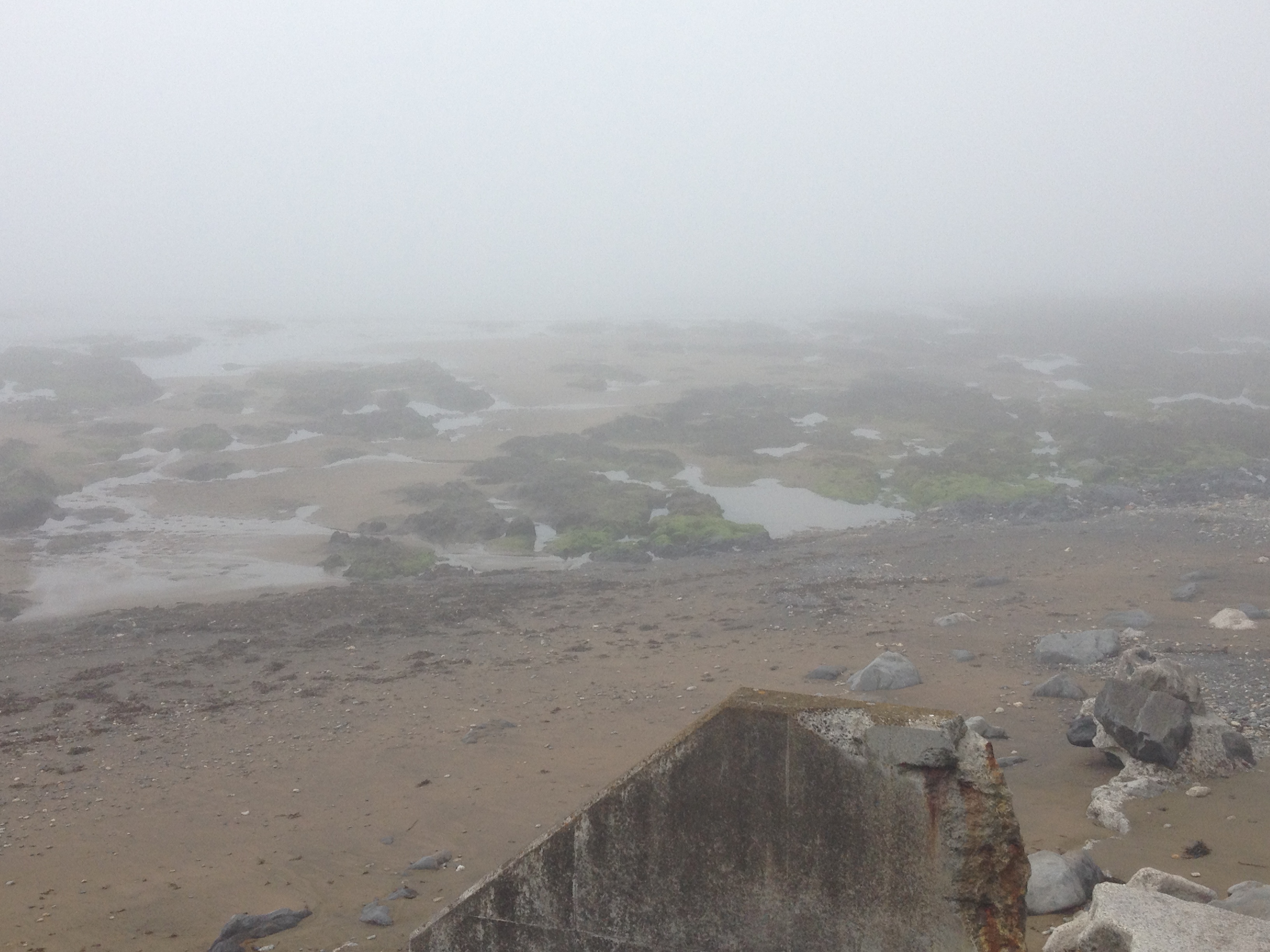
Otherworldly fog took over the landscape on Monday. After dropping my six-year-old son, Simon, off at camp in Dunhill, I went to the unmarked beach again. Suffering from heavy anxiety, I paused to look out over the vast beach from the top of the steep cement stairs, and the line of vision was severely blocked by the heavy white cloud.
Exploring and seeking an inspiring place to dance, I walked west, passing several beaches that were framed by giant, fallen boulders. I came to a cave (or perhaps the shaft opening of an old copper mine) and investigated briefly, then suddenly realized that I had no phone reception whatsoever. I was nervous about being out of contact while Simon was at camp. Lately, I have been unusually nervous about keeping us safe, given a series of mishaps. Simon has also been nervous, asking me to sketch out endless scenarios of what would happen if one of us got hurt or died during the trip; and he has been unwilling to be apart from me in any room of our friend’s 300-year-old cottage, as he believes it haunted. I have tried to calm his fears, but at times I have also felt afraid. I held the phone in my hand and walked back toward the cement stairs, staring at the screen and pausing whenever it said, “searching.” I settled on a still-remote-from-the-stairs spot with very black sand where the signal flickered in and out. I put the phone on a rock where I could check on it, created a large circle in the sand that I could dance inside of, then settled into a patient Flowing. As Staccato arose out of Flowing, I went to check the phone and realized that it was again saying “no service.” I tried to talk myself into letting go of the nervousness about being out of contact.
In the end, I was able to re-connect with Flowing despite pausing to check my phone. I danced a brief wave, moving through each rhythm: Flowing, Staccato, Chaos, Lyrical and Stillness. Resuming after the pause to check the phone, I realized that despite the fog and mist, the day was warm. I took off my clothes. The feeling of the cold mist on my skin helped return me to my senses and release the anxiety I was feeling. It was exhilarating after being so wrapped up in garments for so many chilly days. Before long I returned to a bathing suit, completing the wave fairly quickly. Stillness emerged vividly and the felt senses of the cliffs, the sea, the mysterious and heavy air, and the rocks and boulders found their way into my movements.
Then, I moved to the opposite end of the beach, where it was much less remote, but where I did have reception. For this second wave, as with the first, I started by creating a circle in the sand to dance inside of, though I did not stay inside it except for in the beginning of Flowing. This wave was definitely practice. Bits of beauty flecked it, but I was not particularly inspired. I was left thinking about how anxiety blocks receptors to everything—to danger, to joy, to fluid experience, and to the constant stream of information we receive from the world around us.
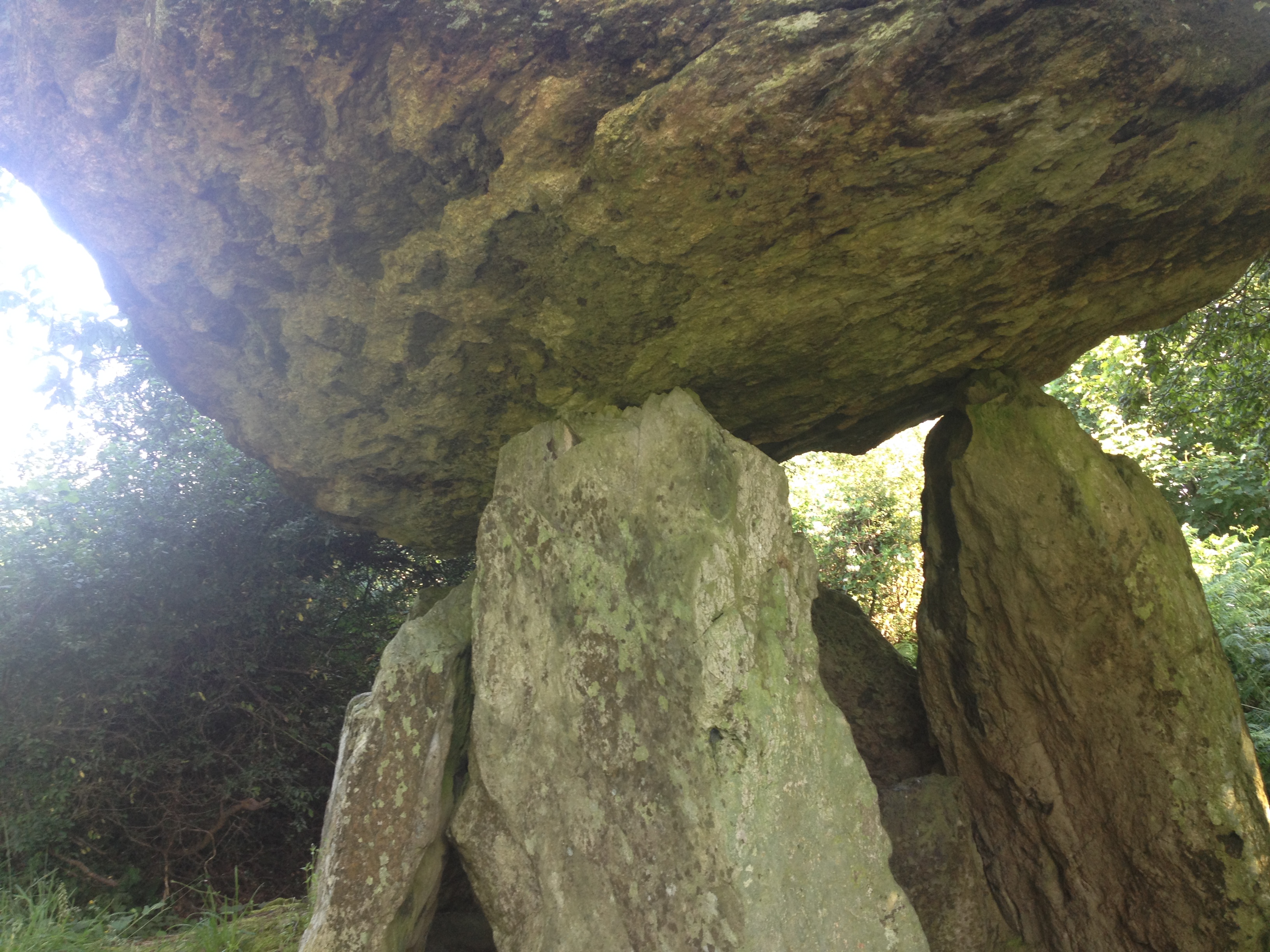
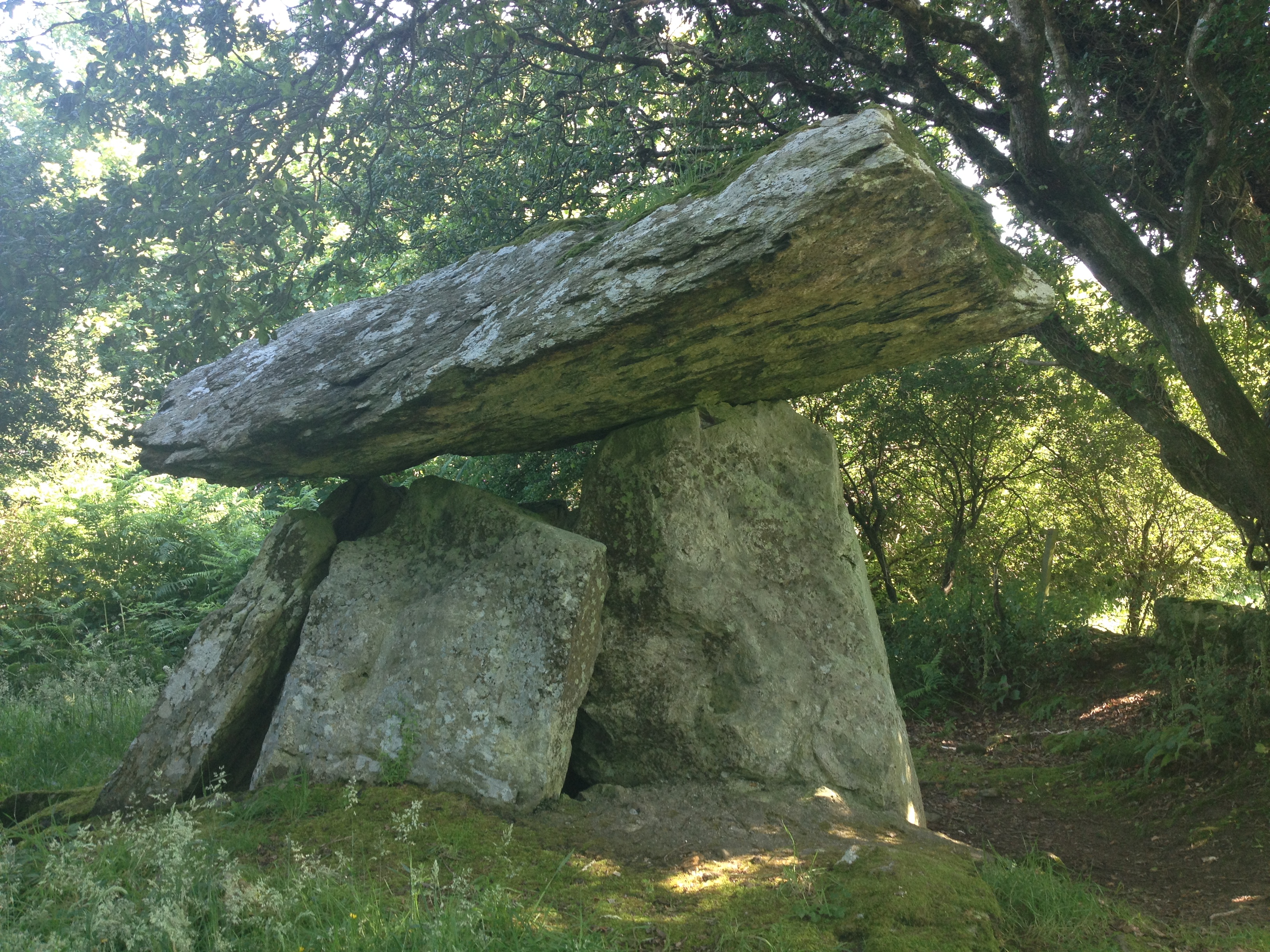
In the brief time I had before picking Simon up from camp, I made an unsuccessful attempt to find an ancient site that my friend had urged me to visit, but the next day (Tuesday) I was determined. I re-traced my driving steps, remembering not to turn down the tiny, stone-walled lane where I had aroused suspicion the day before. I had a map my friend’s archaeologist neighbor had given me, which included all of the small rural roads. Even armed with it, it was very difficult for me to navigate. I was told the site was just next to a cow field, and that it was locked gate but that there was a stile—a gap in the gate—that allows people to enter. That description seemed to match pretty much every gate I passed. I asked a woman who was walking on the road if she knew of the site, and she scrunched up her face, looking upward to think and pointing downhill. “I’m not sure, Pet. I think it might be down there, but they’re building a house there now. I suppose you could go there and ask if you could enter.” I felt discouraged, but decided to go just a tiny bit farther down the road. Shortly, I actually did find what I was looking for—indicated by a discreet arrow sign that said, “Gaulstown Dolmen.” I walked through the stile, down the driveway, through another entrance, then down a wooded path.
The monument is remarkable. It consists of six very large, flat stones that were placed in a Stonehenge-like configuration around 5,000 years ago. No one knows exactly how, as they appear to be extremely heavy. According to the archaeologist, it is likely a burial site, based on nearby similar sites that have been excavated. There was a small clearing around the dolmen, but it was very much enclosed with grown over trees and grasses. I sat for a few minutes, then got up to walk in a circle around it. Prickers caught my long skirt; and I moved into a flat spot to dance in Flowing. Absorbed, I imagined a low, chanting hum as I listened and sensed the place. I saw a moving black shape out of the corner of my eye that could have been the farmers’ dog, but that got me to thinking of ancient spirits. Staccato was brief but expressive. In Chaos, I stepped right inside the dolmen, wondering if it had also been intended as a portal. I was slightly afraid of the possibility of possession and at once totally fascinated. In Lyrical a flash of creative energy entered into me. In Stillness I moved with reverence—an homage to the ancients. I was left feeling like I should do what I can to develop my capacity as a mystic, and that all I need is available in every moment, if I know how to pay attention properly.
Later, I went again to the secret beach. Reception was better without the fog, and I choose a spot that was not as remote. Still, the phone came in and out. The day before I’d told myself, “Maybe I can be ok with being out of reach for a little while.” When it came to it, I was still nervous, and couldn’t bring myself to practice until I found a spot where the phone would have at least one bar. I stayed in Flowing for a long time, returning to the image of the dolmen again and again.
As with previous dances, threads of Stillness continued to present, for example during Flowing when I witnessed a bird soaring absolutely in place, not moving at all, buoyed by strong wind. I realized that at times I have confused Inertia—which can present as a lack of energy and is considered to be the “shadow” of the rhythm of Flowing—with Stillness. Stillness, as it continued to present during my many dances with the land and sea in Ireland, was very much invigorated and alive.
The rest of the wave unfolded. Staccato started only after a long time in Flowing; and I returned many times to Flowing even after I had fully entered Staccato. Staccato was not very energetic until Chaos began to appear, then the last burst of Staccato was very vigorous. I covered vast ground, moving far beyond the little circle I had drawn in the sand at the beginning of Flowing, all the while taking in the landscape even as it flashed across my field of vision in Chaos. In Lyrical I again played with my version of Irish step dancing. In Stillness I experimented with concentrating my energy field close to my body, then extending it far beyond my own edge. I ended the wave with my feet firmly planted and wide apart, holding my hands together in front of my chest, standing still and facing the sea, sensing myself as a colossus—taller even than the high, green cliffs.
The next day was the final day that I was able to dance in Ireland during this trip. As soon as I dropped Simon off at camp, I went to the secret beach, where it was again overcast and deserted. I spent some time creating an artwork, then drew a circle in the sand around myself and began to move in Flowing.
From the beginning, this wave was alive. In Flowing, I moved with ease and freedom far beyond the outlines of my little circle. The weather started to improve and a few people made their way down the cement stairs. Shy about occupying so much territory, I moved back behind some boulders, though I was still partially in view. Flowing shifted into Staccato and I covered even more distance, discarding my concerns.
I tracked the subtle shifts of energy, moving intuitively. The wave followed this pattern, if I recall correctly: Flowing, Staccato, Flowing, Staccato/Chaos, Staccato, Flowing, Flowing Chaos, Chaos, Flowing, Lyrical, Chaos, Lyrical, Chaos, Flowing, Flowing Lyrical, Stillness. I let everything in, deeply sensing the enormity and vast power of this incredible place. I went into Lyrical two or three times inside of Chaos, rising up onto my toes. In Stillness, I returned again to the original circle I had drawn in the sand. I invoked deities, helpers and guides, including Gabrielle Roth—the creator of the 5Rhythms practice—asking for help on my path, a clean heart, and the courage and insight to live my life in service to love.
I picked Simon up from the little, rural camp a little early since it was his last day. The camp included only children from the small, local villages; and most had multiple siblings. I told Simon I was incredibly proud of him for having the courage to step in and find his place there. As we moved toward the car, many of the children hung over the fence, waving, and calling out, “Bye, Simon!” The next day, we set out for home.
This blog consists of my own subjective experiences on the 5Rhythms® dancing path, and is not sanctioned by any 5Rhythms® organization or teacher.
by meghanleborious | Jul 17, 2016 | Notes on Practice, Uncategorized
-
Yesterday we woke to blue skies for the first time since we have been in Ireland. After dropping my son, Simon, off at camp, I set out to explore the local beach again, hoping to find a place to dance. Given the fair weather, there were several people enjoying the beach and I didn’t feel comfortable dancing there. Because it is exceedingly dangerous, I’ve sworn off the unprotected cliff path that departs from the east end of the beach, despite its compelling beauty. I spotted a different cliff path at the west end of the beach and decided to at least try it. This time, most of the path was set back from the cliff’s edge (with the exception of one short section) and I felt more at ease. The vast horizon was striated with deep emerald and turquoise water. Views from the cliff walk included huge rock formations topped with greenery, toppled boulders, squared green fields, rock walls and the endless crashing waves far below.
Absolutely by chance, on the secluded cliff path I ran into a childhood schoolmate of the friend who is hosting us and we chatted briefly. “I think it is a little bit dangerous up here. There has been a lot of erosion lately,” she shared. I nodded and told her that I decided I wouldn’t go on the other cliff path anymore; and that I am trying to play it safe, given a number of holiday calamities.
Reaching the end of the cliff path, I saw a beautiful, unpeopled beach far below. There were only sheer cliffs in front of me and there didn’t seem to be a way down, so I decided to try to reach it by way of the road. Returning, I avoided the one very dangerous section of path by detouring through a heavily prickled patch. I turned off the path and walked through a field, hoping I could avoid returning all the way to the beach I’d started at, but a wire fence that I feared might be electrified blocked my way. I returned to the beach where I’d started, then turned onto the road and tried to find the secret beach. I regretted my choice to walk, as a long section of the road was treacherous for pedestrians, but I jogged along in my flipflops, hoping to get out of the way before any cars came barreling along. I got off the road as soon as I could, then walked parallel to it through someone’s field. Again, I reached a dead end, totally blocked by impassable shrubs and brambles. Determined still, I returned to the cottage and got into the car. Driving west, I spotted a nearly concealed, unmarked road in the middle of a hairpin turn and turned onto it.
The graveled parking lot was at a 45-degree angle and I made sure to engage the parking brake to the last possible “click” before getting out and gathering my things. This was, surely, the secret beach that I had seen from the cliff path. Despite the first-in-many-days blue sky, there wasn’t a single person besides me.
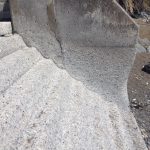
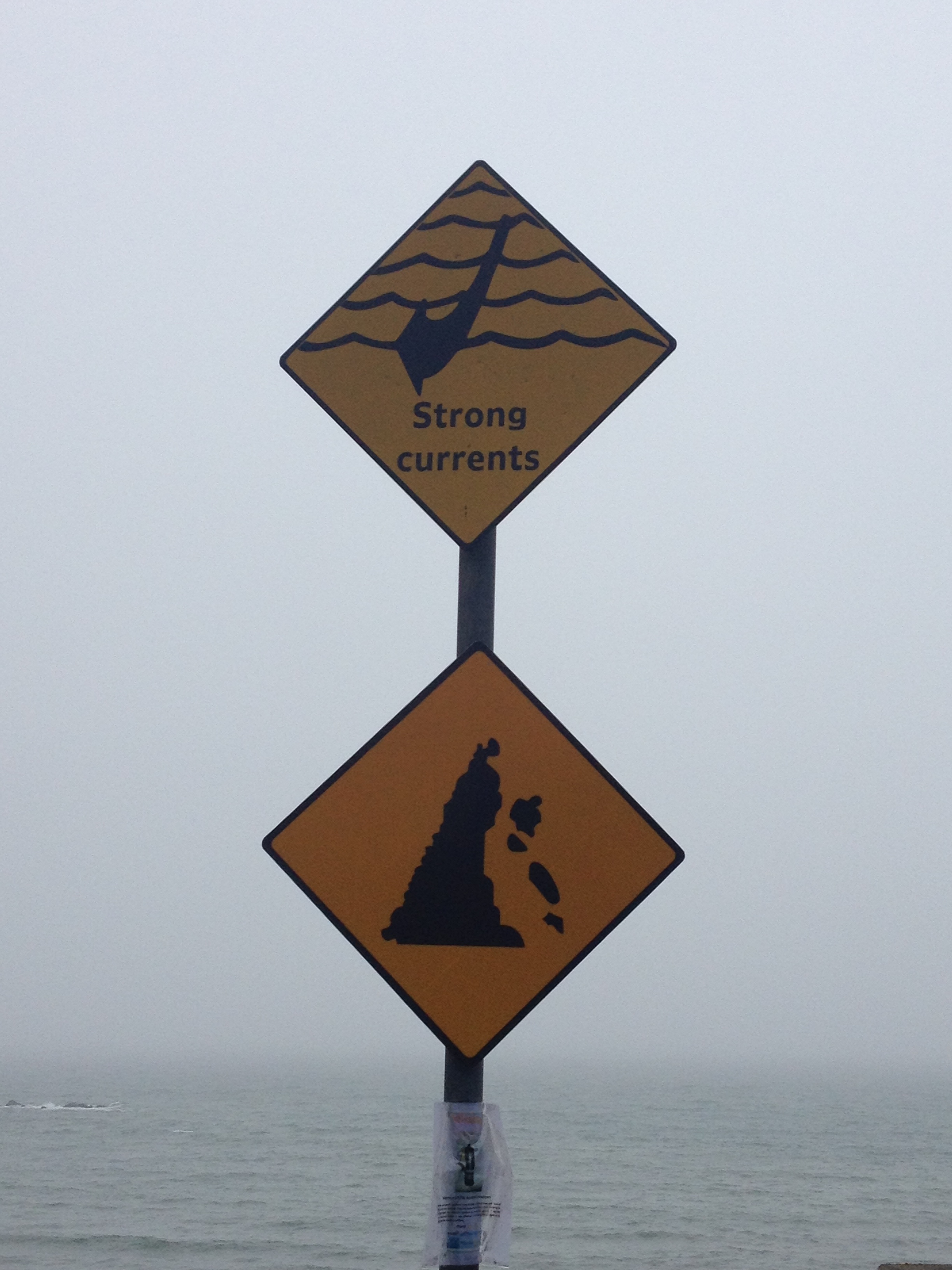
There were two graphic signs on the stairs leading to the beach below indicating falling rocks and strong currents. The stairs were made of concrete with big, coarse rocks cast inside, and were very, very steep. The first flight was relatively intact with the exception of a few crumbles, but on the second flight the stairs were severely eroded, smoothed almost to a flat ramp in some places by powerful high tides.
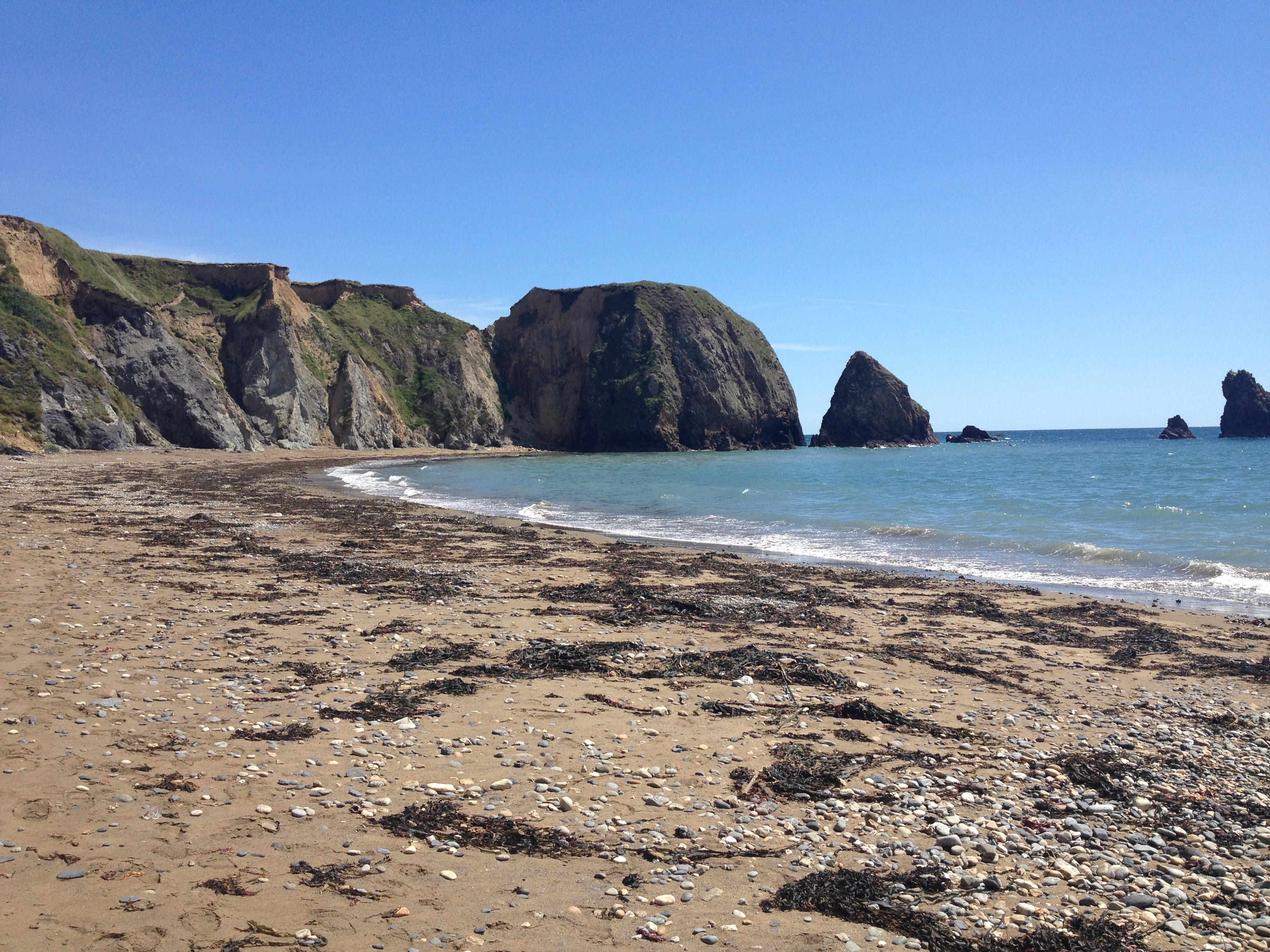
The beach itself was remarkable. Soaring and crumbling cliffs formed its north face, with fields and endless plants and grasses visible above them. Green-topped rock islands jutted into the sea at both its ends. Rocks and boulders were cast throughout the water, causing the powerful waves to act erratically. Thankfully, it was near low tide, since based on the most recent high tide line, the beach would be treacherous at high tide, if at all accessible. On a stormy day at high tide, the waves could reach the top of the long stairs, pummeling the cliffs and beach and making access impossible.
Looking up, I could see the crumbling cliffs with the turf edging hanging down like thick carpeting. I resolved once again, firmly, to stay off of high cliff paths that are right on the edges of cliffs.
I wasn’t totally sure what stage the tide was at, and I eyed the sea warily. This is dragon land, without question. I ventured a short way down the beach, but chose a spot to dance that was a short sprint away from the steep, cement stairs in case high tide came in fast. I made a circle of stones for myself and also noted a cluster of round stones a short distance in front of me. If the sea reached those stones, I decided, I would call it day and head for the stairs, no matter what phase of the 5Rhythms wave I was in at that point.
I broke the crusty surface of the warm sand with my bare feet. As with the previous day, moving brought tears almost immediately. I don’t know how long I was in Flowing, but I do remember that it was characterized by totally unselfconscious, fluid movement. In Staccato, I moved along the beach so I could dance on the unbroken sandy crust instead of in the sand that was already churned up by my circling feet in Flowing. I felt a tiny bit restrained. Respectful of the danger around me. Chaos, as in the previous days, was slightly restrained, also. I endeavored to release my head, but never moved with wild abandon. In Lyrical, I traced the gliding movements of birds with my hands while raised up onto my high toes, seeking sections of unbroken sand to help with lifting upward.
Stillness in the first wave took its time. I let in the energy of everything around me—cliffs, ocean, sky—and it was almost overwhelming. I had the thought that if you really let in the reality of the absolute, you let in the reality of your own death, too, and let in the reality that those you love will one day die. I staggered a little at the enormity of it, and at the wondrous enormity of the landscape around me. Perhaps that is why it can be so frightening. Sometimes. For me.
One of the biggest benefits of practicing independently is that I can really work with the mercurial shifts of energy as they arise. I realize that (in previous days) it made no sense to “hold” myself in Flowing. The fact is that even once I did move into Staccato, I moved back into Flowing many times. It wasn’t an all-or-nothing thing. Even when I got to Chaos, I still found myself going back to Flowing. I have often felt that I needed to keep myself in Flowing longer than felt intuitive so I could be responsible and find the ground beneath me before taking on any other investigation. Here, the stakes were different. I needed to attend to the many small subtle shifts of energy as I fluctuated between different rhythms. And in doing so, the energy of the land started to reveal itself to me.
It was not what I expected, to say the least. The land or anything else about Ireland. I have contemplated my relationship to this place at length. My Irish American grandmother and aunties were very Irish identified, but as I became an adult, I related uncomfortably to this heritage. I can see how identifying strongly helped them to feel empowered (perhaps in the face of discrimation), to connect with their families and community, and to find meaning and purpose. For me, though, several generations removed, taking it on has felt more like an identity decision, not a real connection to a living culture. Before this trip, I thought, “Perhaps I could connect with this lineage in a real way, and claim this one of many parts of who I am.” I felt strong emotion in the Waterford museum in Dungarven reading about the famine, the independence movement, the seafaring history. And in talking with one well-dressed, sweet, old Irish lady, who strongly remembled my now-gone beloveds. And again, at a country fair, seeing teenagers in a dance performance—jaunty, alive, lyrical. The peasant history, the mystical strains, the aching land. I know all of this in my body. And yet I have felt distant. And more afraid here. I hope I haven’t betrayed my ancestors. My heart wants to be open, though. Perhaps there will be a breakthrough.
The second wave emerged organically. Again, in Flowing I moved in linked, concentric circles, totally unselfconsciously. I found a melody that has appeared in independent practice again and again, feeling like an ancient song. Since I was totally by myself (except for one lone man in a blue jacket, a tiny dot far on the other side of the beach), I sang it with full force. It morphed into a chant—an homage to the sun that had tremendous density and power, and that persisted for most of the second wave. A thread of Stillness passed through as I danced with five black birds who soared together overhead—crossing, dipping, and gliding. The gestures of Chaos arose totally from the angles of my feet in the already agitated sand. In Lyrical, I again found lift, in my own joyful version of Irish step dancing. In Stillness, I let the waves pass through me; and at the end of the wave, I sat briefly in meditation, cross legged on a towel on the sand.
Today, I went again to this achingly beautiful, secret beach. First, I carefully checked the tide charts, since I did not want to be caught far from the stairs in a rising tide. This time, the sky was not blue, but white; and I walked west instead of east. The horizon was a vague shift in densities. Although according to the tide chart I should be ok for over an hour, I continued to fear the possibility of a quickly rising tide and watched the sea carefully. I explored at length, passing the first open beach to a set of giant rocks that would surely be islands at high tide, and on to another open beach (this one with black sand) and to another set of giant rocks. Everyone makes such a big deal about the greenness of Ireland, but here, the power of Ireland’s ancient rocks and stones presented. The stones became anthropomorphic as they began to reveal themselves, and I saw not only people, but animals and otherworldly creatures. I shot them with the phone camera like I was doing portraits; and they revealed themselves even more.
I crossed paths and chatted briefly with the man in the blue jacket that I had glimpsed far down the beach the day before. I noticed that he was attractive and we chatted about the weather. He asked if I planned to swim. In keeping with my recently established personal guidelines about safety, I asked, “Is it safe to swim here?” He said, pointing, “Well, you don’t go out too far, just in that part there.” I didn’t fully take it in, believing the sea much too cold, and said, “Well, have a great morning!” and moved on.
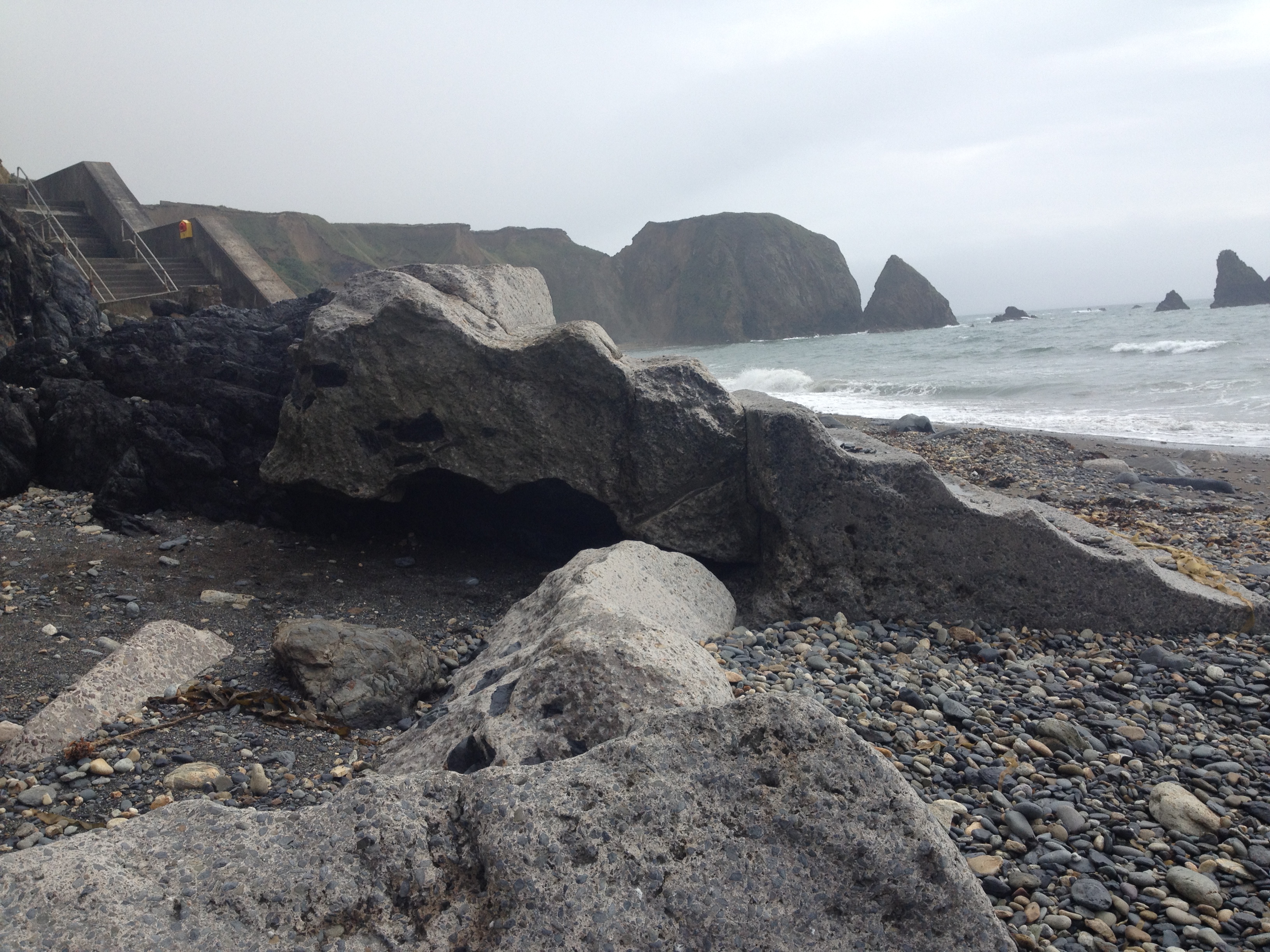
I finally had my fill of exploring, and selected a place close to the sea-damaged escape stairs. In fact, I found another cement staircase and the remains of a man-made walkway that had been totally pummeled and melted by the sea. I fell in love with it—this sturdy man-made creation that was easily felled by the raging power of the ocean. It was both humbling and heartening. Humbling because of the failed hubris of creating human structures on this wild beach. Heartening because nature so quickly reclaimed and restored itself in the face of human intervention—making our constructed foibles look like mere flashes in the pan.
In Flowing, I was happy and at ease. I felt no exertion, no inertia and no self. In Staccato, I felt no urgency or strain.
I saw the man I had spoken with swimming far down the beach, and began to feel like we were sharing a dance. After a long while in Flowing, I realized he had finished his swim and was standing by the escape stairs, drying off and watching me. This was an interesting development. I let Staccato emerge fully, rushing into space far beyond the original circle that I occupied in Flowing, some bold back cross-steps and deep squatting gestures working their way in, as I grew taller, smiling and engaging fully with the sometimes conflicting gestures of breaking waves. I kept glancing at the man, very aware that he was watching, but never made eye contact with him. I wanted to speak with him, to connect with him, but I lost my chance. As Staccato transitioned, I saw that he was walking up the stairs. I had suspected that he was naked but at this time it was confirmed. I waved good-bye to him, wishing he would come back and telling myself, “Oh well, he’s probably married anyway, like almost everyone in Ireland.”
This got me to thinking of physical love, and of the many memorable lovers I have met in my travels over the years. I thought about another beach meeting, near Puntarenas, Costa Rica. In that instance, I was on a long vision quest on the beach, lone, ecstatic, far from the village I was staying in, when a beautiful man literally rode up on a black horse, stopped short and said, “I want to dance with you!” Yes, I said, “Como no?” (Ironically, I never had sex with the horse riding man, who I quickly fell in love with, but instead entered into a primal tryst with an itinerant surfer from Argentina who sold jade jewelry to tourists and lived in a lean-to on the beach.)
For a spell, I was distracted from my senses. Chaos did not so much arrive as support my intention to complete the wave. Spinning, I quickly grew dizzy on the tilted plane of the beach, then found a familiar way of moving in Chaos that I realized is just a very articulated and weighted way of spinning. I moved in and out of Chaos, Lyrical and Stillness again and again, letting the flow of energy have its way.
This place, where two twisting strands of my ancestors hail from, is not what I expected. The pre-digested Ireland of cartoon leprechauns and Blarney Stone kisses is only a tiny piece of the story. In reality, it is much scarier. Much darker. Incredibly beautiful. And still, totally foreign.
July 16, 2016, Annestown, Co. Waterford, Ireland
This blog consists of my own subjective experiences on the 5Rhythms® dancing path, and is not sanctioned by any 5Rhythms® organization or teacher.
by meghanleborious | Jun 27, 2016 | Notes on Practice
For the second week in a row, I unexpectedly attended the Sunday Sweat Your Prayers class. For the second week in a row, the class was guest taught by an accomplished teacher from another country, in this case Hannah Loewenthal from South Africa. And for the second week in a row, I explored new and delightful aspects of partnership.
I took a long time to gather myself on entering; and I went silently through a ritual of bowing into the space. I felt emotional and took tiny steps, moving like water through the many floor-moving bodies that were distributed equally around the studio. I found a spot near the middle of the room and began to move in energetic circles, rolling over the back of my head again and again and letting the gestures cast me in arcs, pausing to tense in key stretches as I was quickly called to action.
Hannah, perhaps noting the quickening of the room, dialed the music back to tonal and encouraged us to take our time in arriving. To find the breath and our relationship to it. Most of us were on our feet by then, and the room seemed to move inside clear gel, slow and graceful, dipping collectively into the Stillness inside Flowing. Hannah coaxed us through a meditation of body parts, beginning with the feet. Interestingly, the only part of her narration I recall is about attention to the spine, which I reveled in, remembering that one partner of many years told me early in my 5Rhythms career that I flow with my spine, not just with my feet. Before long, I stepped into this very partner—someone I rarely meet in Flowing—but on this day it felt like the parts of our spines that sit behind and inside the rib cage were enacted, and palpable energy from that part of the body mingled as we moved. We were gentle, but retained a hint of the precise edges that I love about dancing with him.
I have often been amazed at this partner’s ability to meet me exactly where I am. For a long time, I assumed he could just go anywhere. For example, he seemed to be the only one who I could meet in the sharpest of Staccato fields. Over time, I have come to believe that it only looks like he can go anywhere, when in fact it is because he can see the room so clearly that he knows who is in the same energetic field, and then moves into the dances that call him directly.
With my eyes nearly closed and sunken low into my hips, I luxuriated in the coiling and whipping of my spine. A partner I shared a long dance with recently stepped right beside me. I felt him and opened my eyes, laughing, as the last time we met I felt I had stepped into a clearing and felt like I surprised him. This time, he playfully surprised me—a lovely kind of balance.
In the first wave, I hung back in Flowing Staccato and never fully expressed Staccato before the room was barreling into Chaos, loud with joyful vocalizations, including my own. I loved seeing Hannah move in unbridled Chaos, her long arms sailing up and down around her, her long neck in concert. Somehow early in my 5Rhythms career, I got the impression that raising the arms high up is a no-no, but in the last several years, I have been investigating more and more of the sky and the expansive space above. In fact, Hannah repeatedly invited us to dance with the space around us, even when we were told to take partners.
Indeed, there was an unusual amount of space in the room, owing in part to the fact that many people seemed to be drawn to gather in small, quietly moving groups. At moments, the room looked like a sea-bottom kelp-forest, waving collectively with the energetic currents.
Hannah taught the class in two waves, as is the usual custom in a two-hour class, but did not pause for verbal teaching in the middle of the class. Although the frame was two main waves, many tiny little waves expressed inside the larger structure; and Hannah repeatedly chanted, “The rhythms inside the rhythms.”
In Chaos, I spent long periods dancing with myself. I note that during Chaos I am least likely to partner. I wonder if I can extrapolate that I am very self-sufficient in Chaos, very comfortable and confident in Chaos—at least at this point. Often, for me, trances arise here; and I am inclined toward my own inner world. I am much more likely to meet a partner in any of the other four rhythms.
My dance was delightful throughout. My energy level was constant except when I was swept completely away by effusive expression, which gave rise to uncontainable bursts. I found joy in partnership, and was receptive (on this day) to everyone in the room. I found joy in my own inner experience. I found joy in brand new ways of moving, rolling out completely uncontrived. I found joy in stepping into moving with a brand new partner, and, too, stepping in with an intrepid long-time friend who is always willing to off-road from the basic map and from the many notations and traces we have recorded over the years on our uncharted, unchartable adventures.
Leading us from the Stillness of the first wave into the Flowing of the second, Hannah did something curious. Instead of guiding from the feet first as is nearly always the instruction with Flowing, she invited us to begin with the hands, working our way through the body and into embodied Flowing from there. I recalled Kierra’s aside the week before when she taught the Friday Night Waves class, that in many cultures the hands are considered to be the “messengers of the heart;” and I wondered if the hands might be particularly important in Hannah’s personal practice. As I remarked about the class the week before with Anne Marie, taking class with a teacher I have never encountered before can be very valuable—perhaps just as my grandmother, Muriel Grigely, used to feel about stepping into a different church for the first time.
Hannah invited us to partner; and I found a good friend. Both of us were faster than the music; and we giggled and super-sped up, then slowed down and leaned in toward each other: slowing, moving around. Instructed to turn the partnership into a foursome, two others joined us, though the group remained very porous, with several people from other groups or dancing individually moving partially in the field we created. Without instruction, the group dissolved and my partner and I returned to each other briefly before moving on to other parts of the room.
I noticed a friend I recently shared a sublime dance with standing a bit off to the side. I considered trying to engage him, but thought better of it, wondering if it might not be best to let him have whatever experience he was having. I also felt hesitant because our most recent dance was so beautiful—sometimes I feel shy after sharing an experience like that. I noticed that another dancer did succeed in drawing him out and that he seemed to move cheerfully and fluidly, as their group at moments intersected with ours at the point when we were told to dance in groups of four.
During both waves, in the bridges from Lyrical into Stillness, repetitions bubbled up. In the second wave I found a gestural expression of the disbelief that precedes grief, my hands sobbing, crying, “No, no, no, no, no!” I didn’t connect it to a specific experience. It didn’t make me cry, but I could feel its resonance. In Lyrical, I experimented with an awkward groundedness, then took off and sailed throughout the room with luxurious, expansive gestures, pouring my smiling eyes into whoever’s eyes I could manage to meet, high on the toes and raised into the front chest.
As the final wave of the class began to draw itself to a close, I stepped into a partner’s field who I recently shared a long dance with, slightly hesitant. He smiled, inviting, and we resumed a previous class’s investigation of tiny, crossed over steps, flashed foot soles, elbows held close to the torso, occasionally moving in a way that was as closely contained as could possibly be without touching. I moved in and out of more stretched and extended gestures and big, back-crossing steps, but drew back closely into this minute and quirky investigation again and again, delighted.
We came seamlessly into unselfconscious contact, each planting the outside of one foot to touch, side by side. He leaned into me and I returned the gesture, at once pushing and yielding, then stepped around his planted foot, curving us into an arc. The room fell away, the sound of breath grew stronger. We moved in a little matrix, opening at moments into a kind of ballroom glide. At other moments we balanced, finding small swinging movements inside the balances. I noted that he is closer to my small scale than many men, and found balancing exceptionally dynamic and available, feeling like the animations you see of shifting crystalline forms, alive and clear, seeing and seen.
The process of leaving was overlayed with a conversation with a friend. As we took the elevator from the 5th floor down and stepped onto 6th Avenue, he expressed that sometimes he feels like he has to really make a commitment to be in “his” dance. Otherwise, he would just be partnered all the time, doing someone else’s dance—a sentiment I have heard expressed hundreds of times. He was already hugging me goodbye; and we didn’t have time, but this is what I wanted to say:
“This might be unique to me, but at this moment I don’t feel that I have a “my” dance. And I don’t think there is a lack in that. Just as there is no “me” that is separate and self-existing, there is no “my” dance. My deepest, most emotional, or most idiosyncratic personal expression is not separate from any of the dances I have shared with partners or in community. For me, dancing alone and dancing with others are not opposites, but are shades of difference—all part of the beautiful display comprising the myriad forms of this tiny, precious life.”
June 19, 2016, Brooklyn, NYC
This blog consists of my own subjective experiences on the 5Rhythms®dancing path, and is not sanctioned by any 5Rhythms® organization or teacher.
(Images: The tangled rainbows is an image from my own studio. The beautiful sunset photo of the Brooklyn Bridge was taken and shared with me by 5Rhythms teacher Hannah Loewenthal .)