by meghanleborious | Apr 3, 2017 | Notes on Practice
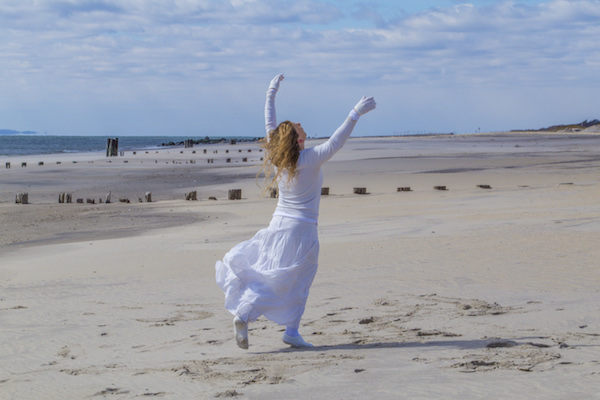
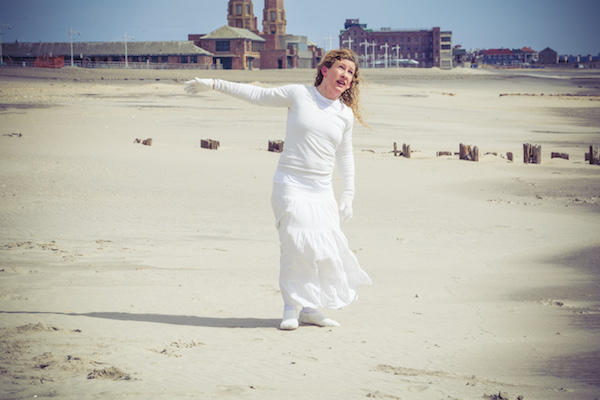
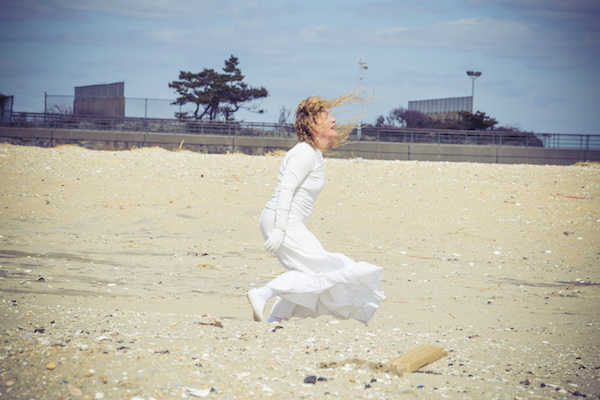
At Riis Park, the solitary birds are my first dance partners this morning. Before long, however, I join with an entire flock, soaring as they soar, holding my arms out wide, twisting in an arc as they move to the farthest edge of an orbit, sinking deep and looping one arm through the other as they change sides, rising suddenly and falling back into my edge, my feet grinding circles in the cold winter sand, covering vast distances on the deserted beach. Seeking solace and insight in these deeply troubling times, I planned this artwork performance—a ritual, of sorts—hoping to find some clues to show me the way forward.
Another place I go to seek solace and insight are 5Rhythms classes and workshops. Created by Gabrielle Roth in the 1980’s, 5Rhythms is a dance and movement meditation practice that embodies Gabrielle’s vision, “A body in motion will heal itself.” The five rhythms are Flowing, Staccato, Chaos, Lyrical and Stillness. Each rhythm has its own character, which becomes territory for endless experiments. To dance a wave is to pass through each of the 5Rhythms in sequence. In a typical two-hour class, we move through two waves. On first glance, a 5Rhythms room would probably just look like a wild dance club, but for most people it is also much more. For me, it is laboratory for life, encompassing psychological, emotional, philosophical, interpersonal and shamanic levels.
At a 5Rhythms class just a few days before the performance at Riis Park, 5Rhythms teacher Tammy Burstein says, “We don’t have to just be at a loss, because we have a map,” remarking that many people seem to be stepping into the class “still carrying a lot.” In having a map, we have the comfort of knowing that we have a way forward that doesn’t rely solely on our own initiative or motivation. This is particularly useful when we feel stuck or overwhelmed, as many, including myself, have felt for the last several months.
Waiting in line for the bathroom before class, a woman I had shared a dance with the week before says, “I love your dance. It is like you are always weaving, somehow.” I think she is talking about the way I move through the room, sharing dances, winding gestures inside the empty spaces, and following the currents caused by the many moving bodies. I introduce myself and smile, thanking her for the compliment and for the feedback.
Just two days later, I find myself weaving the air with my arms as I undertake the performance artwork at Jacob Riis National Seashore. I had been thinking of doing this performance for many months, but when I finally decide to actually do it, I have less than a week to prepare. I send an invite to a few close friends, but I send it late at night, just a few days before; and I anticipate that it might be just me and the photographer.
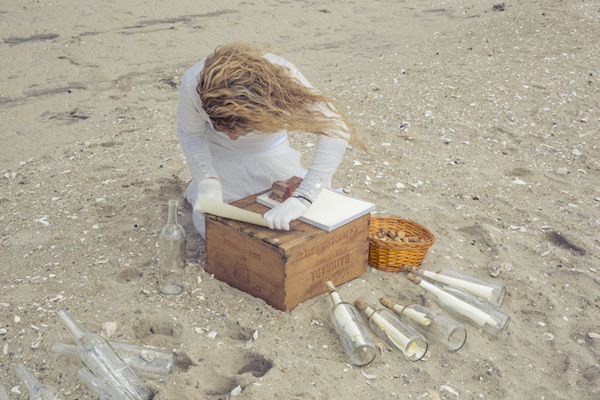
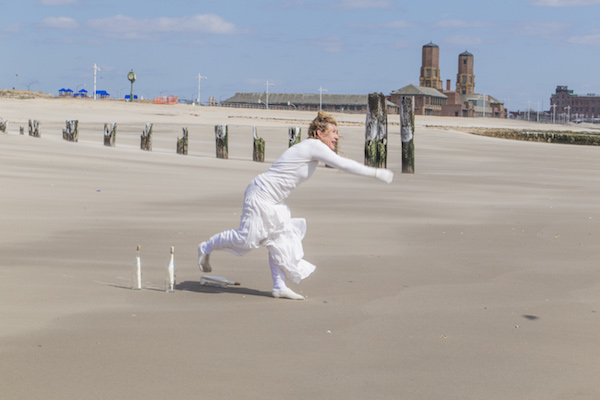
In frigid temperatures, my hair a taut flag in the caustic wind, I set up a wooden box as a table, a dozen glass bottles with corks, a pen, and a ream of paper—barely held in place by a jagged piece of brick. Then, I begin to move with the ocean birds as they appear in the sky. I watch them carefully, doing my best to revive the lost art of augury—an important ritual for several groups of ancients—divination, or fortune telling, by the flights of birds. I hoped to draw some meaning from the sky that might offer hope and direction in the coming months, especially since the political situation has grown increasingly worrisome of late.
Stepping into the 5Rhythms class a few minutes late, I do not start down on the floor, as is my usual custom, but instead stay on my feet and join the group in moving my attention slowly through different body parts, as led by the teacher. I find vibrant movement quickly, releasing the shoulders, releasing the spine and releasing the head’s weight, which cascade me into circular motion in the first rhythm of Flowing. Flowing is characterized by rounded, unending motion with a strong emphasis on the feet; and I move softly, with weight, the soles of my feet in in close contact with the floor.
Still engaging in the Body Parts exercise, we segue into the second rhythm of Staccato, and I begin to move around the room. Staccato is characterized by sharp, clear movements with an emphasis on the hips; and I sink low, my knees sharply bent, moving forward and back, my elbows forming pointed triangles and leading me into movement. Tammy suggests that we could make a choice to just let go of everything we are carrying. I stop thinking of things outside of the dance and step into many successive, brief partnerships. Wondering if she perhaps prefers to be left alone, I nonetheless join with a friend who often favors the periphery. As I move toward her, she smiles and steps forward to dance with me. Another friend joins us, seeming to boing upward as he approaches, then twisting and weaving around us. We both become even more activated, the three of us moving in an elastic matrix, swapping places and moving around the edge of our small group, and taking turns moving through the middle.
The third rhythm of Chaos and the fourth rhythm of Lyrical reveal the miracle of being totally unique and totally universal, at once. I join with a woman in Lyrical with whom I have shared many dances of rolling shoulders and circling hips, each of us bending forward in turn as our shoulders descend and cross downward, losing eye contact, then rising again as the shoulder pulls back from blocking the jaw, smiling, and moving similarly around each other’s backs, always arriving again at smiling eye contact. This time we find new patterns—intricately-syncopated steps inside of steps—as a playful, remixed disco song booms from the powerful speakers.
I learned that the Ancient Roman augurs—the ritualists who read the flights of the birds for official purposes—would have had a great deal of say in who would lead Rome. If the signs were interpreted favorably, a king or emperor would be crowned—the origin of the word “inauguration.” It was believed that the birds transmitted the will of the Gods, and reflected the relative chaos or harmony of the larger cosmos. I wondered what would have happened if anyone read the birds’ flights on January 20, 2017; and if dire predictions would have mattered.
Total porousness comes a little easier after so many years of practice; and it’s been awhile since I’ve had the pleasure of being totally shattered as a result of feeling integrated into the collective field. In this case, during the fifth and final rhythm, Stillness, I move through the room gently, like breeze, passing through people’s energy fields and allowing them to pass through mine.
Again on the beach in the performance ritual, as words arise, I kneel in front of my little table and write down any phrases that come to mind. Then, I roll up the paper I have written on, push it into a glass bottle and cork it. It is very cold and I have to sustain vigorous movement, but I do this a dozen times, quickly, preparing the bottles that will be thrown into the sea at the conclusion of the ritual. Of my attempts at divination, one stands out:
“In times of fear,
Turn to community-
Fly in formation.”
The following week at class, the experience of having undergone the performance ritual with the birds works its way into my dance.
This time I begin with my body in full contact with the floor in the first rhythm of Flowing, moving in concentric circles in every direction, edgeless, finding tension at the most extended points to stretch my muscles, arcing through my side, shifting over the back of my head onto the spine, then back around. Still moving in concentric circles on the floor, I begin to move through the room, one leg reaching far behind me and pulling me into another level of circling. While rolling over the back of my head, I gaze up at the standing people around me, finding empty space as it opens up and moving into it, still on the floor.
I’ve been working with a therapist lately; and we begin each of our sessions with five minutes of movement. Recently, I started with my ear on the soft oriental carpet. Hums from the building became audible; and I heard two voices from the floor below in conversation. I thought of 5Rhythms teacher Kierra Foster-Ba, who has often said, “Just like any other animal, we receive a lot of information from the ground.” With my ear to the ground, literally, I felt like I could listen for danger, read the signs, and respond appropriately—engaging my primal instincts during a time when I might otherwise be tempted to rationalize the signs of danger to convince myself I am safe.
A recurring dream came up then, too. I am at Cape Cod in a rented cottage on a cliff by the sea with several members of my family. The ocean has receded by miles, exposing the sand beneath; and an eerie quiet had arisen. Although when I first had this dream I didn’t know the early signs of a tsunami, somehow I knew that a gigantic wave was about to erupt from the silence. Walking through the screen door, I plead with my mother and sister to leave with me, to flee to high ground. They decline, peacefully resigned. I get into a car and drive uphill, overtaken by complex emotions—a sharp desire to live, both grief and admiration for my mother and sister, and fear that the massive wave will overtake me.
On the way in to class, I feel annoyed and unreceptive. There is someone in attendance I always have a lot of mind chatter about, believing she is superficial for some reason that surely has little to do with her. But before long, the music hooks me and I am moving through the room. A dance version of Erykah Badu’s “On and On” offers me a Staccato door to enter through, and I step into multiple partnerships, moving low and backward, ratcheting different body parts, and articulating movements with precision and thoroughness.
Before dance that night, my seven-year-old son, Simon, uses the phrase “magical sweat” in relation to some wet socks that have surprised him by drying quickly. The phrase “magical sweat” repeats for me several times during the class, and particularly as Staccato gathers fire. As Staccato transitions into Chaos, I let loose, grateful for a reserve of easily available energy. My hair falls over my face and eyes as my head whirls freely, leading my entire body in spinning. I note the woman who I had judged as superficial dancing right next to me, and realize the smallness of my petty resentment. The truth is that we are all superficial to some extent, myself included. As I let go, I inwardly celebrate that she lets go, too, and move with many emphatic and wild dancers in close proximity.
In Lyrical and then in Stillness, I spin and leap in the center of the room, my wings held wide, recalling the movements of my many bird partners the week before. Several successive dancers join me in flight, each seamlessly integrating into my dance of sky, swooping and soaring very close to me, then spinning off into new partnerships.
Realizing that my feet will get wet when I go to the edge of the sea to throw in the bottles, I know I have to move quickly or risk frost bite. I make three trips, carrying several bottles at once, and toss the bottles into the waves. As soon as the last one hits the water, I sprint to put on my boots and winter jacket, considering the performance complete.
Regardless of whether the signs I have divined in any way foretell the future, and, too, regardless of the direction the map may or may not take me, I am grateful to have a map, grateful for a way forward, and grateful for the unlikely blessing of this life, this tiny glimmer that reflects the magnitude of infinity.
“Good hope is often beguiled by her own augury.” -Ovid
March 19, 2017, Brooklyn, NYC
This blog consists of my own subjective experiences on the 5Rhythms® dancing path, and is not sanctioned by any 5Rhythms® organization or teacher.
by meghanleborious | Nov 2, 2016 | Notes on Practice
I gave a little shudder as I stepped up onto the sprung dance floor at Martha Graham studio this weekend and gently eased my body down onto it, tears coming even in these first few moments.
I fell in love at “Heart’s Content,” the 5Rhythms Heartbeat workshop lead by Tammy Burstein at Martha Graham, this weekend. I’m not sure who I fell in love with exactly, but the answer that feels right is “with everyone.” Gabrielle Roth—the creator of the 5Rhythms practice—designed the Heartbeat Map as a way to describe and work specifically with the energy of the emotions. In the Heartbeat Map, each of the five rhythms are correlated to five of the strongest human emotions: fear, anger, sadness, joy and compassion. The weekend was an intensive investigation of how each of us relates to these different emotional states.
The first night began with a wave and also with a series of paired speaking exercises. The wave was, for me, characterized by happiness and freedom of movement. I stepped into several beautiful dances, but one in particular stands out—a bouncing, kinetic, shaking Chaos that I shared with a smiling friend. Because of its forgiving floor, Martha Graham is one of the few studios where I occasionally let myself leap straight up, an exclamation point on a whirling gesture. When we entered the speaking exercises and it was my turn to speak, the main theme was again joy, and also the stamina to sustain joy.
I shared that for the first several years of practice, I could scarcely relate to Lyrical—the rhythm associated with joy. When I practiced independently, I would move through Flowing, Staccato and Chaos, then very glancingly nod to Lyrical and to Stillness. I experienced Lyrical only in tiny glimpses—at times transported—but never really acknowledging my relationship to it. That all changed about a year ago, when the energy of Lyrical came into my experience with a sudden rush, and I began to develop confidence that I, too, like many I had admired, could walk in joy.
I got up to dance with my last speaking partner of the night, who, like me, had spoken from the depths of his heart. We soared, even moving together in a few big gestures throughout the room. My face hurt from smiling.
Stillness in the last wave of Friday night’s session found me very conscious of the pulses in my hands as I moved them slowly around myself, imagining I was healing places of energetic malady in my own physical field.
For the next session, Saturday morning, I was late. Over a half hour late. This was despite Tammy’s repeated requests during Friday’s opening session that everyone arrive early enough to start dancing right at noon. I was in pain as I waited for my parents, who had been delayed by traffic, to arrive so they could care for my six-year-old son, Simon. “What? What time does the GPS say?” I asked repeatedly, distracted from connecting with Simon on these few weekend moments we would share. In the meantime, Simon worked in his art studio, creating decorations for the front door. Remarkably, he created three drawings on small post-its, one for happy, one for sad, and one for mad. Then, he used a red marker to divide a large page into many separate boxes and drew many of the more subtle emotions that he could find images and language for. I had not shared with Simon that my weekend dance workshop would be about emotions, but somehow he managed to pull it from the air around me.
The wait continued. When my parents reported that they were close, I called a car service, as I doubted I would be able to park in the West Village on a Saturday. The car service arrived and waited for several minutes, then left with a skid since I still wasn’t ready to go. My parents finally arrived and I greeted them with strained affection, setting off down the block to try to hail a cab. Having no luck, I called another car (from a different car service) and returned to my stoop to wait. The dispatcher told me five minutes, but I waited, 10, 11, 12, 15…finally I was able to hail an unoccupied taxi.
I called to cancel the car service request and settled in for the taxi ride, trying to convince myself to shake it off. I was angry, but fighting it. I sent a text, “My parents were late and I am super late to the workshop. So upset and ashamed.” The response, “Ashamed? Go to your workshop and hold your head high. Get all that you can from it. Life happens. All is a learning tool.” Instead of trying to shake off being upset, I let it all in. I realized I was feeling sorry for myself, and, too, defensive. Then, I recalled Simon’s exquisite front door drawing installation of major and minor emotional states; and I realized that the teaching had actually been happening all along.
As I entered the studio, I made a gesture of apology to Tammy (who smiled warmly and continued to attend to the music), then, instead of stepping up onto the dance floor, this time I crawled up onto it, touching my forehead to the floor, prostrate. I sobbed quietly for a few moments, still feeling sorry for myself. The room was in Staccato as I entered; and, after a few flat footed gestures in Flowing, I, too, moved straight into Staccato. Here, I found a ferocious anger and a dance that was filled with edges and sharp angles. My repeated punctuation here was a gesture of sinking down into the hips—knees squared—and with a forced, hissing, open-mouthed exhalation, and clenched, raised fists. Chaos released me. Once again, I found uncontainable joy; and I partnered with everyone who was available to me as I soared around the room.
In a partnered exercise, we were asked to share what we were taught about the emotions. I blathered on about my parents, casting around for something with emotional charge. Sometimes these exercises can be cathartic, and a crucial insight will jump out of my mouth unexpectedly. Not so on this occasion. Later, reflecting, I was shocked at my omissions. How could I not mention the two relationships that for years dominated my emotional landscape and cost me, collectively, over 20 years of therapy? In those two important relationships, I learned distance from my own heart. I also learned how to walk on egg shells, in constant fear of the next attack.
The next wave unfurled. At its end I found myself in gentle contact with a dancer I have known for many years. Softly, we turned one another and turned around one another. Once again instructed to partner in speaking, we settled onto the floor facing each other. I gazed into his kind eyes—dark with a light blue ring around the edge of the iris—and he gazed into mine. Asked to speak to the question, “What do you fear?” his words moved me deeply. I, too, spoke of my fears, though I held back slightly for some reason.
Tammy gathered us and spoke about Staccato. Sometimes Staccato has the stigma of being officious, administrative, pushy. But on this day, Tammy talked about her love of New York City, of its creative life, of its heartfulness, of its staccato pulse. She has said on many occasions that she identifies most strongly with Staccato, and this time she said as she moved, rocking into her front foot and drawing back, “Even after all these years, I sort of have to rev myself up and back into Flowing.” This seemed like a perfect description to me. She talked about anger, too. She said, “To cut out anger is to cut out the heart,” and proposed that even anger has something to teach us.
I ate lunch in Hudson River Park alone. Leaving the studio building, one perfectly nice woman from the workshop fell into step beside me and began to make small talk. I felt non-verbal, attuned to the sacred, and a bit like I was tripping on acid. After we crossed the street to the park I said, “Have a nice lunch!” and walked to the left, then found a shady bench seat for myself. I ate the food I had packed and watched the heaving of the river’s waves, the shimmering edges as they rose up.
After lunch, we danced a short wave, then set upon an investigation of “No!” We were invited to partner, then each danced our personal version of, “No!” After each person’s dance, the other was told to share if they “believed” the dancer’s version of “No!” After my dance, my partner told me that she was convinced, and that it was a “very dynamic version of No.” For the second round, Tammy invited us to remove all of the tension, but do the same dance. This time, my partner said, “I was convinced this time, too. But this time it was like you were telling me your boundaries and inviting me not to hurt you.” For some reason, this touched a nerve and a ragged sob escaped me. This is something I have really been working on: how to create and maintain boundaries without aggression. Since my family is very symbiotic, this is a not a skill that comes naturally. After years of trying to rise to the occasion, I have finally set a healthy boundary with someone who has lacerated me again and again and again. I think I might have made a tiny bit of progress. After we each had two turns speaking and moving, my partner and I moved into a sinewy dance, with strong eye contact, approaches and retreats and a continued investigation of “No!” though as we moved it began to dissolve itself, moving into Chaos.
As we approached Chaos, I joined with another friend, echoing her swaying diagonals. I realized that I like to get very close if I can curl inside my partner, sometimes in a slow, furled spin, even in the throes of Chaos.
Tammy gathered us into a big circle and we took turns stepping into the middle, letting loose in Chaos, each seemingly responding to the question of anger in our own way. I was tired, but I had promised to dedicate a dance to someone close to me, and this seemed like the perfect opportunity, especially given that he is, at times, plagued with anger. I watched and supported my fellow dancers, then entered the inner circle, moving sincerely, but without inspiration. Moving back to the outside of the circle, I noticed that several people had not yet entered the center. I held back briefly, wanting to make space for them, then decided that I could simply let everyone be responsible for their own needs. On the third go, I found a gigantic dance that was almost demonic, with a fast flipping head and a massive range throughout the circle’s interior.
We explored a number of tribal exercises, when one person assumes a simple gesture and a group follows. I tend to lose interest during Tribal, but I tried to be a good sport and to open myself to the experiment. When we first transitioned, I was in a natural position relative to the dance floor and to the group to take the first lead, and I stepped up with only mild reluctance, finding a simple gesture that everyone easily followed. In the past, it was agonizingly difficult for me to pick one simple movement and I often blundered around at length, in complex syncopated maneuvers that no one could follow.
In another speaking exercise, we sat in a group and each person took a turn expressing what about anger they would like to transform. Someone took a breath to speak first, and I realized right away that I was the last one in the lineup. Tammy let us know when to change, but the second person went way over his time. The next person went over her time, too, and I got anxious, concerned that I might not have a turn to speak. When the second to last person was finished speaking, Tammy said, “Raise your hand if you need more time.” I raised my hand and said I had just started. I lost my train of thought and the group kindly helped me to re-gather it. I again returned to the theme of creating boundaries without aggression, realizing that “if I am confident about the boundary I am making, then I don’t have to be defensive or to police it. I can trust that it simply is, that no one can breach it without my collusion.” I realized that the grief I had about separation when I created a boundary with someone close to me had dissolved; and that I was not mad any more. I no longer needed to be furious to justify my position.
On Sunday, I arrived with time to spare. Although in the early afternoon we were immersed in the investigation of sorrow, for me the entire day was characterized by joy. At Tammy’s invitation to all of us, I sat back-to-back with a woman I had never met, and we moved together in Flowing. Then, we turned to face one another and each spoke to the question, “What moves you?” I was touched by her attention and by her words. We turned to listen to Tammy, then; and I assumed we would break for lunch. I was very hungry, and starting to get tired. I was shocked when I looked at the clock and realized we had only been dancing for two hours. Instead of sending us to lunch, Tammy set us off into another wave. This one started tiny, with the gentlest, released flowing head movements. Tammy skillfully guided us into the emotional energy of sadness, and many sobbed loudly. A few sobs moved through me, too, but as I rose slowly to my feet, I returned once again to the emotion of joy. I soared from partner to partner, as Tammy instructed us to “change” and “change again.”
I stepped up to a man I have been seeing around for some time, but had never spoken with. He was tall and athletic; and I nearly dismissed him because of it. I thought, “Ok, this guy must play a sport. I think it is something with his shoulders and diagonal movement. I am game. Let me get into this. I will swing my shoulders, too. This seems like his thing.” I sort of felt like I was humoring him. To my surprise and delight, the dance caught fire quickly and took off in several directions at once. I realized that I had totally underestimated his capacity. (This has nothing to do with any shortcoming of his, but rather with a prejudice of mine that I notice springs up around certain men.) Staring into one another’s eyes, we were suddenly very close, very connected, and very, very light. We bounded around an entire section of dance floor in loping circles, like we were figure skaters, sometimes in perfect unison, sometimes in opposite gestures. Lately, I have been finding a kick and direction change in the air, with gestures pulling strongly through my heel; and this movement repeated, in different combinations and cadences. We began to include touch in the dance, and moved around and behind each other, softly touching our forearms together and moving into looping arcs. There was a lot of creativity in the way our feet touched ground, in the leaning into each other, in the angles, in the pace changes, in the different levels we toggled through. I stood up to him gently. He led often, but I had input, too.
At one point the music shifted and I started to move away. He lingered and I realized I wanted to continue the dance, moving back toward him again. Moving from Lyrical into Stillness, our dance stayed just as beautiful, but it came back to ground, losing its bounce. We came into more contact.
Instructed to partner in speaking, we were invited to express our feelings about sorrow. I looked into this partner’s eyes, rapt with attention as he spoke. When it was my turn to speak, I barely touched on sorrow, but instead (again) spoke of joy. “I have always been very, very comfortable with sorrow, with grief. I have no problem with opening up to the sadness of the world. I have even—at times—danced the grief of spirits. For me, joy has been much more challenging. For ages, every time the music shifted into Lyrical, I would freak out. I would suddenly have an overwhelming compulsion to check my phone to make sure something terrible hadn’t happened to my small son.” I went on to say, “I also felt uncomfortable with joy, like being joyful was an affront to all the people suffering in the world.” And yet, here it was, this absolutely flowing river of joy. Drenching me completely.
I had a delightful lunch with this partner, watching the rise and fall of the shimmering river once again, and chatting mostly about our relationships to 5Rhythms practice.
Lunch passed quickly; and the final session was also very beautiful. I shared an unbridled, quivering dance with a friend. At one point, I played an invisible violin concerto, making fun of myself for my own melodramas. Later, I found a spot on the floor where I could move gently back and forth from strong sun to shadow; and I rocked between the two with my eyes closed. I also shared a playful dance with a friend who I had to step purposefully into and who pretended he was giving me the stiff arm, then walking away. I pushed against his hand in full suspension as he resisted; and we ended with laughing smiles.
At the end of the day, Tammy gathered us into a big circle, grounding the group’s energy. She offered closing remarks, then sent us back into the world, on our own to integrate the weekend in the coming days and weeks.
September 27, 2016, Brooklyn, NYC
This blog consists of my own subjective experiences on the 5Rhythms® dancing path, and is not sanctioned by any 5Rhythms® organization or teacher.
by meghanleborious | Oct 25, 2016 | Notes on Practice
“In short, no pattern is an isolated entity. Each pattern can exist in the world only to the extent that it is supported by other patterns: the larger patterns in which it is embedded, the patterns of the same size that surround it, and the smaller patterns which are embedded in it.” -Christopher Alexander
Today features a white sky and a steady rain. Although Brooklyn’s trees are still green, just a few hours north, where I am this weekend, the leaves have started to display their colors.
Last Tuesday night I attended the High Vibration Waves 5Rhythms class at the Joffrey in the West Village, taught this week by Peter Fodera. I had a bad cold with a headache and wasn’t sure what kind of energy I would have, but decided to go anyway to see what might happen.
Last weekend at the Parrish Art Museum in Southampton with my six-year-old son, Simon, we talked about the artworks we encountered, trying to identify what might be the main conceptual concern for each artist. Encountering a Dan Flavin sculpture, which featured one, two and then three vertical, white fluorescent lights, I asked Simon what he thought this artist was mostly concerned with. He looked intently at the artwork, then quickly said, “Patterns. And math.” (He is getting pretty sophisticated, this small son. He also said this week, on riding his scooter down the block, “Ah! My back! I’m just not as agile as I was when I was three!”)
In the Flowing part of the class’s first wave, Peter encouraged us to “walk on every inch” of the floor, and to “look for the empty space.” I langored in this opening act, my feet whispering to the floor. Then, Peter invited us to “walk with someone for a while” and to “see their feet.” In Flowing, I love to be pushed and pulled along by the gestures and trails of the dancers around me, occasionally gliding in unison in a shared motion. I particularly love to step into Peter’s wake as he sails through the room—it is like drafting in the water behind a champion swimmer; and as the seas part for him I move in the space he opens up. I slipped from person to person. Even when I have a thought of where to go, something would interfere with my trajectory, and carry me into an entirely different direction. Peter’s next instruction, to “walk with someone” and “see their flow,” had the surprising effect of closing down the movement of the dynamic room. We just couldn’t seem to swoop in and out of each other, and instead became mired in partnerships in one small spot of floor as soon as we joined with another dancer.
When my energy is low, sometimes it is the energy of partnership that carries me through. In Chaos, and continuing through Lyrical and Stillness and the wave’s end, I joined with a dancer I had not danced closely with before. We moved into gentle contact, very much in the hands—in subtle, expressive communion. As our dance concluded, we touched our hands together and rocked back and forth, coming through the wave’s other side once again into Flowing.
In a different partnership during the class—this time with a dancer I was reluctant to partner with—I found myself backing away from him. In the process, I accidentally bumped into a woman behind me. I held onto her arm gently, wanting to express that I was sorry. She tore away from me with a furious snort, moving to the other side of the room.
In the second wave, Peter repeatedly instructed us to partner, then to find a repetition and carry it with us around the room, joining others in brief partnership. As we were moving from partner to partner, I crossed paths with a friend I had sought out but found unavailable earlier. We both smiled, stepping into each other. I am a very small woman; and this friend is a very tall man. He carries his size gracefully, but when I dance with him sometimes I wonder if he feels like he has to contain himself around so many smaller bodies. Absorbed in Lyrical, we did find repetitions, though from the outside, it might not have looked like it. Rather than big, easy-to-follow, repeating gestures as sometimes arise in Lyrical, we skittered down chains of intricately arranged repeating patterns, which would then shift and re-configure, taking form then never landing for long enough to be defined or understood. Our dance featured some bursting and chasing gestures, too. I would rise up on my highest toes, reaching for his height, wanting to be expansive along with him, then squiggle myself down and away. He laughed at my antics, joining in, too. After this long, intricate, layered exchange, we finally ended up doing the initial assignment—a simple repetition—grinning wildly as we both realized it, rocking back and forth.
We spoke for a few moments after class about our experience. “That was such a great dance! You just kept finding all of these patterns—all of this footwork—so intricate!” he said. His compliments opened the doorway to an obliquely procured insight, about one way that energy can be perceived and worked with, something I hadn’t considered before.
I accidentally bumped into the same woman I accidentally bumped into earlier in the class. Later, as we moved around the room, she glared into my eyes as she passed me, both arms raised, her elbows bent. I spent a few moments wondering if she might actually tell me off after the class. I’ve been there! I know how it is to be triggered by someone. And here I was triggering someone! I even prepared a response to the glaring woman in my fantasy version of our possible future exchange. I had two different versions, but in the one I preferred I would say, “I’m sorry I offended you. Thank you for the feedback.”
This conversation with my tall friend helped me find language for a category of repetitive motions that I have experienced in practice. One kind of repetition, I call “catching a glitch.” This can be emotional and personal. For example, when I first started dancing, I had been holding myself so tightly for so long that I found I needed to collapse to the floor again and again. Through all the collapsing, I was able to mine the gesture for insight, and eventually the pattern released me. This is when a repetition suddenly becomes compelling and you follow it along its fully trajectory to see what it has to teach. According to 5Rhythms teacher Kierra Foster Ba, Gabrielle Roth, the creator of the 5Rhythms practice, used to tell a story about a painful memory from babyhood that was lodged in her wrist—and that took years of working with to arrive at.
Another kind of repetitive motion—of pattern—is, I think, the kind identified by my tall friend. Perhaps in this case, the pattern that gets expressed is a tiny window into something that is bigger than any one of us. Perhaps it is something mundanely cosmic—the very movement of energy as it flows around and through us.
Three days later, at Tammy Burstein’s Friday Night Waves class, I arrived late, during the transition of Flowing into Staccato. I know how important it is to ground myself in Flowing, and lowered myself to the floor for a few brief moments. Sometimes, however, you have no choice but to step right into Staccato. On these occasions, all I can do is hope that all the Flowing I have practiced over the years has been integrated enough that I can rely on it. Tammy played a Michael Jackson song that I love. Instructed to partner in Staccato after just a few minutes of being in class, I joined with a smiling woman, actually singing the lyrics as we moved in joyful unison, expanding diagonally into the available spaces around us.
At work that afternoon, a colleague had “thrown me under a bus,” in my own words. When I told a friend about the incident, he said, “No, she didn’t just throw you under the bus. She tied you up in rope, rolled you into the street and then beckoned a bus to come toward you!” I was called into a meeting with supervisors, with no warning, no chance to work up to it, no chance to prepare. As I walked to the meeting, I correctly guessed its nature, and realized that I would have to step right into Staccato, praying for as much skillfulness as I could muster. I let this colleague speak, only expressing myself at key moments, as she dug herself a very big hole. It was truly remarkable. Sometimes, you have no choice but to step right in, and hope that your relationship to the ground is well enough established that it will carry you through, even when the stakes are high.
The valuable opportunity to practice stepping straight into Staccato gave way before long; and, by the end of the class, once again, I explored a new way of perceiving patterns of energy during dance. Moving again in Lyrical, I entered a partnership with a very practiced friend who seems to have a gift for seeing energy. Though I love to soar, this friend prefers to remain grounded in Lyrical due to the need to care for his knees; and I met him there. I experimented with resistance, dragging my feet slowly along the floor as part of the foundation of my gestures. As we transitioned to Stillness, I let go of the dragging feet, but instead found woven resistance residing in the spaces of the air, moving along with this partner, expressing, again, the energetic patterns in and around us.
October 19, 2016, Brooklyn, NYC
This blog consists of my own subjective experiences on the 5Rhythms® dancing path, and is not sanctioned by any 5Rhythms® organization or teacher.
Image: Fibonnacci Spiral children’s artwork published on afaithfulattempt.blogspot
by meghanleborious | Sep 22, 2016 | Notes on Practice
“Ouch!” one teenager cried out as another slammed her into the hallway wall, smiling not kindly, her arm shooting straight out from her shoulder as she passed, not even looking as she struck. The teen who got slammed walked not ten paces, then slammed another girl into the wall as she passed, using the same gesture she had been slammed with. Aggression seemed to be ricocheting around in rip currents.
On September 11, Daniela Peltekova taught the Sunday Sweat Your Prayers 5Rhythms class at the Joffrey Ballet in the West Village. Loving the extra space of Sunday’s class, I stretched out on the ground, rising and falling in the shape of a moving starfish. Daniela lead us through a very fast wave at the beginning of the class, wasting no time. Traveling around the room, I noted a little tourist tchotchke of the World Trade Center—part of the visuals for the class that a member of the crew had created—and remembered with remarkably little emotional charge that it was September 11th.
The music faded and Daniela began to speak, stepping into the middle of the room with all of us surrounding her, still standing. She expressed that the events of September 11 are unavoidably heavy—something that lives in our collective memory as New Yorkers whether we were actually there or not. Although I don’t recall her exact words, she also expressed that there was some aspect of beauty in it, too, something about pain and struggle that gives us grit—the inspiration to push deeper.
My own experience of September 11th feels remote by now, but it definitely marked my life indelibly. At the time, I was working in downtown Manhattan. I rollerbladed to work, as was my habit, and paused on the way to look at what I thought was a fire at the Bell Atlantic building. I even took out my sketchbook and did a few drawings, standing in the middle of the bike path that parallels the East River. Concerned I might arrive late to work, I continued on my way. It slowly began to dawn on me that things were not right. People seemed to be walking slowly in many different directions, some with white stuff (which I later realized was ash) on their hair and shoulders. Skating up Chambers Street behind City Hall, a man was yelling at the top of his lungs, “Get out! They’re lying to you! It’s terrorists! Get out! Save yourselves!” I moved more and more slowly, not processing the information fully. A few minutes after I heard the man yelling, I finally realized that I wouldn’t be going to work. I began to retreat and make my way north. Streams of people now seemed to have direction—they were also moving north, away from the World Trade Center. No one ran, no one screamed. Almost no one made eye contact. The scene devolved into silent slow motion.
I skated north, more or less. I had just given up my cel phone, believing it a passing fad that was having a negative impact on my consciousness, so I tried to use a payphone to call a girlfriend, my sister and my parents. The payphone just buzzed angrily—tied up with system overload. Skating in the East Village and on the Lower East Side while searching vaguely for a working payphone, radios were on everywhere. Many people stood beside their cars with the radio on, staring into space. Everywhere I went, people gathered in silence or walked north in droves.
Eventually, I made my way home to Brooklyn across the Williamsburg Bridge, skating slowly. Stranded and shell-shocked commuters made their way across the bridge on foot. A group of people stood silently on a section of the bridge just before the descent into Brooklyn where they could watch the two burning skyscrapers. Many hooked their fingers on the caged safety wire as they overlooked. I don’t remember anyone speaking. I went to my favorite café. There was a TV on the counter. No one was speaking. I went to the health food store on Bedford Avenue. There was a TV on the counter. No one was speaking.
I went home and climbed up to the roof. I had a full view of the burning towers from there, and stood watching as the first tower turned to toxic dust and crumpled, buckling sideways, then down. Nuns from a church on the next block stood on their own roof, also watching the building fall, their royal blue, full nun’s habits flapping in the wind, emphasizing their frozen gestures.
My mother’s hair turned white that day.
In the first wave, I had stepped cheerfully into partnership with a tall, white man. We began to dance together again just as Daniela began to speak. In concluding her remarks, Daniela invited us to turn to whoever was closest and join them. I smiled unshyly and stepped my foot next to his, by way of introduction. He stepped his foot in relation to mine. I stepped again, turning my foot and noticing how much darker my skin was than his—tanned from a summer spent outside. In this case, we moved in Stillness first, gently around each other, back to back, side to side, rising and falling in response to silent currents in and around us. Then, we moved together into Flowing and into Staccato, receding and advancing, smiling and looking into each other’s eyes.
A friend cut in then. Bereft, she clung to me, sobbing. I held her tightly and rocked with her side to side, wondering if she was feeling the post-trauma of September 11th.
The music got heavy, resistant, hard with only short bits of rest. One song lead me back and forth between dragging, clawing, harsh gestures to brief, uncompressed, spacious movement. I was deep in the hips, gyrating and jiggling. I thought of the song, “My Name is NO!” that I had spent the week dancing to along with my six-year-old son, who has developed an entire choreographed staccato routine to the tune, including a dramatic spin with a hard end-stop.
Chaos was a collective exorcism; and on this day there was no way around it but through. It went on and on and on, sometimes spiking in intensity, but holding back from Lyrical. An idea for a project I have been wanting to make burst through; and I got excited about new possibilities.
I very much wanted to dance with a friend I had met several times in an interesting pocket a few months before—a tiny, contained dance of precision and restraint. He did not seem available, and I stepped into another partnership, realizing that the same unique, quirky dance I was sharing with him came into my partnership with the woman I was then dancing with, as he continued to dance nearby. I thought about how much energy slips around, how mercurial it is, how much we are subject to the currents that race through us.
On September 11th after I watched the first tower fall, I skated to Woodhull Hospital to volunteer. There, I found empty, parked ambulances and paramedics leaning on them with crossed arms. No volunteers were needed, as there were so few survivors. I lingered for awhile, then skated to Prospect Park and looped it again and again on the bike path, watching the smoke rise across the river and hearing the rush of military fighter jets racing overhead.
When Daniela finally lead us to Lyrical, we tipped right over the edge of Chaos and found flight. It contained the beauty that can only arise from maturity, from the clarification of intense pain and perhaps from opening—instead of closing down—to grief, sadness, fear and insecurity.
September 18, 2016, Brooklyn, NYC
This blog consists of my own subjective experiences on the 5Rhythms® dancing path, and is not sanctioned by any 5Rhythms® organization or teacher.
by meghanleborious | Aug 26, 2016 | Notes on Practice
“Take a minute to notice what you’re arriving with,” said 5Rhythms teacher Amber Ryan as she started the Sweat Your Prayers class today with a long, attenuated period of tonal music. I found a spot on the floor in the northeast corner of the studio, nearest to the home of the late Gabrielle Roth—the founder of the 5Rhythms practice. As the music unfolded, Amber also encouraged us to set an intention for our dance today, and to offer as many prayers as occurred to us during the dance. Instantly, a flurry of prayers arose, ending with the simplest and most complex of prayers—a wish for self love.
I lay on back, and drew my legs gently in to my torso, noting a sore back, and resolving to move gently to avoid injuring it further. On Friday, before Tammy’s Friday Night Waves class I had made the same resolution. That day, I had carried a heavy backpack all day, assisting with a field trip for my six-year-old son, Simon’s, camp, then traipsed around with him after. On the way home, he crashed his bike into the sidewalk and I had flung myself off my bike to run to his aid. My neck hurt, my back hurt.
Shortly after I began to move in Friday’s class, the pain disappeared completely. In fact, the neck pain was totally gone until yesterday afternoon when I got a $175 parking ticket—at which point the pain returned with a vengeance. The back pain stayed disappeared until a giant wave knocked Simon and me over at the beach, after we had been playing and diving over and through the waves for nearly an hour. Alone, I would just release and let the wave toss me around until I found which way was up, but Simon is an emerging swimmer; and (despite his protestations) I clung to his swim shirt, holding on as the wave overtook us, moving heavily into my back again during this maneuver (though we ended with tumbling smiles).
Today for the Sweat Your Prayers class I shared the elevator to the 5th floor dance studio with a friend. “How are you?” I asked. She said, “Well, I can finally make eye contact,” and explained that she’d been very sad recently. “I did wonder when I saw you on Friday if there might be something going on.” I had danced up to her, usually a joyful encounter, but she kept her eyes down, her head tilted forward. I got the message immediately that she wanted privacy and moved to give her the space she seemed to need.
There is so much information in the way we use our eyes. Early in my dance career, I thought it would be rude to make direct eye contact with other dancers, like it would be an intrusion, and might break the aesthetic trance they were immersed in. Now, it is when I feel like I need to keep to myself that I avert my eyes. Or if for some reason I can’t or don’t want to invite someone in. Or if I am listening carefully to something that is going on inside. I note with interest that the people who partner the most seem also to be the people who make the most eye contact. Lately, I make gentle eye contact with everyone I encounter, even people I pass on the street. Some days, I feel like everyone in New York and I are in on a private joke, our eyes glittering with the juiciness of it.
After considerable time stretching in gentle circles, I attained my feet and began to move slowly through the room, staying out of my edges completely, especially the edges in my back. I set the intention to see everyone, saying silently, “I see you there; and I am grateful for it.” (A meditation adapted from a practice taught by the Zen master, Thich Nhat Hahn.) I looked up from my looping circles, meeting some eyes and not meeting others, but taking the time to notice each person. The point was not eye contact, but seeing, noticing and acknowledging the presences of the people in the room. The slow, thick music continued for some time as each of us found our individual ground, and as we established a ground as a class.
Pain did not disappear so much as fade from the front of my experience. I still felt a bit of tenderness in the back, but as I released into the wave it was a far-off echo. I marveled at this. Once, I was barely able to walk I was so gimped from dancing ferociously on the first day of a three-day workshop. Somehow I hobbled into the studio on day two, unable to imagine how I could possibly move. Miraculously, as soon as the music started, the experience of physical pain completely reversed. I spent the remaining two days alternating between soaring and flying; and the pain never returned. The biographer of Dipa Ma, a highly realized teacher in the Buddhist Vipassana tradition who did not begin meditation practice until after the age of 40, wrote that before learning to meditate, Dipa Ma experienced such intense physical and emotional pain—including a severe heart problem—that she could only drag herself to the monastery temple where she would practice meditation by crawling up the stairs. After learning meditation, she walked upright, free of pain.
This is not to stay that 5Rhythms practice always makes pain disappear, certainly the opposite has happened to me, too; but I am grateful and amazed for the times that pain has suddenly left me, and wonder about the mechanisms of pain’s disappearance.
Another related example occurs to me. I have had the experience on many occasions that I have been on a chilly beach or other inspiring outdoor site practicing sitting meditation. I might meditate for an hour or more in these cases. Immediately after I decide that I am “done” meditating, the cold rushes in, the wind starts to bite, and I can no longer bear to be subject to the elements. What would it be like if, like Dipa Ma, I could sustain whatever was happening during the “official” period of meditation and generalize it to other areas of my life? And, significant to our consideration here, what are the internal and external factors at play when pain totally disappears as soon as I step in to the dance? (In other words, how can I get me some more of that!)
Once the long, slow arriving began to transform, the class picked up like a windstorm. As Amber told us at the end, she led us through four consecutive mini-waves in the two-hour class. (In contrast, most two-hour waves classes feature just two waves, separated by a break between the two.)
I noticed that I often decide to hold myself back in a given rhythm before charging on to the next one, especially with Flowing. Today, I wasn’t always aware of which rhythm we were in. I thought I really needed to work on something in Staccato; and when I finally let myself leave Flowing and move into Staccato, it seemed like I barely registered Staccato as Staccato before we were moving into Chaos.
The big, nasty parking ticket the day before gave me some insight into aspects of Staccato that I need to repair. I was on a beach trip to celebrate my friend’s birthday and she suggested her favorite beach. We saw a line of cars parked on the side of the road. Also, farther down, a red sign that said, “No Standing.” My friend went to ask the people in a car ahead of us if they knew it was a legal place to park. “We’ve never been here before actually. But they can’t tow all of us!” was their jocular response. Though squeamish, I wanted to honor my friend’s birthday wish; and we gathered our things for the long walk to Fort Tilden Beach. Returning a few hours later, though I was happy to find that the car had not been towed, my smile faded seconds later when I found a prison-orange parking ticket crammed under the driver’s side windshield wiper. Two separate violations were checked—totaling $175.
I knew it was a bad idea. I got the message from my body. My friend would not have cared at all if I said, “This is not a good idea. Let’s go to the other beach instead.” Instead, perhaps influenced by an internalized voice of someone who was close to me for a long time, I wanted so much to be NOT controlling that I overdid it. I knew the best course of action, but I swallowed it. The problem was not so much about having the confidence to speak, as it was about having the confidence to own my knowledge and intuition, instead of talking myself out of it for some stupid identity reason. Not just getting the message, but clearing the channel into proper expression—the skillful application of Staccato.
Lately, I have been considering the continuum between following what feels like intuition and fully taking on each rhythm as it comes, even when it seems counter-intuitive. Since today I often didn’t know which rhythm we were in, the only thing I could do was move with what felt right.
Although I have fallen in love with Flowing and with the ground in recent years, sometimes the mandate of finding the ground feels like a heavy responsibility. I know that if I don’t take the time to really find the ground—what is a better way to put this? I know if I don’t take the time to fully arrive in my body and in my senses, and take the time to slow down and open my awareness to how my own body relates with the environment I exist in—that it is not responsible to move on to another rhythm. That would be to risk causing harm. The ground—and I mean ground in this broad sense—is what protects you and the people around you. Until you find the ground, as Jonathan Horan, Gabrielle Roth’s son and the current holder of the 5Rhythms lineage said, “There is no point in moving on.” I’m not sure why, for me, sometimes, I make it into a “should,” rather than just receiving it as a blessing. It’s kind of like being in a conversation and just waiting to get your point in, rather than patiently listening to the other person’s words. Committing to finding the ground first even when I want to charge ahead to Staccato and to Chaos is an example of taking on the rhythms and experimenting with resisting my automatic responses, rather than always going with what feels comfortable. I think the trick is to distinguish between the pull of conditioned responses and the wisdom of intuition—a key distinction that will be different in every new set of circumstances.
Chaos—off and on—as it came, was delightful today. Continuing to stay out of my edges, I was as totally released as I can be at this time. We are often taught that Chaos is a fusion of Flowing and Staccato; and today my version of Chaos was much closer to Flowing, though without any of its weight. As we moved into Lyrical, I noticed not only the friend I had seen in the elevator crying, but many others crying, too. Though I avoided the deep arcing bows into the ground that I so love, I found glorious flight, high onto my toes, twittering and soaring, at once quirky and extended, aloft, majestic.
I stepped into a smiling dancer who is new to me and started to cry myself, like so many in today’s class. The fronts of her shoulders were exceptionally open. I tried on her gesture, and realized how much you have to open the front shoulders to release the heart. I continued to experiment with the generous arm and shoulder gestures that were inspired by this brief dance for the rest of the class. I also noticed that my diaphragm, which is a part of my body where I typically hold stuck energy, was released today. That spot has not fully let in air for a very long time, but today it was open, clean.
There was something of a pause after one of the Stillnesses; and I began to move in circles with a friend. Amber marked the start of this wave, beginning an instruction with, “As the end becomes the beginning again…” Both of us spun, moving more quickly than much of the honey-slow room. Her spine undulated, released in all directions. Collectively, the exchange went up several notches and we both broke into open-mouthed smiles as our spins began to find weight and we stepped in and out, behind and around, still moving in unending circles. As the song shifted toward Staccato, my friend moved to the other side of the room. Smiling, I followed her for one more pass. As Flowing transitioned to Staccato, I stepped into the field of another friend, very close, extremely gently. We found a tiny, timeless pocket of Stillness, breathing so fully it seemed breathless, sharing a minute portal; then we each spun back into the collective field.
Amber invited us to return to the intention that we set at the beginning as the class drew to a close, the room joyful, moving out of a drum-heavy Hindu chant. In the final phase of Stillness, I moved unselfconsciously, silently enacting an energetic Buddhist practice that feels like home for me.
Amber concluded the class with a ritual (one of her great strengths as a teacher). We sat in a large circle, then Amber asked us to notice the person to our left and the person to our right. We then were told to hold our left hand facing up and our right hand facing down, so they lined up with our neighbors’ hands, without actually touching. We sat there, receiving and offering, generating energy and filtering everything through the heart, for a few minutes.
Self love seemed more available. Pain seemed unimportant. The world seemed workable. My heart felt full. The circle dissolved, the class dissolved.
In the hall, I saw the friend I had taken the elevator with before class who shared that she had been terribly sad. She was smiling even as she pulled a clean shirt over her head, shining, apparently pain free, or at least having a break from it.
“Sweat your prayers, dance your pain and move on.” –Gabrielle Roth
August 22, 2016, NYC
This blog consists of my own subjective experiences on the 5Rhythms® dancing path, and is not sanctioned by any 5Rhythms® organization or teacher.


